
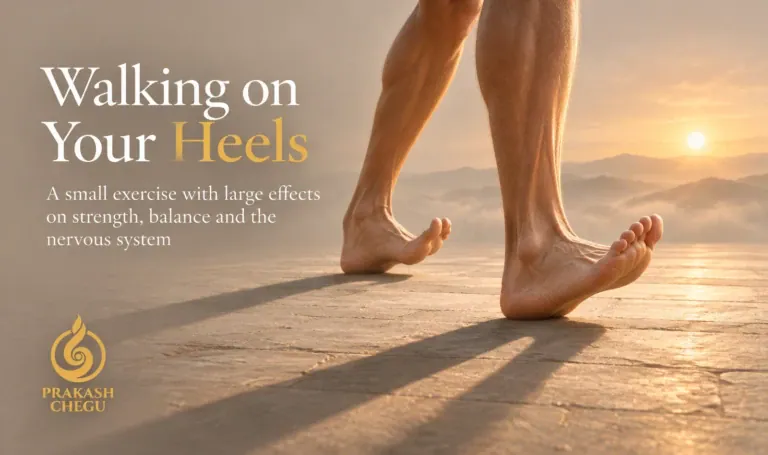
Walking on the heels may look like a playful movement from childhood, but it is also used in physical therapy, athletic conditioning and neurological examinations.
The exercise is simple: lift the front of the feet away from the floor and walk while keeping the toes elevated. Within a few steps, most people feel an intense contraction along the front of the lower legs. Balance becomes less automatic. Each step requires attention.
That immediate difficulty reveals why the exercise can be useful.
Heel walking places unusual demands on the ankle dorsiflexors—the muscles responsible for pulling the foot upward. It also challenges coordination, foot clearance, postural control and sensory feedback from the ankles and feet.
However, the phrase “healing effects” requires care. Heel walking does not detoxify the body, cure neurological disease or repair every form of knee and back pain. The direct research on heel walking as a standalone treatment is limited.
Its value is more specific.
Used appropriately, heel walking may help:
- Strengthen the muscles that lift the foot
- Improve awareness and control of the ankle
- Expose asymmetry or weakness in the lower legs
- Support gait and balance training
- Improve the ability to clear the toes while walking
- Complement broader rehabilitation or fall-prevention programmes
To understand why this matters, we need to look more closely at what happens during an ordinary step.
Walking Is a Controlled Fall
Human walking is not simply a matter of placing one foot in front of the other. It is a repeated cycle in which the body moves forward, temporarily loses stability and then catches itself with the next step.
During normal walking, the foot must perform several different jobs.
As the leg swings forward, the ankle dorsiflexors lift the front of the foot so that the toes do not drag along the ground. As the heel contacts the floor, these muscles help control how quickly the forefoot lowers. Later in the step, the calf muscles contribute to stability and forward propulsion.
This means that the muscles on the front of the shin are involved in two especially important actions:
- Clearing the foot during the swing phase
- Controlling the foot after heel contact
If the dorsiflexors are weak, slow or poorly coordinated, the toes may come too close to the ground. A person may begin to shuffle, trip more easily or compensate by lifting the knee higher.
Research involving older adults has found that delayed ankle dorsiflexion during the swing phase is associated with a greater tendency to fall. This does not prove that dorsiflexor weakness is the sole cause of falling, but it demonstrates that the timing of foot elevation is an important component of safe gait. (PubMed)
Heel walking exaggerates this part of the gait cycle. Instead of lifting the toes briefly, you maintain dorsiflexion continuously as you move.
That turns an ordinary neurological action into a focused exercise.
The Main Muscle: Tibialis Anterior
The burning sensation felt during heel walking usually comes from the tibialis anterior.
This long muscle runs down the front and outer portion of the shin. Its tendon crosses the ankle and attaches toward the inner side of the foot. Its principal actions include dorsiflexing the ankle—lifting the front of the foot—and assisting inversion of the foot.
The tibialis anterior is active during ordinary walking, particularly around initial contact and during the transition into the swing phase. Its activation also changes with walking speed, illustrating that the nervous system adjusts dorsiflexor activity according to the demands of gait. (PubMed)
Heel walking asks the tibialis anterior to maintain a much longer contraction than it normally would.
This is why even fit people may find that their shins fatigue after 20 or 30 seconds. Cardiovascular fitness does not necessarily mean that the ankle dorsiflexors possess good local endurance.
Regular, gradual heel walking may therefore improve the strength endurance of the tibialis anterior and the other muscles involved in keeping the forefoot elevated.
These include:
- Extensor hallucis longus
- Extensor digitorum longus
- Tibialis anterior
- Supporting ankle and foot stabilisers
The exercise does not isolate these muscles perfectly, but it loads the dorsiflexion pattern in a functional, weight-bearing context.
Why Dorsiflexor Strength Matters
Ankle dorsiflexion strength is not just about producing a visible movement. It contributes to the precise timing and control needed for safe walking.
Weakness may appear as:
- Difficulty lifting the toes
- Frequent catching of the foot
- A slapping sound after the heel lands
- Shortened steps
- High-stepping compensation
- Difficulty walking on the heels
- Reduced confidence on uneven terrain
More pronounced dorsiflexor weakness can contribute to foot drop, a clinical sign that may arise from peripheral nerve injury, spinal nerve-root compression, muscular disease or neurological conditions. Foot drop is characterised by difficulty lifting the front of the foot during gait. (NCBI)
Heel walking can strengthen mildly underused muscles in an otherwise healthy person, but it should not be presented as a treatment for unexplained foot drop.
New or progressive difficulty lifting one foot requires medical evaluation.
Heel Walking Is Also a Neurological Examination
One of the most important facts about heel walking is that clinicians use it as a functional neurological test.
A doctor or physiotherapist may ask a patient to walk several steps on the heels while keeping the forefeet elevated. The task provides a quick view of dorsiflexor strength, side-to-side symmetry and the ability of the nervous system to recruit the relevant muscles.
Research on physical examinations for lumbar nerve-root involvement describes heel walking as an assessment of ankle dorsiflexion strength. (PMC)
Difficulty with heel walking can occur when signals are not travelling effectively through the pathways that control dorsiflexion. Depending on the wider clinical picture, this may involve:
- The L4 or L5 nerve roots
- The common fibular—or peroneal—nerve
- The deep fibular nerve
- The muscles of the anterior lower leg
- Central neurological pathways
For example, weakness associated with chronic L5 nerve-root irritation may make heel walking difficult and can be accompanied by weakness or wasting in muscles involved in dorsiflexion. (NCBI)
This does not mean that everyone who finds heel walking difficult has nerve damage. Many healthy people simply lack practice, strength or balance.
The movement is useful because it can reveal a deficit that normal walking may partially conceal.
Movement as Assessment
An ordinary strength exercise usually tells you whether a muscle can produce force. Heel walking reveals more than that.
It may expose:
- Differences between the right and left sides
- Poor ankle endurance
- Reduced foot clearance
- Difficulty maintaining the toes in elevation
- Balance limitations
- Coordination problems
- Pain provoked by dorsiflexion
- Fear of loading the heel
Suppose one side fatigues much faster than the other. That does not immediately establish a diagnosis, but it provides information.
Suppose you can lift both feet strongly while seated but cannot maintain the movement while walking. The limitation may involve balance, motor control, endurance or confidence rather than isolated muscular strength.
The exercise therefore functions simultaneously as training and self-observation.
The body is not merely performing the movement. It is revealing how well several systems cooperate under load.
The Proprioceptive Effect
Balance depends on more than strong muscles.
The brain must continuously receive and interpret information about the body’s position. This process involves vision, the vestibular organs of the inner ear and sensory signals from muscles, tendons, joints and the skin.
Proprioception refers broadly to the sense of body and joint position.
The ankle is especially important because it is located close to the body’s contact with the ground. Small changes in ankle position can influence the movement of the entire body above it.
Mechanoreceptors around the ankle contribute to postural balance and reflexive muscular responses by sending information to the central nervous system. (PMC)
During normal walking, the nervous system has years of experience predicting what will happen next. Much of the process becomes automatic.
Heel walking changes the task.
The base of contact is different. The toes cannot contribute normally to stability. The centre of pressure shifts. The brain must make continuous corrections to prevent the body from leaning too far forward or backward.
This increased challenge may train:
- Ankle-position awareness
- Rapid postural correction
- Coordination between the feet and trunk
- Confidence during unusual movement
- Conscious control of foot placement
Research broadly supports the role of ankle proprioception in balance control, although proprioception is difficult to isolate from strength, reaction time and other sensory systems. (PMC)
It would therefore be too strong to claim that heel walking alone “rewires the brain.” A more defensible conclusion is that it gives the nervous system a less familiar movement problem to organise.
Does Heel Walking Improve Balance?
Potentially—but the answer needs qualification.
Heel walking challenges balance while you are performing it. That does not automatically mean that a few seconds of the exercise will produce broad, lasting improvements in balance.
Long-term change depends on:
- Frequency
- Progression
- Individual ability
- The presence of injury or disease
- The inclusion of other strength and balance exercises
Studies show that ankle function is associated with balance performance in older adults. In one study, weight-bearing ankle dorsiflexion range of motion was associated with dynamic balance, while plantar-flexor strength was more predictive of static balance. (PMC)
Other research has found that foot and ankle strength, mobility and posture are associated with balance and functional ability in older populations. (PubMed)
This supports the general principle that healthy ankles matter for balance. It does not prove that heel walking is superior to calf raises, resistance-band dorsiflexion, single-leg standing, tai chi or structured balance training.
A 2025 systematic review found that ankle and foot exercise programmes may improve certain measures of strength, flexibility and balance, but the quality of evidence was low and the review did not find a clear reduction in falls. (PubMed)
The appropriate conclusion is therefore modest:
Heel walking may be a useful ingredient in balance training, but it should not be treated as a complete fall-prevention programme.
The Connection With Tripping and Falling
Many falls occur not because someone lacks general strength, but because the foot fails to clear the floor at the right moment.
Even a small delay in lifting the forefoot can matter when walking over:
- A rug edge
- An uneven pavement
- A doorstep
- A cable
- Loose soil
- A change in floor height
Dorsiflexor strength and timing help create adequate clearance beneath the toes during the swing phase.
Heel walking trains the sustained “toes-up” position. It may therefore be relevant for people who shuffle or habitually allow the forefoot to remain low, provided that there is no underlying neurological disorder requiring treatment.
However, fall prevention is multidimensional. Vision, vestibular function, blood pressure, medication effects, reaction time, hip strength, cognition, environmental hazards and fear of falling can all contribute.
Heel walking can address one narrow part of that larger picture.
It cannot address all of it.
What Heel Walking Does to the Gait Pattern
Normal walking alternates among heel contact, controlled lowering of the foot, mid-stance, propulsion and swing.
Heel walking removes most of that sequence.
Because the toes remain elevated:
- The ankle stays dorsiflexed.
- The normal forefoot-loading phase is reduced.
- Push-off from the toes becomes limited.
- Steps become shorter.
- The body must prevent excessive backward leaning.
- The hips and trunk make compensatory adjustments.
- The dorsiflexors remain active for longer.
This altered pattern is precisely why heel walking is useful as a drill—and why it should normally be performed for short distances rather than used as a replacement for natural walking.
Normal gait requires both the muscles on the front of the lower leg and the calf complex at the back. Training only one side would create an incomplete programme.
Heel walking is best paired with movements such as:
- Calf raises
- Toe raises
- Controlled ankle circles
- Single-leg balance
- Foot-intrinsic strengthening
- Hip-abductor exercises
- Natural walking at different speeds
The objective is not to become a permanent heel walker.
The objective is to restore options and control.
Can It Help the Knees?
The ankle and knee are mechanically connected, so improving ankle control can influence how forces travel through the lower limb.
Limited ankle dorsiflexion may cause compensations such as:
- The heel lifting prematurely
- The foot collapsing inward
- The knee moving differently during squatting
- The hip or trunk shifting to create more range
Strengthening the dorsiflexors may improve control of the foot as it approaches and contacts the floor.
However, knee pain has many possible causes. It can involve cartilage, tendon, meniscus, ligament, joint irritation, hip weakness, training load, sensitisation or systemic disease.
Heel walking should not be advertised as a cure for knee pain.
It may be helpful when a person’s movement assessment identifies poor dorsiflexor strength or control as one contributing factor. In that situation, it belongs within a broader rehabilitation plan.
For another person, heel walking may have little relevance—or may even aggravate symptoms.
Can It Improve Posture?
Some people feel more upright while heel walking because the altered foot position forces them to organise the trunk differently.
But permanent posture change is unlikely to arise from a single lower-leg exercise.
Posture depends on:
- Habit
- Vision
- Breathing
- Spinal mobility
- Hip control
- Muscular endurance
- Pain
- Environment
- Psychological state
- The task being performed
Heel walking may increase awareness of alignment and strengthen one component of the kinetic chain. That is useful, but it does not “realign the whole body” in a few minutes.
Claims that it automatically corrects the pelvis, spine, neck or jaw go beyond the evidence.
A sounder view is that better control at the ankle may reduce the need for certain compensations elsewhere, especially during walking.
The Nervous System Is Training More Than Muscle
When you walk on your heels, the brain must organise several processes at once:
- Voluntarily maintain ankle dorsiflexion
- Sequence alternating steps
- Stabilise the pelvis
- Adjust the trunk
- Process sensory information from the feet
- Predict loss of balance
- Correct errors quickly
The motor cortex, cerebellum, basal ganglia, spinal circuits and peripheral nerves all participate in human walking. But this does not mean that heel walking uniquely activates a hidden area of the brain.
Every coordinated movement involves distributed neurological activity.
What makes heel walking interesting is novelty. Because most adults rarely perform it, the movement requires more conscious supervision than ordinary gait.
This may create a temporary sense of heightened alertness or embodiment.
That experience is real, but it should not be exaggerated into claims that heel walking regenerates neurons or directly treats cognitive decline.
What About Fascia?
Fascia is part of the connective-tissue network that transmits and distributes force throughout the body. Heel walking changes the loading experienced by the muscles and connective tissues on the front of the lower leg.
Over time, tissues adapt to repeated mechanical load.
However, there is little direct evidence that heel walking has a unique “fascial release” effect.
The term fascial release is frequently used too loosely. A temporary sensation of openness does not necessarily mean that adhesions have broken apart or that an entire fascial line has been reset.
A more accurate statement would be:
Heel walking loads the anterior lower-leg tissues in a way that differs from ordinary walking and may improve their tolerance and capacity when progressed appropriately.
That is already useful. It does not need mystical embellishment.
The Traditional Yogic Perspective
Certain yogic and movement traditions include unusual walking patterns, including walking on the heels, toes, inner edges or outer edges of the feet.
Traditional explanations may describe heel walking as strengthening the nervous system, increasing grounding or changing the flow of energy through the body.
These claims belong to a different explanatory framework from modern rehabilitation science.
There is some meaningful overlap.
Heel walking does demand concentration, coordination, sensory attention and postural adaptation. A traditional teacher observing thousands of practitioners could reasonably have recognised that the practice improves steadiness and awakens areas of the body that are normally underused.
But it is important not to force a false equivalence.
Modern science does not currently confirm that heel walking manipulates a specific subtle-energy channel or produces a unique spiritual state.
The most honest approach allows traditional experience and modern physiology to coexist without pretending that one has fully proven the other.
A practitioner may experience heel walking as grounding, focusing or energising. That subjective experience can be meaningful even when it cannot yet be reduced to a single measurable mechanism.
A Simple Heel-Walking Practice
For a healthy adult without significant pain, neurological symptoms or balance impairment, heel walking can be introduced gradually.
Preparation
Stand near a wall, railing or stable chair.
Place the feet approximately hip-width apart.
Lift the toes and the balls of both feet while keeping the heels on the floor.
Notice whether both feet lift equally.
Keep the knees soft rather than locked.
Allow the spine to remain upright without leaning dramatically backward.
Beginner Practice
Walk forward for 10 to 15 controlled steps.
Rest for 30 to 60 seconds.
Repeat two or three times.
Practise two or three days per week initially.
Progression
Over several weeks, gradually increase to:
- 20 to 30 steps
- Three or four rounds
- Slow forward and backward heel walking
- Gentle changes of direction
- A slightly faster but still controlled pace
Do not progress all variables at once.
Quality matters more than distance.
The toes should remain elevated, but the ankles should not be forced into a painful end range.
What Should You Feel?
A normal training response may include:
- Muscular work along the front of the shins
- Mild fatigue
- Increased concentration
- A sense of balance challenge
- Slight trembling as the muscles tire
The exercise should not produce:
- Sharp pain
- Burning or electric nerve pain
- Numbness
- Sudden weakness
- Significant lower-back pain
- Loss of balance
- Persistent pain in the heel or ankle
- Symptoms that worsen after the exercise
Muscular fatigue and neurological symptoms are not the same thing.
A healthy muscle may burn during unfamiliar work. Nerve irritation may produce radiating pain, tingling, altered sensation or sudden loss of control.
Knowing the difference is important.
When Heel Walking Should Be Avoided or Modified
Heel walking is not appropriate for everyone.
Seek professional guidance before practising if you have:
- Recent ankle or foot surgery
- A healing fracture
- Severe osteoporosis
- Acute Achilles or calf injury
- Significant heel pain
- Plantar heel irritation
- Peripheral neuropathy
- Poorly controlled diabetes with reduced foot sensation
- Severe balance impairment
- A history of frequent falls
- Known foot drop
- Recent stroke
- Multiple sclerosis or another neurological condition
- Unexplained weakness in one leg
- Acute lumbar nerve-root symptoms
People with reduced sensation in the feet may not accurately perceive excessive pressure or tissue irritation.
Older adults with balance concerns should perform the exercise beside a secure support and ideally under professional supervision.
When Difficulty Is a Medical Clue
Stop treating heel walking as an exercise and seek assessment if you notice:
- One foot cannot lift as high as the other.
- One foot repeatedly slaps the floor.
- The toes drag during normal walking.
- Weakness appeared suddenly.
- Weakness is progressively worsening.
- There is numbness along the shin or top of the foot.
- Symptoms follow a back injury.
- There is severe back pain with leg weakness.
- Walking ability has changed without explanation.
Difficulty heel walking may reflect simple deconditioning, but it can also indicate impaired nerve or muscle function.
The exercise should never be used to self-treat progressive neurological weakness.
Heel Walking Versus Toe Walking
Heel walking and toe walking train opposite sides of the ankle system.
Heel walking emphasises:
- Dorsiflexors
- Forefoot clearance
- Anterior shin endurance
- Toes-up control
Toe walking emphasises:
- Calf muscles
- Plantar flexion
- Push-off strength
- Posterior lower-leg endurance
Clinicians may use both tasks during an examination because the contrast provides information about different muscles and nerve pathways.
For general conditioning, training both patterns produces a more balanced result.
A simple sequence might include:
- Ten to twenty steps on the heels
- Rest
- Ten to twenty steps on the toes
- Rest
- Normal walking
- Single-leg balance practice
This creates a broader ankle-strength and motor-control drill than heel walking alone.
What the Evidence Supports—and What It Does Not
Reasonably supported benefits
Heel walking can reasonably be used to:
- Challenge and train ankle dorsiflexor endurance
- Assess the ability to maintain dorsiflexion
- Reveal side-to-side weakness
- Practise keeping the forefoot elevated
- Add variety to gait and balance training
- Increase conscious awareness of foot placement
- Complement rehabilitation prescribed by a clinician
Possible but not conclusively established benefits
Heel walking may contribute to:
- Improved balance when included in a larger programme
- Better toe clearance
- Reduced tripping risk in people with mild functional weakness
- Improved confidence in ankle control
- Better gait mechanics in selected individuals
These effects are plausible, but direct, high-quality trials isolating heel walking are limited.
Claims not established by current evidence
There is no strong evidence that heel walking alone:
- Detoxifies organs
- Stimulates a unique hormone response
- Heals the spine
- Cures sciatica
- Reverses neuropathy
- Regenerates nerves
- Corrects all posture problems
- Releases stored trauma
- Prevents every fall
- Produces a specific spiritual awakening
The absence of evidence does not mean that no one can experience broader subjective benefits. It means those experiences should not be presented as medically proven outcomes.
The Deeper Value of the Exercise
The most important effect of heel walking may be that it brings awareness to a neglected part of human movement.
We tend to notice the feet only when they hurt. We notice balance only when it fails. We notice dorsiflexion only when the toes begin to catch the floor.
Heel walking interrupts that neglect.
It makes the front of the lower leg visible to awareness.
It shows whether the ankles can hold the feet up, whether the brain can coordinate the movement and whether the body can adapt to an unfamiliar base of support.
This is a valuable principle in movement therapy:
Sometimes an exercise heals not because it is magical, but because it restores a capacity that has quietly been lost.
A person who has stopped using a movement gradually becomes less capable of producing it. A person who reintroduces that movement carefully can regain strength, confidence and neurological familiarity.
The healing is not hidden in the heel itself.
It is found in adaptation.
Muscles respond to load. The nervous system responds to practice. Balance responds to challenge. Awareness responds to attention.
Final Thoughts
Walking on the heels is a small exercise with a legitimate physiological basis.
It trains the ankle dorsiflexors, challenges balance, demands coordination and provides useful information about lower-leg and neurological function.
But its power lies in precision, not exaggeration.
Heel walking is not a universal cure. It does not replace natural walking, medical assessment, resistance training or comprehensive rehabilitation.
What it can do is help restore one essential human capacity: the ability to lift the foot, control the ankle and move through space without catching the ground beneath us.
Practised for a few controlled rounds, several times a week, it may become a valuable addition to a broader movement routine.
And perhaps that is the real lesson.
Healing does not always require an extraordinary intervention. Sometimes it begins by discovering that one small, forgotten movement has become difficult—and then patiently teaching the body how to perform it again.
Frequently Asked Questions
What is heel walking and what does it do?
It is exactly what it sounds like: you lift your toes off the floor and walk on your heels, keeping the toes elevated. Within a few steps most people feel an intense contraction along the front of the lower legs, and balance suddenly stops being automatic, each step requires attention. That immediate difficulty is actually the point: it loads muscles and demands coordination we rarely use.
What are the benefits of this small exercise?
It targets the ankle dorsiflexors, the muscles that lift the front of the foot, which are important for a strong, stable gait and for not tripping as we age. It also challenges balance and engages the nervous system’s coordination, so it touches strength, balance and neurological health at once. Weak dorsiflexors are a quiet contributor to falls, so training them is more valuable than its simplicity suggests.
How should I practice it safely?
Start short and supported. Try a few steps near a wall or counter you can touch for balance, keep the distance modest at first, and build up gradually as it becomes easier. Because it genuinely challenges balance, the point is consistent, careful practice rather than pushing, a little heel walking regularly does far more than an occasional strenuous attempt.