Why Releasing Anger, Acknowledging Harm, and Rebuilding Trust Are Three Different Processes
Forgiveness releases the anger.
An apology acknowledges the damage.
Neither one automatically repairs what was broken.
These three sentences contain an important truth about healing—one that is often lost beneath spiritual ideals, social expectations, and our desire to make painful situations disappear as quickly as possible.
We are frequently taught that forgiveness completes the healing process.
“Forgive and move on.”
“Let go of the past.”
“Don’t carry resentment.”
“Be the bigger person.”
There may be wisdom in these teachings, but they can also collapse several very different processes into one. Forgiveness, apology, reconciliation, trust, and repair are related, but they are not interchangeable.
You can forgive someone and still not trust them.
Someone can apologize and still not change.
A relationship can continue without ever being repaired.
And sometimes, genuine healing requires accepting that forgiveness may be possible even when reconciliation is not.
Forgiveness Releases the Anger
Forgiveness is primarily an inner process.
It is the gradual decision to stop allowing the injury to occupy your body, mind, and nervous system in the same way. It does not necessarily mean that what happened was acceptable. It does not erase the consequences. It does not require you to reinterpret cruelty as kindness or betrayal as a spiritual lesson.
Forgiveness simply means that you no longer want to remain internally bound to the person through anger, hatred, or the endless repetition of the wound.
Anger has an important purpose. It tells us that a boundary has been crossed, something precious has been violated, or an injustice has occurred. Healthy anger can restore dignity, provide energy for action, and help us recognize what we must never permit again.
But anger was never meant to become a permanent home.
When anger remains unprocessed, it can keep the event alive long after it has ended. The person who harmed us may no longer be present, yet the nervous system continues to react as though the injury is happening now. We replay the conversations. We imagine different endings. We prepare arguments that may never be spoken.
Forgiveness begins when we decide that the wound will no longer be given unlimited access to our life force.
This does not have to happen quickly.
Premature forgiveness can become another form of self-abandonment. If we try to forgive before we have fully acknowledged our pain, anger may not disappear; it may simply move beneath the surface. It can return later as numbness, bitterness, exhaustion, anxiety, physical tension, or difficulty trusting others.
Authentic forgiveness does not bypass anger. It listens to anger, receives its message, establishes the necessary boundary, and then slowly releases the emotional charge.
Forgiveness says:
“What happened mattered. It hurt me. I will learn from it, but I will not remain imprisoned by it.”
An Apology Acknowledges the Damage
An apology belongs to a different process.
Forgiveness happens primarily within the injured person. An apology must come from the person who caused the harm.
A sincere apology is not merely an expression of regret. It is an act of recognition.
It says:
“I see what I did.”
“I understand that it affected you.”
“I am not going to minimize, justify, or place the responsibility back onto you.”
This distinction matters because many apparent apologies are designed to relieve the discomfort of the person apologizing rather than address the experience of the person who was hurt.
“I’m sorry you feel that way.”
“I’m sorry, but you also…”
“I already apologized. Why are you still upset?”
“I didn’t mean to hurt you, so you shouldn’t take it personally.”
These statements may contain the word sorry, but they do not necessarily acknowledge the damage.
Intention matters, but impact also matters.
A person may not have intended to break a valuable object, betray a confidence, frighten a child, humiliate a partner, or abandon a friend during a difficult time. The lack of harmful intention may help us understand what happened, but it does not automatically remove the consequences.
A mature apology can hold both truths:
“I may not have intended this outcome, and I accept that my actions caused it.”
A genuine apology includes responsibility without self-destruction. It does not require the person to declare themselves irredeemably bad. In fact, excessive shame can interfere with accountability because the conversation becomes centred on comforting the person who caused the harm.
Accountability is quieter and stronger than shame.
Shame says, “I am terrible. Please reassure me.”
Accountability says, “I caused harm. Tell me what I need to understand, and let me show you that I am willing to change.”
Why Forgiveness and Apology Are Not Enough
Forgiveness may release the emotional poison.
An apology may acknowledge the wound.
But repair requires action.
Imagine someone throws a stone through the window of your home. They may sincerely regret it. You may completely forgive them. But the window is still broken.
Someone must remove the shattered glass.
Someone must replace the window.
Someone must make the home safe again.
Emotional damage works in much the same way. Words, betrayals, neglect, manipulation, broken promises, financial irresponsibility, or repeated boundary violations can leave practical and relational consequences that remain even after the emotional intensity has softened.
Repair asks:
What was actually damaged?
What does restoration require?
Who is responsible for doing the work?
What must change so that this is less likely to happen again?
Without these questions, forgiveness can become a beautiful curtain placed over a broken window.
Repair Requires More Than Remorse
Remorse is a feeling. Repair is a practice.
Someone may feel genuinely terrible about what they did and still lack the capacity, discipline, or willingness to behave differently. They may cry, confess, ask for forgiveness, and promise change—and then repeat the same pattern when the emotional intensity passes.
This does not always mean that their remorse was false. It may mean that remorse alone was insufficient.
Lasting repair often requires several elements:
1. A clear acknowledgment of the specific harm
Not simply, “Mistakes were made,” but:
“I lied to you.”
“I disappeared when you needed me.”
“I violated an agreement.”
“I spoke to you in a degrading way.”
“I used your vulnerability against you.”
Specific acknowledgment prevents the harm from being dissolved into vague language.
2. Space for the injured person’s reality
The person who was harmed must be allowed to describe the impact without immediately being contradicted, rushed, or corrected.
Listening is part of restitution.
This does not mean that every interpretation must be accepted as objective fact. It means that the emotional experience deserves to be heard before explanations and disagreements take over the conversation.
3. Willingness to accept consequences
A sincere apology does not guarantee immediate access, closeness, trust, or reconciliation.
The injured person may need distance.
They may change the terms of the relationship.
They may require transparency, counselling, financial restitution, new agreements, or consistent evidence of change.
They may also decide not to continue the relationship.
Accountability means understanding that apology does not control the outcome.
4. Concrete corrective action
Repair may require replacing what was lost, correcting misinformation, repaying money, completing neglected responsibilities, seeking treatment, changing communication patterns, or developing the skills that were previously absent.
Without corrective action, an apology remains incomplete.
5. Consistency over time
Trust is rarely restored by one intense conversation. It is rebuilt through repeated experiences of safety.
A promise can be spoken in seconds. A new pattern must be demonstrated across time.
When someone has repeatedly broken trust, the question is no longer, “Do they sound sincere?” The deeper question is, “What are they consistently doing differently?”
Forgiveness Does Not Restore Access
One of the most damaging misunderstandings about forgiveness is the belief that forgiving someone obligates us to return the relationship to its previous form.
It does not.
Forgiveness does not require renewed intimacy.
It does not require unrestricted access.
It does not require another chance.
It does not require pretending that the danger has passed when the behaviour has not changed.
Boundaries are not evidence that forgiveness has failed. Sometimes boundaries are evidence that the lesson has been integrated.
You may forgive a person and never speak to them again.
You may love someone and refuse to continue living with them.
You may release resentment and still decline a business partnership.
You may wish someone healing while protecting yourself from their patterns.
You may forgive a parent while limiting contact.
You may forgive a former partner without reopening the relationship.
This is not punishment. It may simply be discernment.
Forgiveness concerns what you release from your heart. Access concerns what you allow into your life.
They are not the same decision.
Reconciliation Requires Mutual Participation
Forgiveness can be unilateral. Reconciliation cannot.
One person can release anger without the other person understanding, apologizing, or changing. But a relationship cannot be rebuilt by one person alone.
Reconciliation requires participation from both sides.
One person cannot provide all the honesty, accountability, emotional regulation, communication, and behavioural change required to create a healthy relationship. When only one person is doing the work, what appears to be reconciliation may actually be accommodation.
The injured person adapts.
They lower their expectations.
They stop naming what hurts.
They become more careful.
They learn how to avoid provoking the next incident.
The relationship may appear peaceful from the outside, but the peace is being maintained through silence and self-erasure.
That is not repair.
Repair produces greater truth, safety, responsibility, and freedom for everyone involved. Accommodation merely makes the dysfunction easier to survive.
Trust Must Be Re-Earned
Forgiveness may be given. Trust must be earned.
Trust is not a moral reward for apologizing. It is the nervous system’s recognition that a person or situation has become reliably safe.
This is why someone may consciously want to trust again while their body remains guarded. Their mind may accept the apology, but their body remembers the unpredictability.
They tense when the phone rings.
They study changes in tone.
They prepare for disappointment.
They struggle to relax into closeness.
This does not mean they are vindictive. Their nervous system may simply be waiting for enough new evidence.
Trust returns through congruence—when words, actions, choices, and patterns begin to align.
If the person says they will call, they call.
If they agree to a boundary, they respect it.
If they commit to help, they follow through.
If they become reactive, they take responsibility and repair the rupture.
Over time, the body begins to recognize that something has genuinely changed.
Trust cannot be demanded into existence. It grows through lived evidence.
When Spirituality Is Used to Avoid Repair
Spiritual language can illuminate healing, but it can also be used to avoid accountability.
“You need to let go.”
“This is your karma.”
“Everything happens for a reason.”
“Your reaction is showing you what you need to heal.”
“Unconditional love means accepting people as they are.”
Each of these ideas may contain a fragment of truth, but truth used without compassion can become a weapon.
Perhaps the experience does reveal an unhealed wound. That does not mean the harmful behaviour should continue.
Perhaps love can remain unconditional at the level of the soul. That does not mean access should remain unconditional at the level of the relationship.
Perhaps the event carries a lesson. That does not absolve the person who caused the harm from responsibility.
Spiritual maturity does not ask us to transcend discernment. It asks us to unite compassion with truth.
Compassion without boundaries can become enabling.
Boundaries without compassion can become punishment.
Healing requires both the open heart and the clear eye.
The Injured Person Is Not Responsible for Completing the Offender’s Redemption
Another subtle burden is often placed upon the injured person: the expectation that their forgiveness must complete the other person’s healing.
But no one is obligated to provide absolution on demand.
The person who caused the harm may need to sit with discomfort. They may need to accept that the relationship has changed. They may need to repair what they can without receiving reassurance, closeness, or a declaration of forgiveness.
True accountability does not say:
“I apologized, so now you must make me feel forgiven.”
It says:
“I understand that my actions created this distance. I will respect your process. I will do the work because it is right, not because it guarantees that I get you back.”
This is one of the clearest signs of genuine transformation: the person becomes committed to integrity even when the desired outcome is not promised.
Forgiveness Is Not Forgetting
Forgetting is not always possible, and it is not necessarily wise.
Memory protects us. It helps us recognize patterns, evaluate risk, and make better choices. Healing does not require amnesia.
The goal is not to erase the memory but to change our relationship with it.
At first, the memory may feel alive, sharp, and controlling. Over time, it can become information rather than an open wound.
You remember, but you are no longer reliving.
You recognize what happened, but it no longer defines every relationship that follows.
You retain the wisdom without carrying the venom.
This may be the deepest form of forgiveness—not the destruction of memory, but the liberation of life from its emotional captivity.
Sometimes the Broken Thing Cannot Be Restored
Not everything that breaks can be returned to its former condition.
A repaired relationship may become wiser and stronger than it was before. But sometimes the damage changes the relationship permanently. There may be forgiveness, understanding, and even love, yet the previous form of intimacy cannot be recovered.
This is painful, but it is not necessarily a failure.
Repair does not always mean restoration.
Sometimes repair means creating an honest ending.
Sometimes it means returning what is owed.
Sometimes it means taking responsibility without being welcomed back.
Sometimes it means establishing a different kind of relationship.
Sometimes it means ensuring that the pattern is not carried into the next relationship or the next generation.
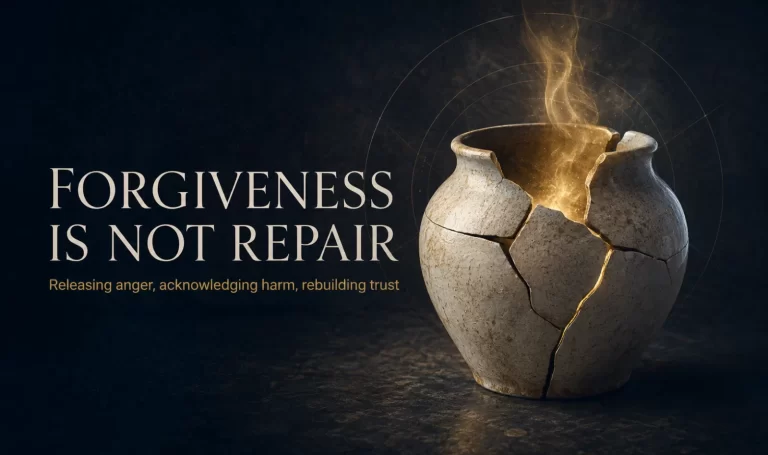
A broken cup may be carefully mended, but it will not become the untouched cup it once was. That does not mean it has no value. It means its history must become part of its truth.
Three Different Questions
When harm has occurred, it can help to separate three questions.
1. What do I need to release?
This is the territory of forgiveness.
What anger, fixation, fantasy of revenge, or emotional attachment is continuing to consume my life force?
What would it mean to free myself, even if the other person never changes?
2. What needs to be acknowledged?
This is the territory of apology and accountability.
What exactly happened?
What impact did it have?
Has responsibility been taken clearly, without minimization or deflection?
3. What needs to be repaired?
This is the territory of action.
What was lost, damaged, or destabilized?
What practical restitution is possible?
What new behaviours, structures, agreements, or boundaries are required?
Keeping these questions separate prevents emotional pressure from replacing genuine healing.
A More Complete Language of Healing
Instead of saying only, “I forgive you,” we may sometimes need a fuller language:
“I am releasing the anger, but trust has not yet returned.”
“I accept your apology, but the damage still needs to be addressed.”
“I no longer wish to punish you, but I cannot continue the relationship in its previous form.”
“I understand that you are sorry. I now need to see consistent change.”
“I forgive you, but I am keeping this boundary.”
“I am open to repair, but repair will require participation from both of us.”
“I love you, but love does not require me to remain available for harm.”
This language may feel less poetic than immediate reconciliation, but it is far more honest.
The True Architecture of Repair
Healing becomes possible when we stop asking one gesture to accomplish everything.
Forgiveness releases the inner bondage.
Apology restores truth.
Accountability accepts responsibility.
Restitution addresses the consequences.
Changed behaviour rebuilds safety.
Time reveals whether the change is real.
Trust grows from consistent evidence.
Reconciliation becomes possible only when both people participate.
Each has its place. None should be used as a substitute for the others.
Forgiveness is sacred, but it is not a repair plan.
An apology is meaningful, but it is not evidence of transformation.
Love may inspire us to remain open, but love alone cannot rebuild a structure that honesty, responsibility, and consistent action are still neglecting.
The deepest healing does not come from pretending nothing was broken. It comes from seeing the damage clearly, releasing what must not be carried forever, and deciding—with wisdom, courage, and compassion—what can genuinely be rebuilt.
Forgiveness releases the anger.
Apology acknowledges the damage.
Repair is what we choose to do next.