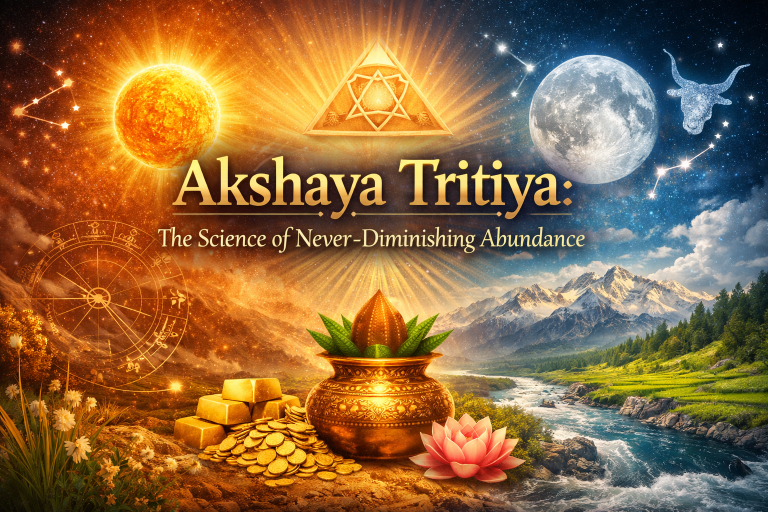
A Vedic Astronomical Lens on the “Never-Diminishing” Field of Creation
There are festivals that are celebrated.
And then there are days that are engineered into the fabric of time itself.
Akshaya Tritiya is not simply a cultural moment of buying gold or beginning ventures—it is a cosmic configuration, a precise alignment where astronomy, mathematics, biology, and consciousness converge into a single, potent window.
The ancients did not arrive at this day through belief.
They calculated it.
And what they discovered is extraordinary:
There exists one day in the year where solar power, lunar stability, and geometric timing align into a field of sustained expansion.
They called it Akshaya — that which never diminishes.
1. The Double Exaltation: When Sun and Moon Peak Together
At the heart of Akshaya Tritiya lies a rare astronomical phenomenon:
A simultaneous exaltation of the two primary celestial regulators of life on Earth—the Sun and the Moon.
☀️ The Sun in Aries (Mesha)
In Vedic astronomy (Jyotisha), the Sun reaches its point of highest strength—its Uchcha (exaltation)—in Aries.
This is not symbolic language. It reflects:
- Maximum solar radiation intensity
- Peak life-force transmission
- Heightened metabolic and biological activation
Aries marks the ignition point of the zodiac—the beginning of motion, will, and action.
🌙 The Moon in Taurus (Vrishabha)
Simultaneously, the Moon reaches its exaltation in Taurus.
Here, the Moon expresses:
- Maximum stability of emotional fields
- Optimal water balance and hormonal rhythm
- Enhanced “Soma” quality — the cooling, nourishing essence of life
Where the Sun activates, the Moon stabilizes.
The Result: A Perfect Dual-System Equilibrium
On this one day:
- The Sun = Peak Output
- The Moon = Peak Regulation
This creates a closed-loop coherence system:
Energy is not just generated.
It is held, stabilized, and multiplied.
This is the deeper meaning of Akshaya:
Not just growth—but sustained, non-depleting growth.
2. The Mathematics of Time: Understanding “Tritiya”
Akshaya Tritiya is not fixed by date—it is calculated through lunar geometry.
At the core is the concept of a Tithi.
The Angular Relationship
A Tithi is defined by the angular distance between the Sun and Moon, measured in degrees.
Each Tithi spans:
- 12° of separation
For Tritiya (the third lunar day):
24∘≤θMoon−Sun<36∘24^\circ \leq \theta_{Moon-Sun} < 36^\circ
This range represents a critical expansion phase.
Why This Matters
- The Moon is far enough from the Sun to begin independent reflection
- Yet still close enough to remain energetically connected
This creates a harmonic growth window:
- Not chaotic (like later lunar phases)
- Not inert (like the new moon)
Instead, it is coherent expansion.
🌱 Shukla Paksha — The Waxing Intelligence of Nature
Akshaya Tritiya occurs during Shukla Paksha—the waxing phase of the Moon.
This phase governs:
- Growth
- Construction
- Regeneration
- Forward movement
When combined with Tritiya geometry, it forms a natural amplification cycle.
3. The Seasonal Intelligence: Spring as a Biological Reset
Akshaya Tritiya occurs in Vaishakha (April–May)—the height of spring in the Northern Hemisphere.
This is not accidental.
It aligns with:
- Peak photosynthesis cycles
- Increased solar radiation exposure
- Heightened cellular regeneration
- Hormonal shifts in both plants and humans
In agricultural systems, this marks:
- End of harvest cycles
- Preparation for new sowing
In biological terms:
The Earth itself enters a state of renewal and readiness.
This makes Akshaya Tritiya not just a celestial alignment, but a planetary resonance event.
4. Abujh Muhurat: When Time Has No Friction
In traditional Muhurta (electional astrology), time is divided into:
- Auspicious windows
- Inauspicious windows
But Akshaya Tritiya is different.
It is classified as an Abujh Muhurat—a time that does not require calculation.
Why?
Because:
- Solar energy is at peak coherence
- Lunar energy is at peak stability
- Angular separation is in a growth harmonic
- Seasonal biology supports regeneration
The system becomes self-balancing.
The Physics Analogy
Think of it like this:
Most days = turbulent systems
Akshaya Tritiya = resonant system
In a resonant system:
- Inputs are amplified
- Loss is minimized
- Stability sustains growth
This is why traditions recommend:
- Investing in gold
- Starting businesses
- Initiating spiritual practices
- Making long-term commitments
Because:
An action taken in a stable field tends to inherit the stability of that field.
5. Myth, Geology, and Reality Intersect
Many stories are associated with Akshaya Tritiya.
But beneath them lie observable patterns.
🌊 The Descent of the Ganges
Mythology speaks of the Ganga descending to Earth.
Geophysically, this corresponds to:
- Glacial melt acceleration in the Himalayas
- Beginning of high river flow cycles
Water—symbol of life—literally descends and expands during this period.
🌾 Agricultural Synchronization
Across India:
- Fields transition from harvest to renewal
- Soil undergoes nutrient reset cycles
The land mirrors the sky:
Completion → Reset → Expansion
6. The Deeper Insight: This Is Not Belief—It Is Design
When you strip away ritual and symbolism, what remains is:
- Precise astronomical alignment
- Measurable angular mathematics
- Observable seasonal biology
- Predictable system behavior
Akshaya Tritiya is a designed moment in time where:
- Energy is high
- Stability is high
- Growth vectors are open
This is rare.
7. The Real Meaning of “Akshaya”
Most people interpret Akshaya as:
- Wealth that never diminishes
- Prosperity that keeps growing
But in a deeper sense, it means:
A system where input exceeds loss consistently.
In physics terms:
- Low entropy
- High coherence
- Sustained output
In human life, this translates to:
- Actions that compound
- Decisions that stabilize rather than drain
- Efforts that continue to yield returns
Final Reflection: How to Work With This Day
Akshaya Tritiya is not about doing more.
It is about doing the right thing at the right moment.
Because on this day:
- Time is aligned
- Nature is aligned
- The cosmos is aligned
So the question is not:
“What should I do?”
But rather:
“What deserves to be sustained in my life?”
Because whatever you begin in a field of coherence…
tends to remember how to grow.