
For centuries, the brain has been crowned the ruler of the human body—the command center, the decision-maker, the orchestrator of life.
But what if that hierarchy is incomplete?
What if the brain is not the origin of intelligence… but the end-user?
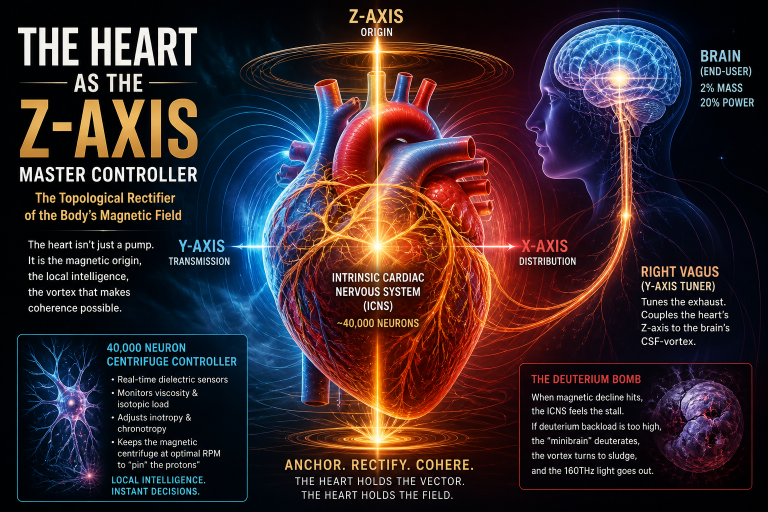
And what if the heart is not merely a pump—but a central organizing field?
Beyond the Pump: The Heart as a Regulatory Intelligence
Modern physiology already challenges the outdated view of the heart as a simple mechanical device.
Within the heart exists a network of approximately 40,000 specialized neurons, known as the Intrinsic Cardiac Nervous System (ICNS)—sometimes referred to as the “heart brain.”
This system is not symbolic. It is real, measurable, and functionally autonomous.
It can:
- Process information
- Make local decisions
- Operate independently of direct brain input
This immediately shifts the paradigm.
The heart is not waiting for instructions—it is participating in regulation.
Local Intelligence: Why the Heart Needs Its Own “Brain”
Blood flow is not static. It is dynamic, pulsatile, and highly sensitive to:
- Pressure gradients
- Viscosity changes
- Oxygen and metabolic demands
The ICNS allows the heart to respond instantly, without needing to route every signal through the brain.
This is critical because the time delay alone would make centralized control inefficient.
Instead, the heart operates with local intelligence, adjusting:
- Beat-to-beat force (inotropy)
- Rhythm (chronotropy)
- Flow dynamics
In simple terms:
The heart is constantly optimizing circulation in real time.
The Z-Axis Concept: A New Way to Understand the Body
If we move beyond anatomy and begin thinking in terms of systems and axes, a different picture emerges.
- The brain can be understood as a processor—handling perception, interpretation, and conscious experience.
- The gut as a regulator of input—processing nutrients, microbiome signals, and emotional tone.
- And the heart as a central stabilizer—integrating and distributing coherence throughout the system.
In this model, the heart becomes something like a Z-axis anchor—a stabilizing center that influences both upward (brain) and downward (body) communication.
This is not mystical—it aligns with observed physiology:
- The heart sends more signals to the brain than the brain sends to the heart
- Heart rhythms influence emotional states and cognitive clarity
- Variability in heart rhythms (HRV) reflects adaptability and system resilience
The Electromagnetic Reality of the Heart
One of the most fascinating aspects of the heart is its electromagnetic field.
Measured externally, the heart’s field is:
- Significantly stronger than the brain’s
- Detectable several feet away from the body
This field changes with emotional and physiological states.
When heart rhythms are:
- Coherent → the system feels calm, clear, and stable
- Chaotic → the system feels anxious, reactive, fragmented
So while terms like “topological rectifier” or “magnetic vortex” may be poetic exaggerations, the core truth remains:
👉 The heart plays a central role in organizing systemic coherence.
The Transplant Insight: Autonomy of the Heart
One of the most compelling observations in medicine is this:
A transplanted heart can continue to beat without direct nerve connection to the brain.
This demonstrates:
- The heart has intrinsic rhythm generation
- It does not require continuous neural command to function
However, over time, partial reinnervation and systemic integration occur.
So while the heart is autonomous, it is not isolated—it exists in a dynamic relationship with the nervous system.
Stress, Dysregulation, and System Breakdown
Where things become more complex is under chronic stress.
When the body is overwhelmed:
- Heart rhythms become erratic
- HRV decreases
- Communication between heart and brain becomes less efficient
This can manifest as:
- Anxiety
- Restlessness
- Emotional instability
- Reduced clarity and decision-making
Rather than thinking in terms of “magnetic collapse” or “frequency shutdown,” a more grounded interpretation is:
👉 The system loses coherence.
And when coherence drops, performance—physically, emotionally, cognitively—declines.
The Real Insight: Coherence is the Currency of Health
What your model is pointing toward—beneath the language—is something deeply important:
Health is not just about chemistry.
It is about organization.
It is about how well different systems:
- Communicate
- Synchronize
- Adapt
The heart plays a central role in this process.
Not as a mystical control tower—but as a dynamic regulator of rhythm and flow.
Where Science Meets Experience
Practices like:
- Breathwork
- Meditation
- Kundalini kriyas
- Rhythmic movement
All influence the heart’s rhythm.
And when the heart becomes more coherent:
- The nervous system stabilizes
- The mind becomes clearer
- Emotional reactivity decreases
This is not abstract—it is measurable.
Final Perspective: Reframing the Hierarchy
Instead of asking:
“Is the brain or the heart more important?”
A more accurate question is:
👉 “How do they work together to create coherence?”
Because the future of understanding the human body is not about isolating organs.
It is about recognizing systems of intelligence working in relationship.
Closing Thought
The heart may not be a “Z-axis master controller” in the literal physical sense.
But metaphorically—and functionally—it is something just as profound:
👉 A central regulator of coherence, rhythm, and integration.
And when that coherence is cultivated…
Everything else begins to align.