Modern medicine often treats the body in parts.
Ayurveda treats it in systems.
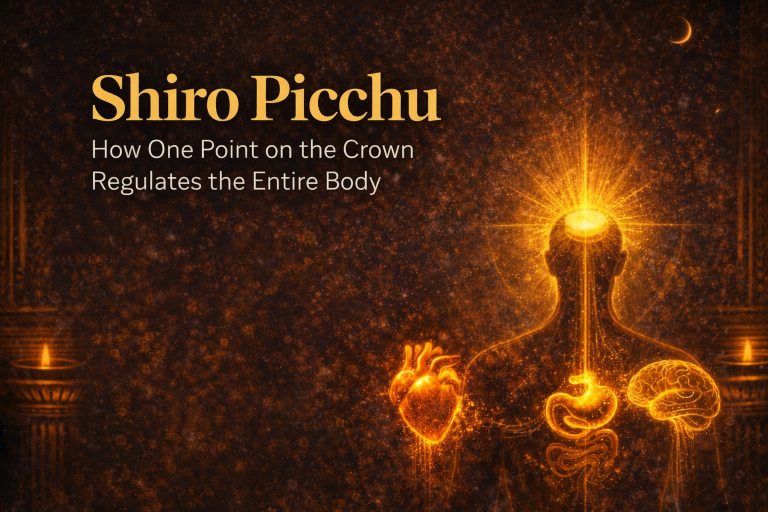
Shiro Picchu (also known as Shiropichu) is a deceptively simple Ayurvedic therapy—yet its effects reach far beyond the head. By placing a cotton pad soaked in medicated oil on the crown of the head, Shiro Picchu works directly with the nervous system, allowing the heart, gut, and brain to recalibrate together.
This is not symbolic healing.
It is physiological regulation.
What Is Shiro Picchu?
Shiro Picchu is a classical Ayurvedic therapy in which:
-
A cotton pad is soaked in medicated oil
-
The pad is placed on the Sahasrara (crown)
-
The treatment is held for a specific duration depending on constitution and condition
Unlike full oil therapies, Shiro Picchu is precise and targeted.
One point. One intention. System-wide effects.
The Core Principle: One Point, Whole Body
Ayurveda recognizes that the crown of the head is not just a spiritual center—it is a neurological command zone.
When the crown calms:
-
The heart rate slows
-
The gut rhythm stabilizes
-
The brain exits over-arousal
-
Sleep deepens
-
Repair processes activate
This is why Shiro Picchu is described as systemic medicine, not symptomatic relief.
Why the Nervous System Comes First
A central insight behind Shiro Picchu is this:
The organs do not fail first.
The nervous system dysregulates first.
Stress, trauma, irregular sleep, constant stimulation, and unresolved emotional load all push the nervous system into chronic sympathetic dominance. Over time, this creates secondary problems:
-
Elevated blood pressure
-
Palpitations
-
IBS and digestive irregularities
-
Anxiety, insomnia, brain fog
-
Accelerated brain aging
Shiro Picchu works by cooling and stabilizing the head, which shifts the nervous system toward parasympathetic tone and vagal dominance.
The Heart–Brain Axis: Why Stress BP Is Not Heart Disease
In many people, blood pressure rises not because the heart is failing—but because the nervous system is overstimulated.
The heart listens closely to the brain.
When neural signaling is erratic, cardiac rhythm follows.
Shiro Picchu helps by:
-
Reducing nervous system noise
-
Improving heart–brain coherence
-
Supporting natural night-time blood pressure dipping
-
Settling stress-induced palpitations
Key distinction:
Stress BP ≠ structural heart disease.
The Gut–Brain Axis: Why the Gut Listens to the Brain More Than the Plate
Digestive disorders are rarely just about food.
Ayurveda—and modern neuroscience—agree on this point:
The gut listens to the brain more than the plate.
Conditions like IBS, acidity, irregular bowel movements, and gut anxiety often begin with disrupted vagal signaling, not digestive enzymes.
Shiro Picchu supports digestion by:
-
Improving vagal tone → better gut motility
-
Normalizing acid rhythm
-
Restoring gut–brain timing
-
Reducing neurological drivers of IBS
This is why IBS is increasingly understood as neurological first, digestive second.
Brain Aging, Stress, and Vata Imbalance
Aging of the brain is not the same as aging of the body.
Ayurveda explains that:
Aging brain ≠ chronological age
Aging brain = chronic over-arousal
Excess Vata—dryness, speed, instability—dries the nervous tissue over time. Chronic stress accelerates this process, leading to:
-
Memory issues
-
Brain fog
-
Insomnia
-
Neuro-fatigue
By calming the crown and nourishing the nervous tissue, Shiro Picchu helps slow stress-driven brain aging.
Deep Sleep and Glymphatic Drainage
Deep sleep is not rest—it is cleaning.
During deep sleep, the brain activates the glymphatic system, flushing metabolic waste and inflammatory byproducts. Without sufficient deep sleep:
-
Mental clarity declines
-
Emotional regulation weakens
-
Neurodegeneration accelerates
Shiro Picchu supports deep sleep by:
-
Quieting cortical overactivity
-
Allowing the brain to drop into repair states
-
Enhancing glymphatic drainage
Result:
Waste out → clarity in.
Why Shiro Picchu Works (Simple Mechanism)
When the head cools:
-
Vagal tone rises
-
Stress BP settles
-
Gut rhythm normalizes
-
Deep sleep activates brain cleansing
Sequence:
Calm head → calm heart → calm gut
Choosing the Right Oil (Dosha + Condition Wise)
VATA
Indications: Anxiety, insomnia, palpitations, IBS-C
Oils:
-
Ksheerabala Taila
-
Mahanarayana Taila
Duration: 30–45 minutes
Best time: Evening / Night
PITTA
Indications: High BP, acidity, migraines, anger, overheating
Oils:
-
Brahmi Taila
-
Coconut oil + Brahmi
Duration: 20–30 minutes
Best time: Evening
KAPHA
Indications: Heaviness, sluggish digestion, dull mind
Oil:
-
Dashamoola Taila (slightly warm)
Duration: 15–20 minutes
Best time: Afternoon
Problem-Based Quick Reference
-
Stress BP / Palpitations → Brahmi or Ksheerabala
-
IBS / Acidity / Gut anxiety → Brahmi or Coconut
-
Insomnia / Brain fog → Brahmi or Mahanarayana
-
Migraine → Ksheerabala
-
Neuro-fatigue / early degeneration → Mahanarayana
Practice Guidelines
-
Best done in a quiet, dim-light environment
-
Avoid screens and stimulation during therapy
-
Therapy cycles range from 14 to 40 days, depending on condition
Final Reflection
Healing does not always require intensity.
Sometimes it requires stillness at the crown.
Shiro Picchu reminds us that the body is not a collection of parts—but a coherent system, listening constantly to the nervous system for cues of safety or threat.
Calm the crown.
And the rest will follow.