
Have you ever noticed how a song you initially disliked somehow becomes your favorite after hearing it repeatedly?
Or how a person, idea, brand, voice, or place begins to feel more trustworthy simply because it has become familiar?
This is not random.
It is one of the most deeply studied psychological phenomena in human behavior:
the Mere Exposure Effect.
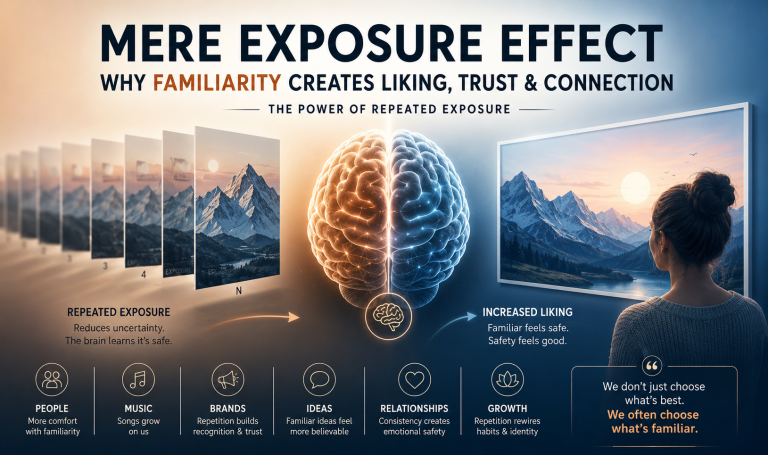
Sometimes people mistakenly call it the “mere expression effect,” but the correct term is the Mere Exposure Effect — a psychological principle showing that repeated exposure to something tends to increase our preference for it.
At first glance this may seem simple.
But underneath it lies an extraordinary intersection of neuroscience, evolutionary biology, emotional regulation, attachment theory, marketing psychology, and even spirituality.
Because human beings do not merely choose based on logic.
We choose based on what feels safe, known, predictable, and emotionally coherent.
And familiarity has a profound influence on all of those.
What Is the Mere Exposure Effect?
The Mere Exposure Effect was first extensively studied by psychologist Robert Zajonc in the 1960s.
His research demonstrated something fascinating:
People consistently developed a preference for things they encountered repeatedly — even when they had no meaningful interaction with them.
The repeated exposure alone was enough to increase liking.
This applied to:
- Faces
- Symbols
- Words
- Sounds
- Music
- Shapes
- Advertisements
- Ideas
- People
Even when participants could not consciously remember seeing the stimulus before, they still tended to prefer the familiar one.
In simple terms:
The brain often interprets familiarity as safety.
The Brain Is a Prediction Machine
From a neuroscience perspective, the brain is constantly attempting to predict reality.
Your nervous system is always asking:
- Is this safe?
- Is this dangerous?
- Is this known?
- Is this uncertain?
- Will this require energy to process?
Novelty requires metabolic resources.
The unfamiliar forces the brain into heightened processing mode.
But familiarity reduces cognitive load.
The nervous system relaxes around what it recognizes.
This is why:
- repeated music becomes enjoyable,
- recurring faces become attractive,
- familiar routines become comforting,
- recurring beliefs become convincing,
- and repeated narratives become “truth.”
The brain conserves energy through familiarity.
Why Familiarity Feels Safe
Evolutionarily, unfamiliar environments often carried risk.
Unknown animals.
Unknown tribes.
Unknown terrain.
Unknown foods.
For survival, the nervous system evolved to approach the familiar cautiously and gradually.
Repeated exposure without danger taught the brain:
“This is safe enough.”
Over time, the amygdala — the brain’s threat detection center — reduces its alarm response.
The nervous system softens.
Comfort emerges.
Trust begins forming.
This is one reason why consistent presence matters so much in:
- relationships,
- parenting,
- leadership,
- teaching,
- community,
- branding,
- and healing.
Humans regulate through predictability.
The Mere Exposure Effect in Relationships
One of the strongest places this phenomenon appears is in human connection.
People often believe attraction is entirely spontaneous.
But psychology tells a more nuanced story.
Repeated interaction increases:
- familiarity,
- emotional ease,
- nervous system relaxation,
- predictability,
- perceived trustworthiness,
- and eventually attraction.
This is why:
- classmates develop crushes,
- coworkers slowly become emotionally close,
- communities create bonding,
- and repeated interaction builds attachment.
Proximity and consistency matter profoundly.
Love is not always lightning.
Sometimes it is accumulated nervous system safety.
Familiarity vs. Genuine Compatibility
However, there is an important distinction.
Familiarity can create attraction even when something is not healthy.
Humans often confuse:
- familiar patterns
with - aligned patterns.
This becomes especially important in trauma psychology.
People raised in chaotic, emotionally inconsistent, or hypercritical environments may unconsciously feel “at home” around those same emotional dynamics later in life.
Why?
Because the nervous system associates familiarity with normalcy.
Even painful normalcy.
This explains why some people repeatedly enter:
- emotionally unavailable relationships,
- volatile partnerships,
- manipulative dynamics,
- or environments that recreate childhood emotional patterns.
The nervous system does not always seek what is healthiest.
Initially, it seeks what is familiar.
Healing often involves teaching the body to tolerate healthy consistency without mistaking it for boredom.
The Mere Exposure Effect in Marketing and Social Media
Modern marketing is built heavily upon this psychological principle.
Brands understand that repeated exposure increases:
- trust,
- recognition,
- emotional comfort,
- and purchasing likelihood.
This is why successful companies repeat:
- logos,
- colors,
- phrases,
- slogans,
- sounds,
- and visual identity systems.
The more often people encounter something, the more psychologically acceptable it becomes.
Even social media algorithms leverage this effect.
Repeated exposure to:
- creators,
- opinions,
- aesthetics,
- ideologies,
- and narratives
gradually shapes perception.
Familiarity slowly becomes perceived credibility.
This is why repetition has such power in culture and media.
Not necessarily because repetition proves truth —
but because repetition reduces psychological resistance.
Music, Memory, and Emotional Conditioning
The Mere Exposure Effect is one reason music becomes emotionally powerful over time.
Songs initially perceived as average may become deeply loved after repeated listening.
Each exposure strengthens neural familiarity.
Eventually the brain begins anticipating:
- rhythm,
- melody,
- timing,
- emotional peaks,
- and resolution.
Prediction itself becomes pleasurable.
Dopamine is strongly linked not only to reward —
but to anticipated reward.
The familiar song creates emotional expectation.
And the nervous system enjoys successfully predicting what comes next.
This is also why nostalgic music can instantly transport someone emotionally through memory networks encoded with repeated emotional experiences.
Repetition Shapes Identity
One of the most important implications of the Mere Exposure Effect is this:
Repeated exposure shapes identity.
The mind becomes conditioned by what it repeatedly encounters.
This includes:
- environments,
- conversations,
- media,
- beliefs,
- emotional states,
- internal dialogue,
- and social circles.
Repeated thoughts become familiar.
Familiar thoughts become believable.
Believable thoughts become identity.
This is why affirmations, mantras, meditation, journaling, and contemplative practices can gradually alter perception over time.
Not through magic.
But through neuroplasticity and repeated cognitive-emotional reinforcement.
The nervous system learns through repetition.
The Spiritual Dimension of Repetition
Ancient traditions understood this long before modern psychology.
Why do spiritual traditions repeat:
- mantras,
- prayers,
- chants,
- rituals,
- sacred movements,
- and meditative focus?
Because repetition reorganizes consciousness.
Repeated exposure stabilizes attention.
Repeated practice conditions the nervous system.
Repeated sacred focus gradually shifts identity away from fragmentation and toward coherence.
In Kundalini Yoga, mantra repetition is not merely symbolic.
It entrains mental and emotional patterns.
The mind gradually becomes familiar with stillness, presence, devotion, and expanded awareness.
What once felt unfamiliar becomes natural.
Even peace itself sometimes requires repeated exposure before the nervous system can trust it.
The Shadow Side of the Mere Exposure Effect
This principle also carries danger.
Repeated exposure can normalize:
- misinformation,
- toxic behaviors,
- emotional manipulation,
- propaganda,
- addictive content,
- and destructive cultural patterns.
Humans often assume:
“If I keep seeing it, it must be normal.”
But familiarity is not the same as truth.
Repetition increases acceptance —
even when the content itself is harmful.
This is why conscious awareness matters deeply in the digital age.
Your nervous system is constantly being conditioned by what you repeatedly consume.
Attention is not neutral.
Exposure shapes perception.
Healing Through Conscious Exposure
Interestingly, therapeutic healing often uses this same principle intentionally.
Gradual exposure therapy helps reduce anxiety by slowly teaching the nervous system that something previously perceived as threatening is actually survivable.
Over time:
- fear decreases,
- stress responses soften,
- and regulation improves.
The nervous system learns safety through repeated non-threatening experiences.
This principle also applies emotionally.
Receiving:
- consistent kindness,
- emotional presence,
- healthy communication,
- reliability,
- and genuine care
may initially feel unfamiliar to someone conditioned by chaos.
But repeated exposure to healthy connection can slowly rewire relational expectations.
Safety becomes learnable.
Love becomes receivable.
Peace becomes tolerable.
Familiarity Is One of the Invisible Architects of Human Life
Most people imagine their choices are entirely rational.
But much of human behavior is quietly shaped by repeated exposure.
What we repeatedly see,
hear,
feel,
consume,
practice,
and surround ourselves with
gradually becomes psychologically embedded.
This principle shapes:
- attraction,
- belief,
- memory,
- politics,
- spirituality,
- habits,
- relationships,
- identity,
- and culture itself.
The Mere Exposure Effect reminds us of something profound:
Human beings are deeply programmable through repetition.
Which means the environments you immerse yourself in matter enormously.
Because eventually,
what surrounds you begins shaping what feels normal within you.
And what feels normal often becomes the life you unconsciously create.