
For decades, solar energy has lived under a hard scientific ceiling.
No matter how advanced the engineering became, no matter how perfectly panels were manufactured, physicists believed there was a fundamental limit to how much sunlight a solar cell could convert into usable electricity. This limit, known as the Shockley–Queisser limit, has governed solar technology since the 1960s.
And now, scientists may have found a way around it.
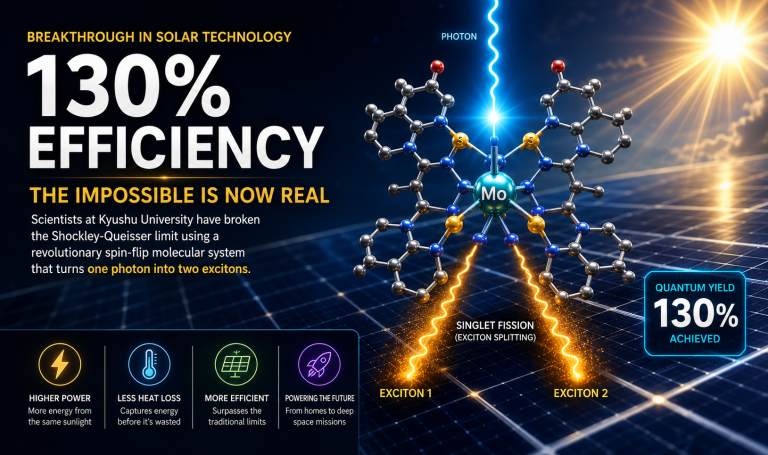
Researchers from Kyushu University in Japan, working with German collaborators, have demonstrated a breakthrough that sounds almost impossible at first glance: a solar system capable of producing the equivalent of 130% quantum efficiency.
Not by violating physics.
But by exploiting deeper layers of it.
What they achieved is not perpetual motion or “free energy.” Instead, they discovered a way to make one high-energy particle of light generate multiple usable energy carriers inside a solar material — something traditional solar panels waste as heat.
This changes the conversation entirely.
We are no longer just talking about capturing sunlight.
We are talking about multiplying its usefulness.
The Problem With Modern Solar Panels
Most people imagine solar panels as highly efficient devices that convert sunlight directly into electricity.
But the reality is surprisingly inefficient.
A large portion of solar energy never becomes usable electrical power. Much of it is simply lost as heat.
The main reason lies in how photons — particles of light — interact with semiconductor materials.
When sunlight strikes a conventional solar cell, photons with low energy often pass through without being absorbed. Meanwhile, photons with very high energy — especially blue and ultraviolet light — overwhelm the material.
Instead of converting all that extra energy into electricity, the material sheds the surplus as heat through ultrafast vibrational losses.
This thermal loss is the core reason traditional solar cells hit the Shockley–Queisser ceiling.
In simple terms:
- Too little photon energy = wasted light
- Too much photon energy = wasted heat
Only a narrow “sweet spot” becomes efficient electricity.
For decades, scientists believed this was unavoidable.
The “Dream Technology” Called Singlet Fission
The new breakthrough centers around a phenomenon called Singlet Fission (SF).
And if perfected, it could redefine solar engineering.
The idea behind singlet fission is elegant:
Instead of allowing one high-energy photon to create only one electrical excitation, scientists induce the material to split that energy into two separate excitons.
One photon.
Two usable energy packets.
Almost like a biological cell dividing.
Under normal conditions, a high-energy photon creates a single excited electronic state called a singlet exciton. In most materials, the excess energy rapidly disappears as heat.
But in singlet fission materials, that high-energy state can divide into two lower-energy triplet excitons before heat loss occurs.
This effectively doubles the number of charge carriers generated from certain wavelengths of light.
And this is why the system can exceed 100% quantum efficiency.
Not because it creates extra energy from nowhere.
But because it extracts more usable electrical potential from energy that would normally vanish into thermal waste.
That distinction is critical.
The Molybdenum “Spin-Flip” Breakthrough
The real challenge with singlet fission has never been the concept itself.
Scientists have known about the phenomenon for years.
The difficulty was controlling it efficiently enough for practical energy systems.
This is where the Kyushu University team made a major leap.
The researchers engineered a molybdenum-based molecular complex capable of something called spin-flip emission.
At the quantum level, electrons possess a property called spin — a kind of intrinsic angular momentum that governs how particles behave and interact.
Traditional light-emitting systems struggle to efficiently manage spin states, especially when trying to harvest triplet excitons for useful electrical work.
The new molybdenum complex acts almost like a quantum traffic controller.
It manipulates electronic spin states in a way that captures excess energy before thermal relaxation can destroy it.
This allows:
- efficient singlet fission dynamics
- near-infrared absorption and emission
- reduced heat loss
- enhanced exciton utilization
- higher overall quantum yields
The result is a system achieving around 130% quantum efficiency under experimental conditions.
In other words:
For certain wavelengths of incoming light, the material produces 1.3 usable excitations for every photon absorbed.
That was once considered nearly unattainable.
Why This Does Not Violate Physics
Whenever people hear “130% efficiency,” alarm bells go off.
Because it sounds like the system is producing more energy than it receives.
But that is not what is happening.
The key lies in understanding the difference between:
- Energy efficiency
and - Quantum efficiency
Quantum efficiency measures how many charge carriers or excitations are generated per incoming photon.
A single photon can contain enough energy to create more than one lower-energy excitation if the material can split and manage that energy properly.
So the total energy output still obeys thermodynamics.
No laws are broken.
Instead, the breakthrough eliminates waste that older systems could not avoid.
It is less like inventing energy from nothing…
…and more like discovering a hidden compartment in every ray of sunlight.
Why This Could Transform Civilization
If this technology scales successfully, the implications are staggering.
1. Solar Panels Could Become Radically More Powerful
Future panels may generate far more electricity from the same surface area.
That means:
- smaller installations
- cheaper energy production
- more efficient urban deployment
- better rooftop systems
- lower material requirements
Entire cities could generate substantially more energy without expanding physical infrastructure.
2. Deep Space Exploration Changes Completely
Space missions are severely constrained by energy availability.
Farther from the Sun, conventional solar efficiency drops dramatically.
But ultra-efficient singlet fission systems could make long-duration missions far more viable by maximizing every available photon.
Future spacecraft, satellites, lunar habitats, and Mars colonies may depend on technologies like this.
3. Heat Loss Reduction Solves Major Engineering Problems
One of the largest challenges in modern electronics and photovoltaics is thermal management.
Heat destroys efficiency.
It degrades materials.
It shortens lifespan.
A system that converts more incoming energy before it becomes heat fundamentally changes engineering design across multiple industries.
4. Energy Economics Could Shift Globally
If solar energy becomes dramatically more efficient, the economics of energy infrastructure begin to change.
Countries with large sunlight exposure could become massive energy exporters.
Remote regions could become energy independent.
Microgrids could outperform centralized fossil infrastructure.
The geopolitical landscape of power itself may shift.
We May Be Entering the Quantum Era of Energy
For most of human history, energy systems have been based on extraction:
- burning wood
- burning coal
- burning oil
- splitting atoms
Solar changed the paradigm by harvesting ambient energy from the environment.
But this new research hints at something deeper:
Not merely collecting sunlight…
…but intelligently reorganizing quantum behavior itself to extract hidden potential from light.
That is a profound transition.
Because the future of technology may increasingly depend not on brute force engineering, but on mastering the strange rules of the quantum world.
Spin states.
Excitons.
Coherence.
Energy pathways invisible to ordinary perception.
The deeper we go into physics, the less reality behaves like solid machinery — and the more it behaves like orchestrated probability.
A Quiet Revolution Is Already Beginning
Most people will not notice this breakthrough immediately.
No headlines screaming “infinite energy.”
No overnight replacement of every solar panel on Earth.
Scientific revolutions rarely happen that way.
Instead, they arrive quietly:
- first in research labs
- then in prototypes
- then in specialized industries
- then suddenly everywhere
The transistor began as a laboratory curiosity.
So did lasers.
So did quantum computing.
And now, singlet fission may be beginning the same journey.
If these systems can be stabilized, scaled, and manufactured economically, future generations may look back at traditional solar panels the same way we look at vacuum tubes today:
An important first step…
before the real revolution began.