
In a world of touchscreens, voice notes, and AI-generated text, handwriting can seem almost ancient.
Slow. Inconvenient. Inefficient.
Yet neuroscience keeps revealing something fascinating:
Writing by hand activates the brain in ways typing simply does not.
Not because handwriting is nostalgic.
Not because old methods are automatically better.
But because the act of writing by hand recruits an extraordinary combination of sensory, motor, cognitive, and memory systems simultaneously.
When you write by hand, your brain is not just recording information.
It is building it.
Your Brain Does Not Experience Handwriting as “Just Writing”
When you type on a keyboard, most keys require nearly identical movements.
But handwriting is different.
Every single letter:
- requires a unique motor pattern
- demands spatial precision
- activates sensory feedback
- engages timing and rhythm
- coordinates vision with movement
- and continuously updates attention
Your brain must orchestrate all of these systems together in real time.
That is why handwriting becomes a kind of neurological symphony.
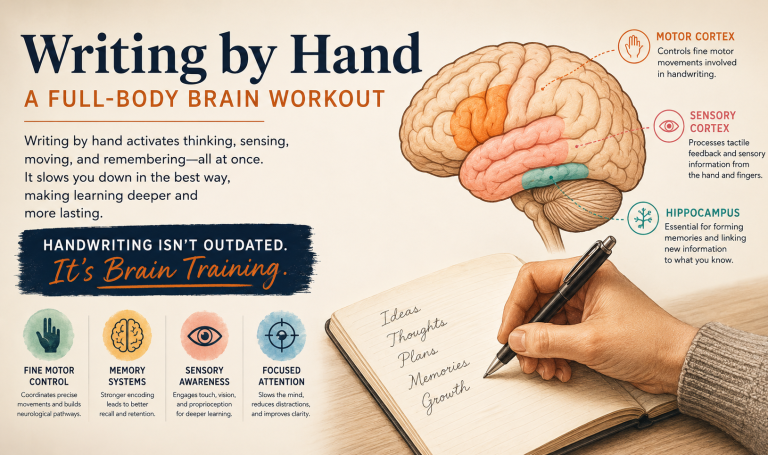
The process activates multiple regions simultaneously, including:
- the motor cortex
- sensory cortex
- cerebellum
- visual processing centers
- language regions
- attention networks
- and the hippocampus, one of the brain’s primary memory structures
Instead of passively receiving information, the brain becomes deeply involved in constructing it.
Why Handwriting Improves Memory
One of the most fascinating discoveries in learning science is this:
People consistently remember information better when they write it by hand instead of typing it.
Why?
Because handwriting naturally slows cognition down.
Typing is fast enough that many people transcribe information almost automatically without deeply processing meaning.
Handwriting forces the brain to:
- summarize
- prioritize
- interpret
- encode
- and organize information actively
In other words:
you do not merely copy ideas when writing by hand.
You metabolize them.
The hippocampus — heavily involved in memory formation — becomes more engaged because handwritten learning creates richer neural encoding.
The brain receives:
- movement information
- tactile information
- visual-spatial information
- semantic meaning
- and attentional focus
all layered together at once.
That creates stronger memory traces.
Handwriting Is a Sensorimotor Experience
Most people think of writing as purely intellectual.
But handwriting is deeply physical.
The pressure of the pen.
The texture of paper.
The angle of the wrist.
The speed of movement.
The visual flow of letters.
The micro-adjustments of finger muscles.
Your nervous system continuously monitors all of this.
That sensory feedback matters.
The sensory cortex becomes involved because the body is not separated from cognition.
The brain learns through embodiment.
This is one reason children who practice handwriting often show improvements in:
- reading acquisition
- language development
- symbol recognition
- fine motor coordination
- and cognitive integration
The body literally helps teach the brain.
The Slowness of Handwriting Is a Feature, Not a Flaw
Modern culture worships speed.
Faster responses.
Faster communication.
Faster productivity.
But the brain does not always learn best at maximum speed.
Some forms of cognition require slowness.
Handwriting introduces deliberate friction into thought.
And that friction can be profoundly beneficial.
When you write by hand:
- thoughts become more intentional
- language becomes more reflective
- emotional processing deepens
- distractions decrease
- and awareness stabilizes
You begin thinking with the body instead of racing ahead of it.
This is why journaling by hand often feels radically different from typing into a notes app.
The nervous system settles.
Thoughts organize.
Emotions surface more clearly.
The mind becomes less fragmented.
Handwriting Strengthens Attention
Attention is becoming one of the most depleted resources in modern life.
Notifications fracture focus.
Algorithms compete for cognition.
Multitasking overloads working memory.
Handwriting counteracts this fragmentation.
Because it is slower and more physically engaging, it anchors attention into a single stream of activity.
You cannot easily scroll, switch tabs, and consume ten streams of information while deeply handwriting.
The act itself promotes:
- sustained attention
- cognitive sequencing
- present-moment awareness
- and mental coherence
In many ways, handwriting functions almost like a cognitive meditation.
It trains the brain to remain with one thing long enough for depth to emerge.
Why Creative Thinking Often Flows Better on Paper
Many writers, scientists, philosophers, and inventors have described a unique quality that emerges when thinking on paper.
Ideas move differently.
This is partly because handwriting is nonlinear.
You can:
- draw arrows
- sketch ideas
- circle concepts
- create symbols
- map connections spatially
- and move fluidly between words and images
The brain loves spatial relationships.
Paper allows thought to become visual and embodied instead of compressed into uniform digital structures.
This often enhances:
- insight generation
- pattern recognition
- conceptual integration
- and intuitive thinking
The page becomes more than a storage device.
It becomes an extension of cognition itself.
The Nervous System and Emotional Regulation
Handwriting also affects emotional processing.
Studies on expressive writing suggest that physically writing thoughts and emotions can:
- reduce stress
- improve emotional clarity
- lower rumination
- and increase psychological integration
Part of this may come from the rhythm and pacing of handwriting itself.
The repetitive motor movement creates a regulating effect on the nervous system.
The body becomes involved in emotional release instead of remaining trapped in purely mental loops.
This may explain why handwritten journaling often feels:
- grounding
- calming
- cathartic
- and deeply personal
The experience is tactile, intimate, and embodied.
Handwriting in the Age of AI
Ironically, as artificial intelligence becomes more powerful, handwriting may become more valuable, not less.
Because what many people are truly losing is not information access.
It is:
- depth of attention
- cognitive integration
- memory retention
- emotional processing
- and embodied thinking
Handwriting restores many of these capacities.
It reconnects thought with movement.
Mind with body.
Knowledge with experience.
The future may not belong exclusively to people who can consume the most information.
It may belong to people who can integrate information most deeply.
And handwriting remains one of the simplest and most powerful tools for doing exactly that.
Handwriting Is Not Obsolete. It Is Neurological Training.
Every time you write by hand, you are activating a remarkable network inside the brain.
You are coordinating:
- movement
- sensation
- attention
- language
- memory
- and awareness
all at once.
Handwriting is not merely a way to record thought.
It is a way to shape thought.
To strengthen memory.
To deepen learning.
To regulate attention.
To embody cognition.
In a distracted world, the pen may still be one of the most advanced cognitive technologies we possess.