One of the greatest misconceptions about healing, spirituality, emotional intelligence, or personal growth is the belief that a “healed” person never gets triggered.
That is not emotional maturity.
Emotional maturity is not becoming emotionally numb.
It is not suppressing your reactions.
It is not pretending to be calm while your nervous system is internally collapsing.
And it is certainly not becoming so detached that nothing affects you anymore.
The goal is not perfection.
The goal is awareness.
The real work is learning to recognize activation while it is happening — and choosing not to abandon yourself or attack another person in the process.
That pause changes everything.
A Trigger Is Often the Nervous System Remembering
A trigger is not weakness.
It is usually the nervous system reacting to perceived danger based on past experiences.
Sometimes the present moment is touching an older wound:
- rejection
- abandonment
- criticism
- betrayal
- humiliation
- emotional neglect
- unpredictability
- lack of safety
The body does not always distinguish between what was and what is.
This is why a simple sentence, tone of voice, delayed text message, facial expression, or disagreement can suddenly create an emotional response that feels far bigger than the current moment.
The nervous system begins preparing for survival:
- fight
- flight
- freeze
- fawn
Heart rate changes.
Breathing shifts.
Cortisol and adrenaline increase.
Defensiveness rises.
Thinking narrows.
Listening decreases.
In neuroscience, this is sometimes described as an “amygdala hijack,” where the emotional survival centers of the brain temporarily override the reflective and rational capacities of the prefrontal cortex.
In simpler words:
you stop responding consciously and begin reacting protectively.
And most conflict between human beings is not actually caused by the present moment itself.
It is caused by unprocessed pain colliding with another person’s unprocessed pain.
Emotional Regulation Is a Form of Intelligence
True emotional intelligence is not measured by how spiritual, calm, articulate, or knowledgeable someone appears when life is easy.
It is measured by what happens when discomfort enters the room.
Can you remain conscious when you feel misunderstood?
Can you stay connected when shame appears?
Can you pause before projecting?
Can you recognize when your body is reliving something old?
Can you communicate without making the other person the enemy?
That is emotional maturity.
Not perfection.
Practice.
Not never feeling activated.
Learning how to work with activation skillfully.
The Power of the Pause
The pause is sacred.
A few conscious breaths can prevent hours, weeks, or even years of damage.
Many relationships do not collapse because of the original issue.
They collapse because of impulsive reactions created during nervous system dysregulation.
Words spoken from activation often come from protection, not truth.
This is why emotionally mature communication sounds different.
Instead of:
- attacking
- blaming
- stonewalling
- escalating
- manipulating
- withdrawing completely
A regulated person learns to communicate awareness in real time.
They say things like:
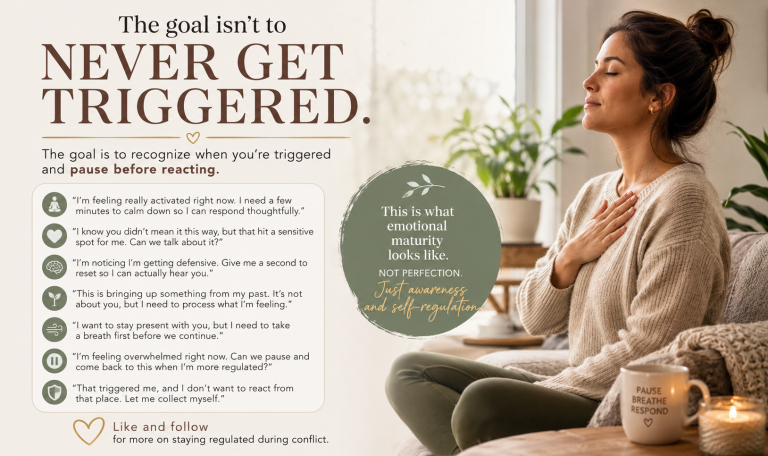
“I’m feeling really activated right now. I need a few minutes to calm down so I can respond thoughtfully.”
“I know you didn’t mean it this way, but that touched a sensitive spot for me. Can we talk about it?”
“I’m noticing I’m getting defensive. Give me a second so I can actually hear you.”
“This is bringing up something from my past. It’s not about you, but I need to process what I’m feeling.”
“I want to stay present with you, but I need to breathe before we continue.”
“I’m feeling overwhelmed right now. Can we pause and revisit this when I’m more regulated?”
“That triggered me, and I don’t want to react from that place. Let me collect myself.”
These statements are powerful because they interrupt unconscious patterns.
They create space between stimulus and reaction.
And inside that space, consciousness returns.
Regulation Is Biological, Not Just Psychological
Self-regulation is not merely a mindset.
It is physiological.
A dysregulated nervous system struggles to perceive safety accurately.
When the body believes it is under threat, connection becomes difficult.
Listening becomes difficult.
Empathy decreases.
The brain prioritizes protection over understanding.
This is why practices that regulate the nervous system are so transformative:
- conscious breathing
- meditation
- Kundalini Yoga
- grounding practices
- somatic awareness
- exercise
- sleep
- emotional processing
- co-regulation through safe relationships
These practices help restore balance between the sympathetic nervous system (mobilization/survival) and the parasympathetic nervous system (restoration/safety).
Over time, the body learns:
“I can feel discomfort without losing myself.”
That is healing.
Self-Awareness Protects Relationships
One of the most mature things a person can say is:
“I am triggered right now, and I do not want to make you responsible for my entire emotional history.”
That level of awareness changes relationships profoundly.
Because emotionally mature people understand something important:
Feeling triggered does not automatically mean the other person is wrong.
Sometimes they crossed a boundary.
Sometimes they communicated poorly.
Sometimes repair is needed.
But sometimes the intensity of the reaction is revealing unresolved pain that existed long before the current interaction.
Emotionally mature people become curious about their reactions instead of fully identifying with them.
Instead of:
“You made me feel this.”
It becomes:
“Something inside me was activated, and I want to understand it responsibly.”
That shift transforms conflict into growth.
Healing Is Not Becoming Untouchable
Many people secretly believe healing means becoming impossible to hurt.
But real healing often looks very different.
It looks like:
- noticing activation earlier
- recovering more quickly
- communicating more honestly
- staying present during discomfort
- taking responsibility without collapsing into shame
- setting boundaries without cruelty
- apologizing without defensiveness
- listening without preparing an attack
A healed nervous system is not a nervous system that never reacts.
It is a nervous system that can return to safety more efficiently.
Conscious Communication Creates Safety
When people feel emotionally safe, defensiveness decreases.
Openness increases.
Repair becomes possible.
But emotional safety is not created through perfection.
It is created through honesty, accountability, and regulation.
People feel safe around those who can:
- pause instead of explode
- communicate instead of punish
- reflect instead of project
- stay grounded during emotional intensity
And perhaps most importantly:
people feel safe around those who can acknowledge their internal state without making others responsible for carrying it.
Final Reflection
The goal is not to become emotionless.
The goal is to become conscious enough to recognize when your nervous system is taking over before your reactions create unnecessary harm.
You will still get triggered.
You will still feel activated.
You will still encounter moments where old wounds resurface.
That is part of being human.
But healing allows you to pause long enough to choose awareness over impulse.
And that single moment of awareness can change an entire relationship, an entire conversation, or even an entire life.
Emotional maturity is not perfection.
It is the willingness to remain present, honest, accountable, and regulated in moments when it would be easier to disappear into unconscious reaction.