The four-page paper from Dhaka that reached Einstein and changed the way physicists count particles.
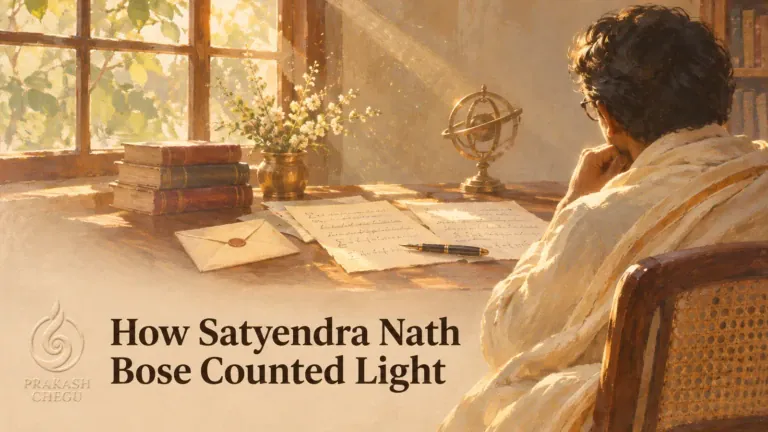
On 4 June 1924, Satyendra Nath Bose wrote to Albert Einstein. He was thirty years old, a reader in physics at the University of Dacca, in what was then British India and is now Dhaka, Bangladesh. He enclosed a paper about light and asked Einstein to read it. I keep returning to the way he opens his request: “I have ventured to send you the accompanying article for your perusal and opinion.” Bose had arrived at a result he trusted enough to send to Berlin. He was also willing to put it in front of someone who could tell him where it failed.
Within a month, Einstein had read the paper, translated it into German, and sent it to Zeitschrift für Physik. The published version occupies four pages. The question inside them sounds almost too simple for the consequences it produced: when we count the possible arrangements of light, what exactly are we counting?
A formula that worked and still bothered him
Heat a piece of iron and it begins to glow. As it gets hotter, the color changes. Behind that familiar sight is a problem that occupied some of the best physicists of the early twentieth century: at a given temperature, how much energy does a hot object emit at each frequency? Physicists study the question using an idealized object called a blackbody, which absorbs all radiation that falls on it. Its emission spectrum depends only on its temperature.
Max Planck found a formula in 1900 that described the measured spectrum. His derivation introduced discrete amounts of energy proportional to frequency, with Planck’s constant setting the scale. But the story of how the formula followed from the underlying physics remained unsettled. Earlier derivations could still turn to classical electromagnetic waves to count how many states were available to the radiation. Bose wanted to know whether he could obtain that count starting with light quanta — the packets of energy we now call photons.
My training as an engineer makes that detail especially satisfying. A calculation can deliver the right number while leaving you uneasy about how it got there. You can use it, teach it, even build something with it, and still find that one step where the explanation quietly changes its terms. Bose stayed with that step. If light came in quanta, he wanted the counting to start there too.
What changes when the particles have no labels?
Imagine two available states, A and B, and two objects to place in them. If you can tell the objects apart, give them names — Red and Blue. The moment you do that, there are four assignments.
| Assignment | Number in A | Number in B |
|---|---|---|
| Red and Blue both in A | 2 | 0 |
| Red in A, Blue in B | 1 | 1 |
| Blue in A, Red in B | 1 | 1 |
| Red and Blue both in B | 0 | 2 |
Now imagine two identical photons instead. A and B are still distinct states, but swapping the supposed identities of the photons in the middle two rows gives you the same physical state: one photon in A and one in B. So the four assignments become three occupation patterns — two in A, one in each, or two in B.
The difference looks modest on a page. Extend it to a vast number of possible states and it changes how the energy is distributed. The split arrangement had an extra entry when we named the objects. Take away the invented labels and that extra entry disappears. And because photons are bosons, a state can hold more than one photon — the two arrangements in which both photons occupy the same state are perfectly legitimate.
In the actual paper, Bose divided phase space — which describes possible positions and momenta — into cells of volume h³, where h is Planck’s constant. He worked out how many ways the quanta could occupy those cells and used the resulting count to calculate the entropy of the radiation. The count recovers the factor Bose had singled out in his letter, 8πν²/c³, where ν is frequency and c is the speed of light. It tells us how densely the available states are packed at each frequency. Combined with how those states are populated at a given temperature, the count gives Planck’s spectrum. The familiar formula survived. Its explanation had changed.
This is the part of the story I would linger over in a classroom. Before getting to the envelope or the famous name on the other end, I would ask everyone to look at the middle two rows. We made them look different by giving the objects names. Then we carried that difference into our arithmetic. Bose’s paper is a reminder of how easily a bookkeeping choice can pass for a fact about nature.
The letter from Dhaka and the postcard from Berlin
Before Bose approached Einstein, he sent the work to the British journal Philosophical Magazine. Biographers describe that episode differently — some accounts describe a negative referee report, others describe Bose receiving no reply at all. By 4 June, Bose had taken a route he could pursue himself. He sent Einstein the manuscript, explained the point of the derivation, and asked for help publishing it in German if Einstein thought it worthy.
Bose described himself in the letter as a stranger to Einstein, though the two had corresponded before. Years earlier, Bose and his colleague Meghnad Saha had translated work by Einstein and Hermann Minkowski into English, making it accessible to readers who could not read the German originals. I love the turn in that history. An Indian physicist had helped carry Einstein’s work across a language barrier. In 1924, Einstein carried Bose’s work back across it.
Einstein answered on a postcard dated 2 July. He told Bose that he had translated the paper and sent it to the journal. He also attached a note describing the derivation as an important advance and pointing toward a possible extension. In the published paper, the author is Bose, and the affiliation reads Dacca-University, Indien. It matters that Einstein did several distinct things. He paid close enough attention to recognize the strength of an argument about a problem he knew intimately. He did the work of translation. He put his judgment on the record. And then he followed the mathematics into territory the first paper had only opened up.
From photons to a new state of matter
A hot cavity’s walls can absorb and emit photons, so the number of photons inside can change. Einstein took Bose’s statistical method and applied it to a different system — an ideal gas with a fixed number of atoms. In papers from 1924 and 1925, he worked out what the statistics implied as such a gas cooled. Below a critical temperature, a macroscopic fraction of the atoms could occupy the same lowest-energy quantum state. This is what we now call Bose–Einstein condensation.
Picture the difference between a crowd of atoms with their energies spread across many states and a gas in which a substantial fraction occupies one state together. In the second case, the quantum behavior can show up at the scale of the whole sample. Einstein could follow that possibility on paper in 1925. The experimental challenge was to make a gas cold and dilute enough to see it happen.
In June 1995, the team led by Eric Cornell and Carl Wieman at JILA achieved the first Bose–Einstein condensate in a dilute atomic gas, using rubidium-87. They used lasers to cool the atoms, then trapped them and let the most energetic atoms escape, cooling the remaining cloud further. A sharply concentrated peak appeared in the measured velocity distribution. Later that year, Wolfgang Ketterle’s team produced a condensate with sodium atoms. The three physicists shared the 2001 Nobel Prize in Physics.
There are seventy years between Einstein’s prediction and that first dilute-gas experiment. Both dates deserve room in the telling. An equation can give experimentalists a reason to look. The ability to build an instrument capable of seeing what the equation predicts has a history of its own.
A Bengali surname inside the language of physics
Paul Dirac coined the word boson in Bose’s honor. In modern physics, bosons have integer spin and can share a quantum state. Photons are bosons. So are gluons, which mediate the strong interaction between quarks. The Higgs boson has spin zero. When the ATLAS and CMS collaborations announced a new particle consistent with the Higgs on 4 July 2012, Bose’s surname was right there in the name being spoken at CERN and repeated around the world.
Bose was elected a Fellow of the Royal Society in 1958. He was nominated for the Nobel Prize, though he never received it. In his later years, he championed teaching and writing about science in Bengali. That detail belongs alongside the word boson. Bose had spent part of his early career bringing new physics into a language more readers could access. He spent part of his later life working to make his own language a place where people could learn and discuss science.
When I think of this story now, I think first of a teacher preparing to explain a formula. Imagine standing before a room of students and reaching a step you can reproduce perfectly, but cannot yet explain to your own satisfaction. The class moves on. The question stays with you. In Bose’s case, that question traveled from Dhaka to Berlin, then into a laboratory where a cloud of atoms finally did something a physicist had imagined seventy years earlier.
The next time you hear the word boson, hear the name inside it. Satyendra Nath Bose — a teacher in Dhaka who had stopped at a step in a familiar calculation and asked what, exactly, he was counting.
— Prakash Chegu
Frequently Asked Questions
Who was Satyendra Nath Bose and what did he do?
Bose was a physicist who, at thirty, was a reader in physics at the University of Dacca (now Dhaka). In 1924 he wrote to Albert Einstein, enclosing a short paper proposing a new way of counting particles of light. That modest four-page paper would change how physicists understand and count certain particles.
Why did his paper matter so much?
Bose derived a new statistical method for counting photons that resolved problems in understanding light and radiation. Einstein recognized its importance, translated it, and extended the idea to matter — giving rise to what is now called Bose-Einstein statistics. Particles that follow these rules are named bosons in Bose’s honor.
What is Bose’s lasting legacy?
His insight became foundational to modern physics. Bose-Einstein statistics describe a whole class of particles (bosons), and the collaboration with Einstein even predicted the Bose-Einstein condensate, a state of matter later realized experimentally. Remarkably, it began with a young physicist in Dhaka trusting his result enough to send it to Berlin — and being open to being told where it might fail.