The ancient question neuroscience has not yet answered
For centuries, human beings have looked inward and encountered something that is at once utterly intimate and almost impossible to explain.
We can observe the body. We can measure electrical activity in the brain. We can trace neural pathways, alter perception with chemicals, stimulate particular regions of the cortex, and watch patterns of activity change as a person remembers, dreams, suffers, meditates, or falls unconscious.
But none of this directly reveals the one who is experiencing.
It does not tell us why electrical and chemical events should be accompanied by the redness of red, the ache of grief, the sweetness of love, the silence encountered in deep meditation, or the irreducible feeling of simply being here.
This is the question beneath neuroscientist and theoretical physicist Àlex Gómez-Marín’s provocative talk, “The Brain Is Not Responsible for Consciousness.” His proposal is not merely that science has failed to locate consciousness in the brain. It is more radical: perhaps the brain does not manufacture consciousness at all. Perhaps it filters, limits, receives, or permits a consciousness that is more fundamental than the organ through which it is expressed.
That possibility sounds revolutionary within modern neuroscience. Within yoga and Vedanta, however, it sounds strangely familiar.
Yet we must proceed carefully. The filter model is a serious philosophical and scientific hypothesis—not an established fact. Near-death experiences do not automatically prove survival after death. Meditation does not, by itself, demonstrate that consciousness exists independently of biology. And the limitations of materialism do not grant us permission to replace one dogma with another.
The real invitation is deeper: to distinguish what science has demonstrated from what it has merely assumed, and to build a study of consciousness spacious enough to include both the measured brain and the person who lives through it.
The assumption hiding inside modern neuroscience
The connection between brain and experience is undeniable.
Damage the visual cortex and sight may be altered. Injure language networks and speech may disappear. Anaesthesia can interrupt ordinary awareness. Psychedelics, medication, exhaustion, trauma, breathwork, contemplative practice, hormonal states, and neurological disease can all change the contents and structure of experience.
From these observations, contemporary culture often makes a further leap:
If changing the brain changes consciousness, the brain must create consciousness.
But the conclusion does not logically follow from the evidence alone.
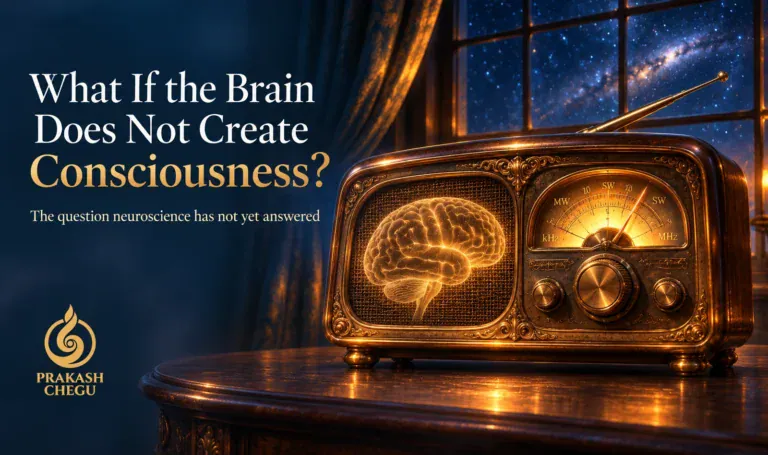
Changing a radio receiver changes the music that emerges from it. Damaging a television changes the image on its screen. Neither observation proves that the programme originated inside the device. The analogy does not prove that the brain is a receiver either—but it exposes the gap in the usual reasoning. Dependence, modulation, and correlation are not automatically the same as production.
Neuroscience has made enormous progress in identifying neural correlates of consciousness: patterns or mechanisms associated with particular conscious states. The philosophical problem remains whether those correlates explain consciousness, generate it, enable it, constrain it, or accompany it. Even the Stanford Encyclopedia of Philosophy’s overview of consciousness neuroscience begins from the well-supported fact that human conscious experience depends on brain activity while asking what a genuinely explanatory neuroscience of consciousness would require. Correlation is indispensable knowledge; it is not yet an ontology. (Stanford Encyclopedia of Philosophy)
If a piano key is damaged, a particular note cannot be played correctly. We would still not say the piano composed the music, created the musician, or invented the laws of harmony.
The brain may be necessary for human consciousness as we ordinarily express it without being the ultimate source of consciousness itself.
Galileo’s bargain—and what science left outside
One of Gómez-Marín’s most valuable observations concerns the history of science.
The scientific revolution became extraordinarily powerful by concentrating on what could be publicly measured: extension, motion, number, weight, position, duration. Qualities as lived by a subject—colour, taste, beauty, pain, meaning—were treated differently. They were difficult to quantify and therefore moved to the subjective side of the ledger.
This methodological decision was brilliant. It gave us modern physics, engineering, medicine, and technology. But a method designed to exclude subjective experience from its measurements cannot be expected to rediscover subjectivity merely by accumulating more third-person measurements.
Imagine removing every mention of music from a research protocol and then being astonished that the resulting equations contain no melody.
Science did not prove that first-person experience is unreal. It bracketed it in order to study the measurable world with extraordinary precision. The difficulty arises when a useful method becomes an unquestioned metaphysics—when “we study only what can be measured from outside” quietly changes into “only what can be measured from outside is real.”
That is not science speaking. It is a philosophical position often called physicalism or materialism.
It may eventually prove correct. But it has not yet explained how objective processes become subjective experience.
The hard problem is still hard
Suppose neuroscience could map every event in your brain while you watched a sunset.
It could record visual processing, memory activation, autonomic changes, emotional response, prediction, attention, and the words you later use to describe the scene. It might eventually predict with stunning accuracy what you will report.
One question would remain: why is any of that processing accompanied by an inner life?
Why does information processing feel like something from within?
This is the famous “hard problem” of consciousness: the explanatory gap between third-person descriptions of brain activity and first-person experience. The problem is not simply that we need a more detailed scan. It is that no inventory of functions obviously explains why function should be illuminated by awareness at all.
A complete account of the neural circuitry of pain is not the pain. A perfect acoustic analysis of a raga is not the experience of being moved by it. A map of meditation is not meditation.
Materialist theories offer sophisticated proposals: consciousness may arise from globally available information, recurrent processing, higher-order representation, predictive modelling, integrated information, or other forms of organisation. These theories deserve serious attention, and discoveries about the brain continue to matter enormously. But there is no scientific consensus that one theory has solved the transition from matter to experience. Indeed, even the basic definition and target of a “theory of consciousness” remain disputed. (Stanford Encyclopedia of Philosophy)
Saying “the brain produces consciousness” can therefore sound more conclusive than the present evidence permits. It names a preferred explanation; it does not yet complete one.
The brain as filter, receiver, or reducing valve
The alternative proposed by Gómez-Marín belongs to a long philosophical lineage.
On this view, consciousness is not a late by-product of sufficiently complicated matter. It may be a fundamental feature of reality—or at least something the brain does not originate. The nervous system shapes an individual stream of experience by filtering a vastly wider field into a form that a biological organism can use.
The brain would then be less like a factory generating light and more like a lens focusing it.
This makes evolutionary sense at one level. An organism does not need access to all possible information. It needs a narrow, actionable world: food, danger, belonging, mating, shelter, direction, and meaning. Too much input would not produce enlightenment; it would make survival impossible.
The filtering brain would reduce a potentially immense field of consciousness into a stable personal world organised around one body, one history, one location, and one set of needs.
Ordinary waking consciousness may therefore be not the maximum of awareness but a biologically useful selection from it.
This is an elegant idea, but elegance is not evidence. A receiver theory must eventually generate testable predictions that distinguish it from production theories. Otherwise “the brain receives consciousness” risks becoming as unfalsifiable as the materialist assertion it challenges.
The right response is neither immediate belief nor automatic dismissal. It is disciplined curiosity.
The experiences that do not fit comfortably
Gómez-Marín argues that science should take anomalous experiences seriously—not because every extraordinary report is accurate, but because anomalies are often where a theory reveals its limits.
Near-death experiences
Some people resuscitated after cardiac arrest report unusually vivid and structured experiences: a sense of separation from the body, panoramic memory, profound peace, encounter with deceased relatives, passage through darkness or light, or a radically changed understanding of life and death.
These accounts are not uniform, and there are plausible biological contributions: oxygen disruption, carbon-dioxide changes, medication, disinhibition, memory reconstruction, expectation, and unusual bursts of neural activity. The presence of a compelling experience does not establish that awareness left the body.
At the same time, serious prospective research has made it harder to dismiss the entire domain as fantasy. The multicentre AWARE-II study followed 567 in-hospital cardiac arrests. Of the 28 survivors interviewed, 11 reported memories or perceptions suggestive of consciousness, encompassing CPR-related awareness, post-resuscitation experience, dream-like experience, and recalled experiences of death. EEG recordings in a smaller monitored group also found activity patterns that the investigators considered compatible with cognitive processes during prolonged resuscitation. The study did not prove consciousness independent of the brain, and its survival and monitoring samples were limited; it did show that the boundary between consciousness and physiological crisis is more complex than a simple on/off switch. (PubMed: AWARE-II)
Terminal and paradoxical lucidity
Families and carers sometimes report a sudden return of clarity in people with severe dementia or neurological impairment, occasionally near death. A person who has been largely incoherent may recognise loved ones, speak meaningfully, say goodbye, or momentarily appear restored.
These episodes are emotionally powerful but methodologically difficult. Many reports are retrospective; “lucidity” is inconsistently defined; the underlying brain condition varies; and unexpected function may reflect preserved networks rather than consciousness escaping damaged tissue.
Nevertheless, the phenomenon is now being studied rather than merely relegated to folklore. Recent reviews stress both the existence of reported lucid episodes and the need for better prospective observation, standard definitions, and objective measurement. This is exactly what scientific openness should look like: neither declaring a miracle nor refusing to investigate because the event does not fit the prevailing model. (2024 scoping review; health-care professional reports)
Mystical and contemplative states
Across cultures, advanced meditators, contemplatives, and ordinary people in exceptional circumstances report states in which the usual boundary of self dissolves. Awareness remains, but the familiar narrator—the personal “me” organising experience—becomes quiet or absent.
Neuroscience can study the brain activity accompanying such states. That work is invaluable. Yet the interpretation remains open. Does altered activity generate a feeling of unity? Does it remove a filtering mechanism that usually conceals unity? Are both descriptions partial views of one event?
The scan cannot answer the metaphysical question by itself.
Yoga made a crucial distinction long ago
Yogic philosophy does not use the word “mind” as a synonym for consciousness.
It distinguishes among layers and functions:
- Manas processes sensory impressions, preferences, and ordinary thought.
- Buddhi discerns, evaluates, and recognises.
- Ahamkara constructs the sense of “I” and “mine.”
- Chitta holds the deeper field of mental impressions, memory, and conditioning.
- Purusha or Atman, depending on the philosophical school, refers to the witnessing principle—not another thought, but that by which thoughts are known.
From this perspective, the brain and mind are instruments through which consciousness becomes localised and functional. Thoughts appear in consciousness, but consciousness is not merely another thought. Memory appears in consciousness, but awareness is not identical to memory. The personality changes, the body ages, waking gives way to dreaming and deep sleep—yet yoga asks us to investigate whether there is a more fundamental continuity beneath these changing contents.
This is not intended as an anatomical theory. Ancient yogic maps cannot simply be pasted over modern neuroscience. Prana is not a synonym for electricity, chakras are not merely endocrine glands, and Atman is not a newly discovered brain region. These systems ask different kinds of questions and operate with different methods.
Yet the resonance is profound.
Gómez-Marín’s filter hypothesis says that the brain may constrain or permit consciousness rather than produce it. Yoga says that the fluctuations of mind veil the nature of the seer. One speaks in the language of an emerging trans-material science; the other in the language of direct contemplative inquiry.
Both challenge the reflexive assumption that consciousness is confined to the stream of thought inside the skull.
Meditation as first-person research
If consciousness is the subject of investigation, third-person measurement alone may never be enough.
We need rigorous first-person methods as well.
This is where yoga offers something more valuable than abstract belief. It offers practice.
Meditation trains attention so that experience can be observed with increasing subtlety. Pranayama reveals how breath, arousal, emotion, attention, and identity interact. Pratyahara explores what remains when sensory involvement is reduced. Dharana stabilises attention. Dhyana changes the relationship between observer and observed. Samadhi, in the classical account, reveals awareness no longer organised around the ordinary separative self.
These states should not be romanticised. Practitioners can misinterpret suggestion, dissociation, nervous-system dysregulation, fantasy, trauma responses, or charismatic conditioning as spiritual revelation. Inner experience requires discernment as much as outer experiment does.
But dismissing all contemplative evidence because it is first-person would be like dismissing pain because only the patient can feel it.
A mature science of consciousness may need three strands held together:
- Third-person measurement: brain activity, physiology, behaviour, and reproducible experimental conditions.
- First-person observation: carefully trained reports of the structure and qualities of experience.
- Second-person inquiry: skilled dialogue in which a teacher, clinician, or researcher helps a participant describe experience without forcing it into a predetermined interpretation.
This would not weaken science. It would make its method adequate to its subject.
Science 2.0: openness without credulity
Gómez-Marín calls for a science willing to investigate what its dominant worldview tends to exclude. This must not mean lowering evidential standards. It should mean applying them more intelligently.
A renewed science of consciousness would:
- distinguish data from metaphysical interpretation;
- study exceptional experiences prospectively wherever possible;
- publish null findings as readily as dramatic ones;
- improve verification and controls in near-death research;
- define terminal lucidity consistently and collect real-time clinical observations;
- integrate phenomenology with neuroscience;
- remain open to physicalist, dual-aspect, idealist, panpsychist, and filter models;
- ask what observation would count against each theory;
- refuse both cynical dismissal and spiritual sensationalism.
The great danger is not scepticism. Good scepticism is a form of care. The danger is premature certainty—whether it declares that consciousness is “nothing but neurons” or that every unusual experience proves a cosmic realm.
Materialism can become dogmatic. Spirituality can also become dogmatic. Both cease to inquire when they already know what every observation is allowed to mean.
If consciousness is fundamental, what changes?
The question is not merely academic.
If consciousness is produced entirely by the brain and extinguished when brain function irreversibly ends, life remains precious. Love remains meaningful. Ethics remain necessary.
But if the brain filters a consciousness that is more fundamental, the implications are immense.
Death may represent a transformation in the conditions through which awareness is expressed rather than the simple destruction of awareness. Identity may be deeper than biography. Human beings may not be isolated machines accidentally generating private interior worlds, but local expressions of a more encompassing field of consciousness.
The yogic teaching of interconnection would then be more than moral poetry. To harm another would be, at a deeper level, to act within the same field of being from which we ourselves arise.
Yet even here, intellectual belief is not transformation. A person can believe that all is One and remain selfish, unkind, frightened, and divided. The purpose of yoga is not to adopt a grander theory of consciousness. It is to refine the instrument until separation is no longer the unquestioned basis of perception and action.
The most important question is not, “Can I win an argument against materialism?”
It is:
What becomes possible when I stop mistaking the contents of my mind for the whole of consciousness?
A simple inquiry: finding the witness
Sit comfortably and allow the spine to rise without stiffness.
Let the breath become natural. Do not try to produce a special state.
Notice a sound.
The sound changes, but awareness knows the change.
Notice a sensation in the body.
The sensation may intensify, fade, or move, but awareness knows it.
Notice a thought.
The thought appears, remains briefly, and disappears. Another may replace it. Yet something knows both the thought and the space after it.
Now ask silently:
Is awareness itself a thought—or is thought appearing within awareness?
Do not answer verbally. A verbal answer is simply another thought.
Rest with the question for three to eleven minutes.
This does not prove that consciousness survives the brain. It does something more immediate: it reveals how quickly we confuse awareness with the objects passing through it.
The humility at the edge of knowledge
We know that the brain matters profoundly. Every responsible discussion of consciousness must honour what neurology, anaesthesia, psychiatry, cognitive science, and medicine have demonstrated. Brain injury changes lives. Mental suffering is not cured by telling someone they are “pure awareness.” Biological care and spiritual insight must never be made enemies.
We also know that the existence of a neural correlate does not, by itself, explain why experience exists. We do not yet possess a universally accepted theory that crosses the gulf between measurable brain events and lived subjectivity. And certain experiences near death, in severe neurological illness, and in contemplative states remain insufficiently understood.
Perhaps the brain creates consciousness.
Perhaps it receives it.
Perhaps “brain” and “consciousness” are two aspects of a reality our present categories divide incorrectly.
The most scientific answer, for now, may be: we do not yet know.
But not knowing is not failure. It is the living threshold of discovery.
The yogic response to this mystery is neither blind belief nor passive uncertainty. It is practice: quiet the noise, refine perception, observe the movements of mind, and investigate the one to whom experience appears.
The brain may be the most exquisite instrument consciousness has evolved for entering a human life. But the instrument should not be mistaken too quickly for the musician, the music, or the silence from which the first note arises.
And perhaps the question “Where is consciousness produced?” will eventually give way to a more radical one:
Is consciousness something we possess—or is consciousness what we are?
Suggested closing note
This article was inspired by Àlex Gómez-Marín’s IAI talk, “The Brain Is Not Responsible for Consciousness”. Gómez-Marín is a theoretical physicist and neuroscientist, Associate Professor at the Instituto de Neurociencias of Alicante, and Director of the Pari Center in Italy. (IAI speaker profile)
This essay explores scientific and philosophical hypotheses and should not be read as medical advice or as proof that consciousness survives bodily death.
Frequently Asked Questions
What is the question this article is really asking?
Whether the brain produces consciousness, or whether it might be more like a receiver of it. We can measure electrical activity, trace neural pathways, alter perception with chemicals, and watch brain patterns change as a person remembers, dreams or meditates. But none of that directly reveals the one who is experiencing, and that gap is what the question lives in.
Is not it obvious that the brain creates the mind?
It is the dominant assumption, and the correlations are real: change the brain and experience changes. But correlation is not the same as explanation. None of our measurements tell us why electrical and chemical events should be accompanied by actual experience at all, the redness of red, the felt quality of being someone. That unanswered why is what keeps the question genuinely open rather than settled.
Does this mean science is wrong about consciousness?
No, and I would be careful not to overclaim. The point is not that neuroscience is mistaken; it is that it has not yet answered this particular question, the one about why there is any inner experience accompanying the mechanism. Holding that honestly is more interesting than pretending either side has closed the case. It is an open frontier, and I think it deserves to be treated as one.