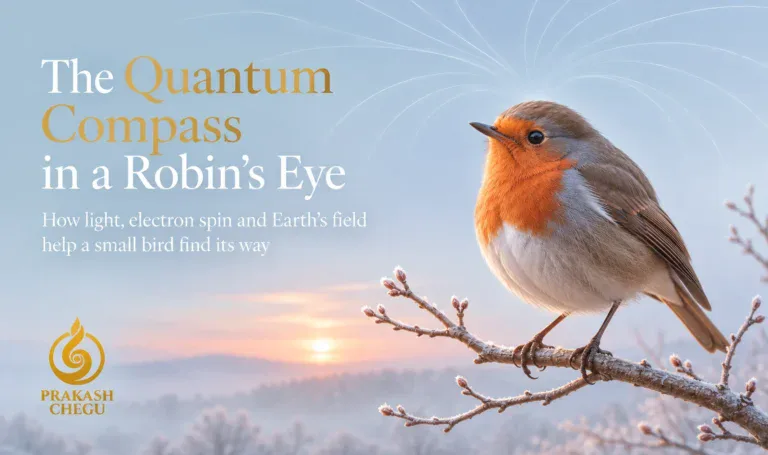
How light, electron spin, and Earth’s magnetic field may help a small bird find its way—and what this reveals about the limits of human perception.
Imagine looking at a tree and seeing something more than its branches, leaves, and movement in the wind.
Imagine that turning your head also changed a faint pattern across your field of vision—a pattern connected to the magnetic field of the planet beneath your feet.
For a European robin, something like this may be possible.
Researchers studying this small songbird have identified a light-sensitive protein whose chemistry responds to magnetic fields. Called cryptochrome 4, it is a leading candidate for the molecular compass that helps the bird orient during migration. The complete mechanism inside a living bird remains unresolved, but the evidence has opened an extraordinary window into the meeting place of physics and life. nature.com
A familiar bird on a branch may be responding to information that our own eyes cannot supply.
That possibility asks us to reconsider a habit so ordinary we rarely notice it: treating the world we perceive as the whole world available to perception.
A compass that works through chemistry
The bird at the center of this research is the European robin, Erithacus rubecula.
Its magnetic compass has an unusual property. It responds to the inclination of Earth’s magnetic field—the angle at which field lines pass through the bird’s surroundings—rather than reading magnetic polarity like the north-seeking needle of a conventional compass. Researchers describe this as an inclination compass, allowing the bird to distinguish poleward from equatorward directions.
Its operation also depends on suitable light conditions. Behavioral experiments have linked normal magnetic orientation to light in the ultraviolet-to-green range. These features helped direct scientists toward a light-driven chemical mechanism in the eye. PMC
The proposed sensor is a chemical process. Direction would become a difference in molecular behavior, which the nervous system could potentially interpret.
A compass also supplies only part of what a traveler needs. Knowing which way to head and knowing where you are are separate problems. Explaining this magnetic sense would therefore illuminate one component of navigation, rather than explain every aspect of migration.
The idea that arrived before the evidence
In 1978, Klaus Schulten, Charles Swenberg, and Albert Weller proposed that a radical-pair reaction could provide a biological magnetic compass.
Schulten had recognized a remarkable possibility: a magnetic field could influence the outcome of certain chemical reactions through its effect on electron spins. Perhaps an animal could use that sensitivity to obtain directional information.
The proposal met sharp skepticism. A historical account from Schulten’s research group records that Science rejected his submission before the work appeared in Zeitschrift für Physikalische Chemie.
The early proposal did not identify cryptochrome as the sensor. That connection came later. In 2000, Thorsten Ritz, Salih Adem, and Schulten published a model connecting a light-sensitive radical-pair system with a possible visual magnetic compass. ks.uiuc.edu
The chronology matters. A theoretical possibility, a candidate molecule, and an experimentally demonstrated biological mechanism are different achievements.
There is courage in proposing an unfamiliar explanation. There is equal discipline in spending decades asking whether it survives contact with reality.
This story contains both.
What cryptochrome actually does
Cryptochrome 4 is a protein found in the robin’s retina. Its proposed magnetic role involves a light-absorbing partner called flavin adenine dinucleotide, or FAD.
Absorbing blue light can initiate electron transfer within this molecular system. A sequence of tryptophan amino acids helps carry that transfer, producing radical pairs.
In this context, a radical is a chemical species with an unpaired electron. A radical pair consists of two such species formed through a linked process.
Light does not create electrons from nothing. It supplies energy that changes their arrangement and starts a reaction.
At Oldenburg, Jingjing Xu, working in Henrik Mouritsen’s group, produced the robin protein in bacterial cultures so researchers could study it in quantity. Oxford experimental groups led by Christiane Timmel and Stuart Mackenzie investigated its properties, alongside theoretical work involving Peter Hore and Ilia Solov’yov. uol.de
This was painstaking work across several disciplines. Behind the arresting phrase “quantum compass” were protein production, optical measurements, calculations, and carefully altered molecules.
Where quantum physics enters
Electrons possess a quantum property called spin.
The word invites us to imagine tiny balls rotating, but that picture is only a rough analogy. Spin is an intrinsic property with magnetic consequences.
For two unpaired electrons, the combined spin state affects which chemical reactions are possible. Scientists distinguish singlet and triplet states. Magnetic interactions can influence how a radical pair moves between these states, changing the balance of reaction products.
In a suitably arranged molecular system, that balance can depend on the orientation of the magnetic field.
Earth’s field would not need to supply the energy for the reaction. Light supplies the initial energy; the field can influence how an already active reaction proceeds. This distinction helps explain how a weak magnetic influence could become biologically relevant. PMC
The proposed sequence is elegant: light starts a reaction, magnetic interactions affect its outcome, and a biological signaling system could turn that difference into useful information.
The remarkable possibility is that an animal’s directional sense depends on these particular spin dynamics.
What the 2021 experiment established
In June 2021, Xu and colleagues published a major result in Nature.
They demonstrated that isolated European robin cryptochrome 4 was magnetically sensitive in laboratory experiments. Under the conditions tested, its response was stronger than that of the corresponding proteins from chickens and pigeons.
By altering specific amino acids, the researchers also investigated how electron-transfer pathways contributed to the magnetic effects. nature.com
This gave the hypothesis a substantial experimental foundation: a candidate molecule from a migratory bird showed the relevant kind of sensitivity.
The scope of the experiment is essential, however. The researchers examined isolated proteins and used magnetic fields stronger than Earth’s. Demonstrating magnetic sensitivity under those conditions did not establish that the protein provides the bird’s compass in its natural retinal environment. Oxford’s account of the work explicitly preserved that distinction. Oxford University
The result brought a long-standing possibility closer to a biological explanation. Completing that explanation requires connecting several scales: electron behavior, protein chemistry, retinal activity, brain processing, and the bird’s orientation.
Does a robin see quantum entanglement?
The phrase is irresistible. It is also misleading.
“Seeing quantum entanglement” suggests that the bird looks outward and perceives entanglement as an object or pattern in the environment.
The hypothesis concerns a quantum process occurring within a sensory molecule. Its possible consequence is information about magnetic direction.
Descriptions of radical-pair sensing involve correlated electron spins and coherent quantum evolution. Those concepts require care; neither amounts to evidence that the bird consciously observes entanglement itself. hore.chem.ox.ac.uk
A comparison helps. When we see a red flower, our experience is color and form. We do not directly experience the molecular changes inside our photoreceptors.
Likewise, if cryptochrome contributes to magnetic perception, a robin could receive a useful sensory signal without experiencing the underlying physics as physics.
The bird would not need a theory of quantum mechanics to benefit from a reaction governed by it.
What might magnetic direction look like?
One influential model proposes that magnetic information could modulate the bird’s visual system.
If light-sensitive molecules were sufficiently ordered within the retina, their chemical responses could vary across the eye according to the orientation of the magnetic field. The resulting differences might provide a spatial pattern that changes as the bird turns. Ritz, Adem, and Schulten explored this possibility in their 2000 model. pmc.ncbi.nlm.nih.gov
This is the basis for illustrations showing a bird’s ordinary view overlaid with bands, shading, or changing contrast.
Such images are visualizations of a hypothesis. They are not photographs of a robin’s subjective experience.
Even so, the possibility is astonishing. Magnetic direction might be integrated into perception so naturally that it is simply part of how the world appears to the animal.
We tend to imagine another creature’s world by subtracting from our own: fewer colors, less detail, less understanding.
The robin invites the opposite exercise.
What information might its world contain that ours leaves out?
The wooden huts and the missing direction
Another important chapter began with an experimental problem.
At the University of Oldenburg, European robins tested in wooden huts on the campus failed to show their expected magnetic orientation.
Researchers investigated electromagnetic noise in the surroundings. In a study published in Nature in 2014, Svenja Engels and colleagues reported that the birds regained magnetic orientation when the huts were screened with electrically grounded aluminum.
The screening reduced noise in a range extending from approximately 50 kilohertz to 5 megahertz by about a hundredfold. Removing the grounding, or generating broadband noise inside the shielded huts, disrupted orientation again. Birds tested away from sources of electromagnetic noise could orient without screening. The experiments used double-blind procedures. ora.ox.ac.uk
The wooden walls were not the explanation. Changing the electromagnetic conditions changed the birds’ ability to use their magnetic compass.
This is a powerful experimental clue because a radical-pair mechanism offers a physical basis for sensitivity to radiofrequency interference. It does not, by itself, identify the responsible protein.
Why the details of the interference matter
A follow-up study published in 2016 found that weak broadband electromagnetic noise disrupted the robins’ compass more effectively than several stronger narrow-band fields tested in the experiment.
The outcome makes a simple point: the biological effect cannot be understood from field strength alone. Frequency content and experimental conditions matter. The study also described screening that strongly attenuated time-varying fields while allowing the static geomagnetic field to remain. PMC
That is a more precise conclusion than saying that “electronics switch off birds’ navigation.”
These experiments examined a specific sensory behavior under defined conditions. Their results do not establish a corresponding injury or compass disruption in humans, nor do they settle the consequences for birds across every outdoor environment.
They do raise a serious ecological question: which human-made signals interfere with the sensory information other species use?
An environment can contain something consequential that our own senses never register.
The research has continued beyond 2021
The search has become more specific as researchers examine different forms of the protein and its possible signaling partners.
A 2025 study investigated two robin cryptochrome 4 variants, Cry4a and Cry4b. Cry4b did not bind FAD in the laboratory experiments, leading the authors to conclude that it was unlikely to provide the proposed radical-pair magnetic sensor. That result distinguishes the variants; it does not eliminate Cry4a as a candidate. University of Southern Denmark
In 2026, another study examined how Cry4a interacts with lipid membranes and a G-protein component from robin cone cells. The laboratory findings supported a possible molecular arrangement relevant to downstream signaling. Wiley Online Library
These developments address a crucial question: how could a magnetically sensitive chemical reaction become information available to a nervous system?
A responsive molecule alone is insufficient. A useful sense also needs organization, communication, and interpretation.
The work is moving into those connections.
What remains to be explained
The central challenge is to establish the causal chain in the living animal.
Does the relevant protein respond to Earth-strength fields in its natural environment? How is it held in an orientation that preserves directional information? How are small chemical differences amplified? Which cellular and neural signals carry the result?
The researchers’ own descriptions continue to treat cryptochrome as a candidate and the detailed mechanism as an active scientific problem. Oxford University+1
Keeping these questions open preserves the achievement already made.
Science can tell a compelling story while leaving the ending unwritten. In fact, the unanswered questions are often where the most interesting work begins.
We can admire the evidence without forcing it to say more than it does.
A reflection on perception and the unseen
For those of us drawn to contemplative practice, the robin offers a valuable invitation.
Its magnetic sense does not need to serve as proof of an ancient teaching. It already gives us something worth contemplating: our experience of reality depends on the sensory equipment through which we meet it.
There is a difference between something being absent and something being unavailable to our perception.
That distinction can deepen humility. It can also sharpen discernment. The existence of an unfamiliar animal sense gives us a reason to investigate particular possibilities carefully; it does not make every claim about invisible forces equally credible.
Wonder becomes more useful when it increases our attention.
In meditation, we may discover that a familiar experience contains details we usually overlook: the texture of breathing, a habitual tension, the moment an impulse begins, the space before a reaction.
That is a reflection on human experience, rather than a claim that meditation activates the robin’s molecular compass.
The connection is an attitude of inquiry.
What becomes available when we look more patiently? What have we mistaken for the limits of reality when we were encountering the limits of our attention—or of our instruments?
The meaning of an inner compass
There is also a human metaphor here, provided we hold it as a metaphor.
People often describe confusion as losing their inner compass. They may be surrounded by advice, obligations, fear, and competing desires while struggling to identify the direction they can actually live with.
The robin experiments do not explain that experience. But the image of a useful signal obscured by interference offers a thoughtful question:
What conditions help me recognize what matters?
For one person, the answer may involve rest. For another, an honest conversation, time outdoors, a daily practice, or the willingness to acknowledge an unwelcome truth.
We can explore those questions without attaching quantum terminology to them.
The scientific discovery and the personal reflection each retain their own meaning. Together, they can encourage a more attentive relationship with life.
Returning to the bird on the branch
Look again at the European robin: the orange breast, the fine beak, the dark and watchful eye.
Research has brought us close enough to ask whether light-driven electron chemistry within that eye helps the bird use the magnetic field of an entire planet.
There is still a bridge to complete between the molecule in the laboratory and the animal finding its direction.
Yet even the unfinished account changes how we look.
A small bird becomes a meeting place of sunlight, chemistry, sensory biology, and planetary magnetism.
We may never know exactly what its world feels like from within. We can still learn to approach that world with greater care.
And the next time a robin turns its head, we might pause a little longer before deciding that we know everything it has seen.
Frequently Asked Questions
How does a robin see the Earth’s magnetic field?
Researchers studying the European robin have identified a light-sensitive protein, cryptochrome, whose chemistry appears to respond to magnetic fields. The leading idea is that as light hits the bird’s eye it triggers reactions whose outcome is subtly influenced by the direction of Earth’s magnetic field, possibly letting the bird perceive something like a faint pattern across its vision that shifts as it turns its head. In effect, the compass may be partly in the eye.
Is this actually quantum physics, or just a metaphor?
It leans on real quantum behavior, not just poetry. The proposed mechanism involves pairs of electrons whose quantum states are sensitive to magnetic fields, the kind of delicate effect we would normally expect to vanish in something as warm and messy as a living body. That it might persist inside a bird is exactly what makes it so remarkable, a meeting place of quantum physics and biology.
Do scientists fully understand how bird navigation works?
Not yet, and I think that honesty is part of the wonder. Cryptochrome is a leading candidate for the molecular compass, and the evidence is genuinely exciting, but the complete mechanism inside a living, migrating bird remains unresolved. It is an open window rather than a closed case, a reminder of how much extraordinary machinery is still hidden in the ordinary life around us.