Why Becoming More Is Not the Same as Becoming Different
In modern culture, the word growth is everywhere.
Personal growth. Business growth. Spiritual growth. Financial growth.
We are constantly encouraged to grow.
And while growth is valuable, there is a deeper process that is often overlooked:
Evolution.
Growth and evolution are not the same thing.
Understanding the difference between them can change how you approach your life, your work, your relationships, and your spiritual journey.
What Is Growth?
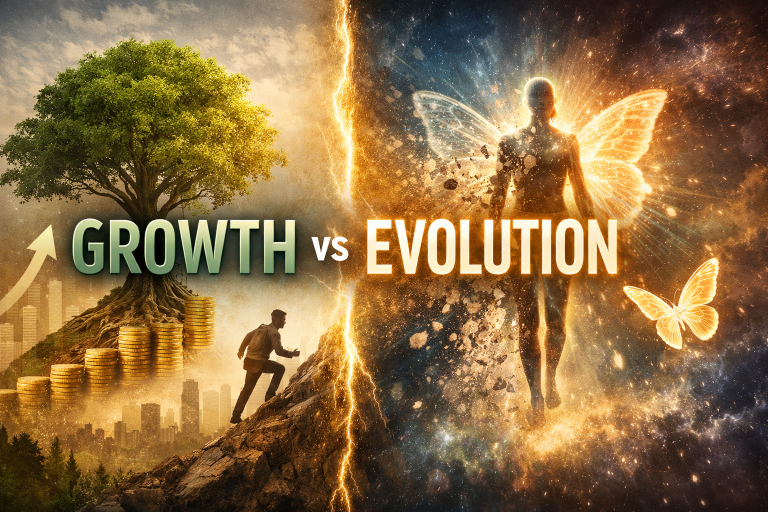
Growth is expansion within an existing structure.
Something becomes bigger, stronger, faster, or more capable—but its fundamental nature remains the same.
A child grows into an adult.
A tree grows taller and wider.
A company grows its revenue.
A person grows their skills.
Growth improves what already exists.
It strengthens the current system.
Growth often looks like:
-
more knowledge
-
more income
-
more strength
-
more experience
-
more efficiency
-
more capability
But the underlying identity usually remains unchanged.
A person may grow in intelligence, but still operate from the same beliefs.
A company may grow in size but still function with the same culture.
A relationship may grow in time but remain trapped in the same patterns.
Growth makes things bigger.
But it does not necessarily make them different.
What Is Evolution?
Evolution is something far more profound.
Evolution is a change in form, structure, or nature.
When evolution occurs, the old identity dissolves and a new one emerges.
A caterpillar does not grow into a bigger caterpillar.
It becomes a butterfly.
That is evolution.
Evolution involves:
-
transformation
-
restructuring
-
identity shift
-
new levels of consciousness
-
new ways of interacting with reality
Where growth adds to what exists, evolution replaces it.
Growth Is Comfortable. Evolution Is Disruptive.
Growth is generally predictable.
You improve a skill.
You gain more experience.
You expand your capabilities.
The system stays stable.
Evolution, however, often feels chaotic.
Evolution requires the death of the familiar.
Old beliefs collapse.
Old identities dissolve.
Old environments may no longer fit.
This is why evolution can feel uncomfortable, confusing, or even frightening.
But it is also the doorway to the most meaningful transformations in life.
Why Many People Grow But Never Evolve
Most people spend their entire lives growing.
They improve their skills.
They accumulate knowledge.
They gain experience.
But they never fundamentally transform how they see the world.
This happens because evolution requires something most people avoid:
Radical self-examination.
Evolution asks questions like:
-
Who am I if I let go of my old identity?
-
What beliefs have been shaping my life unconsciously?
-
What patterns am I repeating?
-
What am I afraid to question?
Growth can happen through repetition.
Evolution requires awareness.
Without awareness, people simply repeat the same patterns in slightly improved forms.
A person might:
-
earn more money but stay emotionally immature
-
build a larger business but remain internally insecure
-
age into their 60s but never become wiser
Growth without evolution creates bigger versions of the same problems.
Evolution Requires a Break From the Known
One of the defining characteristics of evolution is that it requires stepping beyond the known.
Every major turning point in human history reflects this.
Agriculture replaced hunting and gathering.
Science replaced superstition.
New ideas replaced outdated systems.
At an individual level, evolution works the same way.
It requires:
-
questioning what you previously believed
-
confronting uncomfortable truths
-
letting go of identities that once defined you
Evolution is rarely comfortable.
But comfort has never been the engine of transformation.
The Spiritual Dimension of Evolution
Many spiritual traditions emphasize evolution over simple growth.
In yogic philosophy, spiritual development is not about accumulating knowledge alone.
It is about awakening consciousness.
A person may read hundreds of books about meditation and spirituality.
That is growth.
But when someone directly experiences stillness, awareness, and expanded perception—something changes in their very being.
That is evolution.
Spiritual evolution is not an accumulation of ideas.
It is a shift in how reality is experienced.
Growth Builds Capacity. Evolution Changes Direction.
Growth increases your capabilities.
Evolution changes how you use them.
Someone might grow their communication skills, confidence, and leadership ability.
But evolution occurs when they begin using those abilities to serve something larger than themselves.
Growth strengthens the vehicle.
Evolution changes the destination.
When Growth and Evolution Work Together
The most powerful transformation happens when growth and evolution support each other.
Growth provides the tools.
Evolution provides the vision.
For example:
A person may grow their discipline through daily practice.
Over time, that discipline leads them to a deeper realization about their purpose.
Growth prepared them.
Evolution transformed them.
Without growth, evolution lacks structure.
Without evolution, growth lacks meaning.
The Question That Defines Your Life
At some point, every person encounters a choice.
Do I simply grow within the life I already know?
Or do I allow myself to evolve into something entirely new?
Growth improves the existing path.
Evolution creates a new one.
Both are valuable.
But if you want to experience the deepest levels of transformation, fulfillment, and purpose, growth alone is not enough.
Because at the highest levels of human development, the real journey is not about becoming more.
It is about becoming different.
And that is the essence of evolution.