
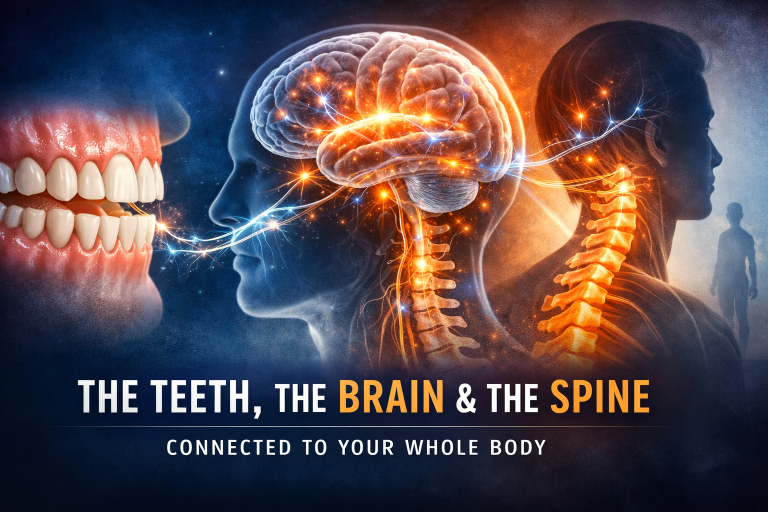
How the Mouth Influences Posture, Balance, and the Entire Body
Most people think of teeth as simple tools for chewing food. They help break down nutrition so digestion can begin. Once that job is done, their role seems finished.
But the reality is far more complex.
Your teeth are not passive structures. They are deeply connected to the nervous system and play a subtle but powerful role in how your entire body organizes itself.
Teeth function as sensory organs that constantly communicate with the brain. Through the jaw, they influence posture, muscle tone, balance, and even the alignment of the spine. When the bite—known as occlusion—is balanced, the body tends to organize itself efficiently. When the bite is disturbed, the consequences can ripple throughout the entire system.
Understanding this relationship reveals an important truth: the mouth is not separate from the body. It is part of an integrated neurological and structural network.
Teeth: A Sensory Interface With the Brain
Inside the ligaments that anchor your teeth into the jawbone are thousands of tiny sensory receptors.
These receptors are incredibly sensitive. They can detect changes in pressure smaller than a grain of sand between the teeth. This sensory information is constantly sent to the brain through the trigeminal nerve, one of the largest and most influential nerves in the human body.
This information helps the brain regulate:
• Jaw position
• Muscle tension in the face and neck
• Head orientation
• Bite pressure during chewing
• Balance and spatial awareness
Every time your teeth come together, the nervous system receives data that helps determine how the muscles around the head and neck should behave.
In other words, the teeth act like biological sensors guiding how the upper body organizes itself.
The Jaw: A Bridge Between the Mouth and the Spine
The jaw joint, known as the temporomandibular joint (TMJ), is one of the most neurologically complex joints in the body.
It sits directly beneath the skull and connects to numerous muscles that influence:
• the face
• the neck
• the shoulders
• the upper spine
Because of this connection, even small imbalances in the bite can alter how the jaw rests in the joint. When the jaw position changes, surrounding muscles begin compensating.
These compensations can gradually influence the alignment of the head and neck.
And when the head shifts position, the entire spine often adjusts in response.
The body is constantly trying to maintain balance and stability. If the bite introduces asymmetry, the musculoskeletal system may adapt around that imbalance.
Over time, this can manifest as:
• chronic neck tension
• headaches
• jaw pain
• shoulder tightness
• uneven posture
• lower back discomfort
In some cases, the root cause of these issues is not located where the pain appears. The origin may be in the mouth.
Occlusion: The Hidden Influence on Posture
Occlusion refers to how the upper and lower teeth come together when the mouth closes.
When occlusion is balanced, the jaw sits comfortably in the joint and muscle tension remains relatively symmetrical.
But if the bite is misaligned—even slightly—the body may unconsciously shift the head or neck to compensate.
This shift may be small at first. Yet over years, small adjustments can accumulate into larger structural changes.
Research in postural dentistry and neuromuscular dentistry suggests that bite discrepancies may contribute to:
• spinal asymmetry
• muscular compensation patterns
• chronic tension in the cervical spine
• altered walking patterns
In simple terms:
the mouth can influence the posture of the entire body.
The Role of Teeth in Balance
One of the lesser-known functions of the teeth is their contribution to balance and spatial awareness.
The brain maintains equilibrium using three primary information sources:
-
The inner ear (vestibular system)
-
Vision
-
Proprioception from muscles and joints
The jaw and teeth contribute to this third category.
Because the trigeminal nerve is closely connected to the brainstem—where balance and motor coordination are regulated—information from the teeth helps the brain determine how the head is positioned in space.
This means your bite can subtly influence:
• head orientation
• muscle coordination
• postural reflexes
Some studies even show measurable changes in athletic performance and balance when occlusion is altered.
When the Bite Is Off
When the bite becomes imbalanced, the nervous system often attempts to compensate.
This can occur due to:
• dental work that slightly changes the bite
• missing teeth
• teeth grinding (bruxism)
• orthodontic changes
• jaw injuries
• chronic stress affecting jaw tension
The body is remarkably adaptable. It will often compensate for these changes without obvious symptoms for years.
But eventually, the accumulated tension may appear elsewhere in the body.
People may experience symptoms such as:
• headaches or migraines
• jaw clicking or pain
• neck stiffness
• chronic shoulder tension
• postural instability
• unexplained muscle fatigue
In some cases, addressing the bite alignment can relieve symptoms that seemed unrelated to the mouth.
The Body Is One Integrated System
Modern medicine has often divided the body into specialties—dentistry, neurology, orthopedics, physiotherapy.
But the body itself does not operate in isolated compartments.
The mouth, the nervous system, the muscles, and the spine are part of a single integrated network.
What happens in one part of the system can influence the entire structure.
Your bite is not just about aesthetics or chewing efficiency.
It is part of the neurological architecture that organizes your posture and movement.
A Broader Perspective on Health
This understanding invites a broader perspective on health.
When someone experiences chronic pain or postural dysfunction, the origin is not always where the symptoms appear.
Sometimes the source lies in overlooked places—like the jaw.
Integrative approaches that consider:
• dental alignment
• posture
• nervous system regulation
• breathing patterns
• muscular balance
often reveal connections that conventional approaches miss.
The human body is an intelligent system that constantly adapts to maintain equilibrium.
And sometimes, the smallest structures—like the teeth—play a far larger role than we imagine.
Final Thought
The teeth are not just tools for chewing.
They are part of a complex sensory network that communicates with the brain, stabilizes the head, and helps organize posture throughout the body.
When the bite is balanced, the body often functions with greater efficiency and stability.
When it is not, the consequences can ripple through the jaw, neck, spine, and beyond.
Health, ultimately, is not about isolated parts.
It is about the harmony of the entire system.
And sometimes, that harmony begins with something as simple—and as overlooked—as your bite.