
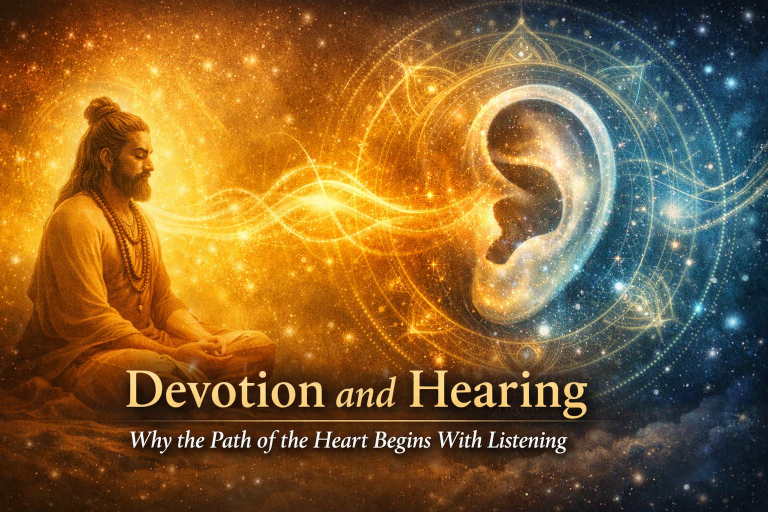
In a world that constantly encourages us to speak, post, react, and express opinions, the deeper spiritual traditions of humanity point toward something radically different.
They suggest that transformation does not begin with speaking.
It begins with listening.
This idea may sound simple, yet it carries profound implications. Across ancient traditions—from the Vedic path of Bhakti Yoga to Christian contemplative practice, Sufi mysticism, and Buddhist chanting—hearing plays a central role in devotion.
The relationship between devotion and hearing is not merely poetic or symbolic. It exists at several levels:
• spiritual
• psychological
• neurological
• energetic
To understand devotion more deeply, we must first understand the sacred role of listening.
The First Step of Devotion Is Hearing
In the Vedic tradition, devotion is described through the concept of Navadha Bhakti, the nine expressions of devotion.
The first of these is Śravaṇa — sacred listening.
The nine forms include:
-
Śravaṇa — hearing the divine teachings or stories
-
Kīrtana — chanting or speaking them
-
Smarana — remembering
-
Pāda-sevana — service
-
Archana — ritual worship
-
Vandana — reverence
-
Dāsya — servitude to the divine
-
Sakhya — friendship with the divine
-
Ātma-nivedana — complete surrender
What is remarkable is that devotion does not begin with prayer or worship.
It begins with hearing.
Before the heart can love something deeply, it must first be touched by it. Listening is how this touch happens.
This is why spiritual traditions historically relied on oral transmission. For thousands of years, sacred knowledge was not read from books. It was heard from a teacher.
Hearing was not passive. It was considered a sacred act.
The Meaning of Śruti: Divine Knowledge Is Heard
The Sanskrit word Śruti means that which is heard.
This term refers to the highest category of sacred knowledge in the Vedic tradition, including the Vedas themselves.
This linguistic detail reveals something profound:
Truth is not invented by the mind.
Truth is received through listening.
A person who is devoted is not necessarily someone who believes strongly. A devoted person is someone who listens deeply enough to allow truth to enter them.
Devotion therefore begins not with belief, but with receptivity.
Hearing Is the Most Receptive Sense
Consider the difference between seeing and hearing.
Seeing is an active process.
We choose where to look.
We analyze what we see.
Hearing is different.
Sound enters us whether we want it to or not. Even when we close our eyes, we continue to hear. Hearing is therefore one of the most receptive senses.
This mirrors the nature of devotion itself.
Devotion is not an act of control.
Devotion is an act of allowing.
To listen deeply requires humility. It requires us to suspend judgment and become receptive to something greater than ourselves.
In this sense, listening becomes a spiritual practice.
The Nervous System of Devotion
Modern neuroscience offers an interesting perspective on why sound is so powerful in devotional states.
The vagus nerve, one of the most important nerves in the body, connects several key systems involved in emotional regulation:
• the ears
• the voice
• the heart
• the breath
This network plays a major role in states of safety, connection, and trust.
When we enter devotional practices involving sound—such as chanting, prayer, or sacred music—the nervous system begins to shift.
Breathing slows.
Heart rhythms synchronize.
Brainwaves calm.
This creates a physiological state associated with:
• emotional openness
• bonding
• reverence
• awe
In other words, sound literally prepares the body for devotion.
This may explain why every spiritual culture on Earth incorporates sacred sound in some form.
The Power of Sacred Sound
Across cultures, devotion has always been expressed through sound:
• Vedic mantra chanting
• Gregorian chants
• Sufi qawwali
• Buddhist sutra recitation
• Gospel singing
Why is sound so universal in spiritual practice?
Because sound has a unique ability to bypass the analytical mind.
When we listen to sacred sound deeply, something shifts internally. The mind becomes quieter, and the heart becomes more receptive.
This is why devotional chanting often creates powerful emotional experiences. People may feel tears, peace, gratitude, or a sense of connection to something larger than themselves.
These experiences are not accidental. They arise because sound reorganizes our internal rhythms.
Inner Hearing: The Deeper Dimension of Devotion
Beyond external sound lies a subtler form of listening.
Many mystical traditions speak of inner sound.
In yogic philosophy this is known as Nāda, the primordial sound current. Advanced meditators describe hearing subtle internal sounds when the mind becomes deeply still.
These are sometimes referred to as:
• Anāhata Nāda — the unstruck sound
• the inner vibration of Om
• the subtle sound of consciousness itself
While this may sound mystical, the principle is simple: when the mind becomes quiet enough, it begins to perceive subtler layers of experience.
Devotion naturally leads to this quietness because the ego softens and the heart opens.
Listening becomes not just something we do with the ears, but something we do with our entire being.
The Symbolism of the Ear in Spiritual Traditions
Many sacred traditions symbolize wisdom through large ears.
Perhaps the most recognizable example is the depiction of the Buddha, whose elongated ears represent deep listening and compassion.
The message is clear:
Wisdom does not come from speaking the most.
Wisdom comes from listening the deepest.
A person who truly listens becomes capable of understanding life at a much deeper level.
Devotion as Radical Listening
When we bring all of these ideas together, a simple insight emerges.
Devotion is not merely emotional love toward the divine.
Devotion is radical listening.
It is the willingness to listen:
• to truth
• to the wisdom of life
• to the voice of the heart
• to the subtle guidance within
When we listen deeply enough, something interesting happens.
The constant argument with life begins to dissolve.
Instead of resisting reality, we begin to cooperate with it.
This cooperation is what many traditions call surrender.
The Devotional Equation
We could express devotion almost like a formula:
Devotion = Attention + Receptivity
Listening trains both of these qualities.
When we truly listen:
• the ego softens
• the mind becomes quiet
• the heart becomes open
In that openness, devotion arises naturally.
It is not forced. It is not performed.
It simply unfolds.
Returning to the Sacred Art of Listening
In modern life, we are surrounded by noise, information, and constant stimulation. The art of listening has become increasingly rare.
Yet the spiritual traditions remind us that listening is not a weakness.
It is a gateway to transformation.
When we listen deeply—to sacred teachings, to music, to nature, or to the quiet voice within—something inside us begins to reorganize.
We become less reactive and more receptive.
Less distracted and more present.
Less fragmented and more whole.
And in that quiet space of deep listening, devotion naturally awakens.
Because ultimately, devotion is nothing more than the heart learning how to listen to existence itself.