Bharata’s vow, the flight of Pushpaka, and the story we remember when we light a Diwali lamp.
Fourteen years is a long time to keep someone’s sandals.
Bharata could have put them away. He could have ruled from Ayodhya and told himself that the kingdom needed a king who was present. He had ministers to advise him, citizens to protect, and fourteen years in which to grow accustomed to being obeyed. Instead, he took Sri Rama’s sandals to Nandigrama and governed with them before him. When his brother returned, Bharata would have something to hand back.
That is the scene I think about when I light a lamp for Diwali. By the time Rama is ready to leave Lanka, Ravana has fallen. Sita and Lakshmana are with him. Vibhishana wants him to stay and receive the hospitality he has earned. But Rama is thinking of the brother who came to find him in the forest and of the words they exchanged at Chitrakuta. What can one more day possibly matter after fourteen years? To Bharata, it matters as much as all the years that came before it.
The promise at Chitrakuta
Bharata had gone to Chitrakuta to ask Rama to come home. Their father, Dasharatha, had died. The throne was available to Bharata because of the boons his mother, Kaikeyi, had claimed. Bharata wanted Rama to take it. Rama held to the term of exile because their father had given his word. The brothers agreed about who should rule Ayodhya, and they had to find a way to care for the kingdom while Rama was away.
Bharata asked Rama to place his feet on a pair of sandals and give them to him. He would live outside the city, wear bark, keep his hair matted, and subsist on fruits and roots. He would govern with Rama’s pādukās as the sign of whose authority he was exercising. Then he told Rama what would happen if he failed to see him when the term of exile ended: Bharata vowed to enter the fire if Rama was even one day late. That vow is why a single day matters so much at the end of the story.
Did Rama walk back to Ayodhya?
Vibhishana offers Rama baths, fine clothes, and ornaments after the war. Rama asks him to offer the hospitality to Sugriva and his companions instead. Bharata, he says, has been living in hardship because of him. The road to Ayodhya is long and difficult, and Rama asks how they can get there quickly. Vibhishana replies:
अह्ना त्वां प्रापयिष्यामि तां पुरीं पार्थिवात्मज ।
“Prince, I will bring you to that city in a day.”
The means is the Pushpaka Vimāna, the flying conveyance that Ravana had seized from Kubera. Rama boards with Sita and Lakshmana. Sugriva and the vānaras join them, as does Vibhishana. The Sanskrit gives us Vibhishana’s promise of speed, and the chapters that follow give us the actual scenes of travel, including a stop in Kishkindha and a night at Bharadvāja’s hermitage. A single line about how fast Pushpaka can go leaves out much of what happens on the way home.
What Rama shows Sita from the sky
From Pushpaka, Rama points out the places where he searched for Sita. He shows her Nala’s bridge across the sea. He shows her Rishyamuka, where he made his alliance with Sugriva, and Pampa, where he says he grieved in her absence. At Janasthana he recalls Jatayu, who fought Ravana for her sake. He shows her the leaf hut from which she was taken. At Chitrakuta he remembers Bharata coming to ask him to return.
There is something intimate about seeing these places through the conversation of two people who were separated. Sita knows what happened when Ravana took her. Rama knows what it was like to come back and find her gone. At Pampa, he could have told her about his next move in the search. Instead, he tells her how deeply he grieved. She can finally hear what her absence was like for him.
A name written in the sky
At the very beginning of the Rāmāyaṇa, a father fixes his son’s coronation for the nakṣatra Pushya. The Bāla Kāṇḍa gives Pushya as Bharata’s birth nakṣatra. And now, after fourteen years, the same name appears in a message addressed to Bharata — Hanuman announces that tomorrow, under Pushya, Bharata will see Rama. At the beginning, a father says his son will be anointed tomorrow. At the end, a messenger says a brother will see his brother tomorrow.
When I read the Rāmāyaṇa with an eye for Jyotiṣa, that echo is what draws me back. Dasharatha’s chosen time opens a story he cannot control. Hanuman’s announcement comes after years in which the brothers have had to act without knowing how events would turn out. Before they can stand together under Pushya, one has to finish his exile and the other has to be ready to return the sandals. The sky gives the reunion a time. The brothers have made the reunion possible.
Did Rama return on Diwali?
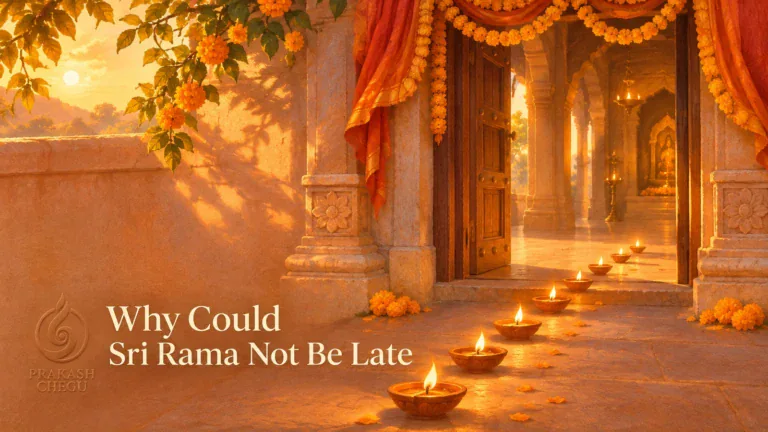
In a widely told North Indian tradition, the people of Ayodhya light rows of lamps to welcome Rama, Sita, and Lakshmana home. In Valmiki’s own chapters, the welcome is given with flags, garlands, conches, and drums; the rows of diyas and the association with Kārttika Amāvasyā belong to the living festival telling. What the Sanskrit gives us is Pañcamī at the hermitage and Pushya for the reunion.
The lamp gives a household a way to take part in a homecoming it could otherwise only hear about. You put oil into a small clay vessel, set the wick, and carry it to the entrance where someone coming toward the house can see it. That last detail matters to me. A lamp at the threshold is meant to be seen by the person who is still outside. Other families tell the festival through Lakshmi, through Krishna and Narakasura, or through other traditions handed down in their communities. The lamp at an Ayodhya doorway is one of the ways Deepavali has carried the Rāmāyaṇa into people’s homes.
Eight places for a Rāmāyaṇa yātrā
Several places named in the poem have traditional counterparts that pilgrims can visit today. These associations show where the episodes are remembered.
| Episode or landmark | Where it is remembered today | What to read there |
|---|---|---|
| Nala Setu and the sea crossing | Rameswaram and Dhanushkodi, Tamil Nadu | The building of Nala’s bridge over five days; Rama points it out to Sita from Pushpaka. |
| Kishkindha | The Hampi–Anegundi region, Karnataka | Sita asks to bring Tara and the other vānaras’ wives to Ayodhya. |
| Rishyamuka and Pampa | The hills and Pampa Sarovar near Anegundi, Karnataka | Where Rama allied with Sugriva and later recalls his grief in Sita’s absence. |
| Panchavati and Janasthana | Nashik, Maharashtra | Rama points out the site associated with Jatayu and the place from which Sita was taken. |
| Chitrakuta | Chitrakoot, on the Uttar Pradesh–Madhya Pradesh border | The exchange of the sandals and Bharata’s vow, remembered at the Bharat Milap temple. |
| Bharadvāja’s hermitage | Bharadvāja Ashram, Prayagraj, Uttar Pradesh | Rama reaches the hermitage on Pañcamī and sends Hanuman ahead. |
| Shringaverapura | Shringverpur, Prayagraj district, Uttar Pradesh | Hanuman gives Guha news of his friend Rama on the way to Bharata. |
| Nandigrama and Ayodhya | Bharat Kund in Nandigram and the city of Ayodhya, Uttar Pradesh | Bharata returns the pādukās at the reunion; the party then proceeds into Ayodhya. |
What Bharata gives back
When Pushpaka lands, Bharata greets Rama, and Rama draws him close. Bharata greets Sita and Lakshmana and embraces the companions who helped bring them home. Then he takes the sandals and places them at Rama’s feet. He uses the word nyāsa for the kingdom — something that was placed in his care and that he can now return.
What stays with me is how long Bharata had to exercise authority before he could give it back. Anyone who has cared for something in another person’s absence knows how easily “I’m looking after this” becomes “this is mine.” People come to you with problems. You get good at solving them. One day you realize the arrangement you once called temporary has become part of how you see yourself. Bharata has fourteen years for that to happen. When the time comes, he knows exactly where the sandals belong.
Rama, meanwhile, has come as quickly as he could, and his first act when Bharata comes close is to embrace him. Before the brothers speak of the kingdom, they get to be brothers again. Whenever I hear the story of the lamps, I think of that moment just outside Ayodhya, when the person who had waited so long finally had someone to put his arms around.
When I light a diya this Deepavali, I want to remember both sides of that welcome. There is someone doing all he can to come home in time. And there is someone who has spent fourteen years making sure there is still a place for him when he arrives.
Shubh Deepavali.
— Prakash Chegu
Frequently Asked Questions
What vow is this story centered on?
It centers on Bharata’s vow during Rama’s fourteen-year exile. Rather than rule Ayodhya as king himself, Bharata placed Sri Rama’s sandals on the throne and governed in his name from Nandigrama — holding the kingdom in trust. He vowed to return it the moment Rama came back, which is why Rama’s timely return mattered so deeply.
Why couldn’t Rama be even a single day late?
Because Bharata had reportedly vowed to end his own life if Rama did not return by the appointed day — making punctuality a matter of life and devotion, not mere schedule. Rama’s urgency to return exactly on time reflects the weight of a brother’s love and sacrifice, and the dharmic importance of honoring one’s word.
How does this connect to Diwali?
Rama’s return to Ayodhya after Ravana’s defeat — arriving home exactly as promised — is the homecoming celebrated at Diwali, when lamps are lit to welcome him. The piece links the festival’s lamps to Bharata’s faithful waiting and Rama’s honoring of his word, making Diwali a celebration of devotion, dharma, and the light of a promise kept.