Independence can feel profoundly empowering at first.
Especially when you have spent much of your life feeling powerless in relationships—disappointed by people, hurt by them, controlled by them, or repeatedly unable to have your needs understood and met.
Perhaps you learned early that asking for help led to rejection.
Perhaps the people you depended upon were inconsistent, emotionally unavailable, overwhelmed, or simply unable to offer the safety you needed.
Perhaps you became the responsible one—the person who solved the problems, carried the emotional weight, remained composed, and found a way forward when everyone else fell apart.
At some point, independence stopped being merely a strength. It became a strategy for survival.
You began telling yourself:
“I’m better off alone.”
“I don’t need anyone.”
“People are too much.”
“Needing someone makes me weak.”
“It is safer to handle everything myself.”
These beliefs may have helped you reclaim a sense of power. They may have protected you from further disappointment and given you the strength to rebuild your life.
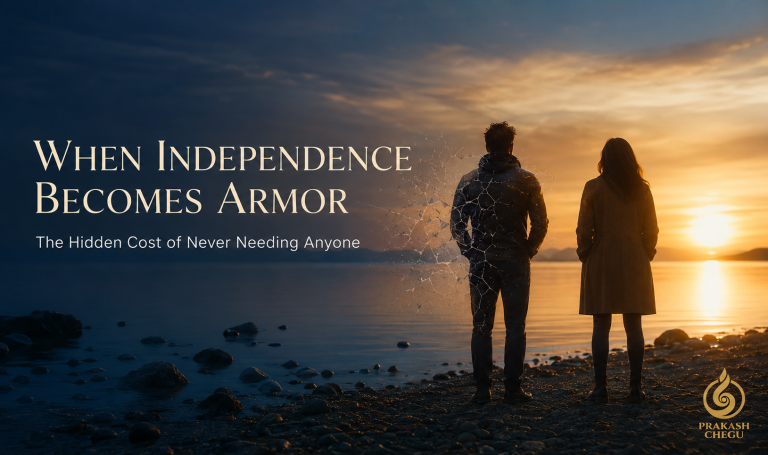
But sometimes, what begins as empowerment eventually becomes armor.
And armor protects the heart—but it also prevents the heart from being touched.
The Difference Between Independence and Hyper-Independence
Healthy independence is the ability to stand within yourself.
It allows you to make decisions, take responsibility for your life, regulate your emotions, honor your boundaries, and remain connected to your own values even when others disagree with you.
Healthy independence says:
“I can care for myself, and I can also allow others to care for me.”
“I can stand alone when necessary, but I do not have to live alone emotionally.”
“I am responsible for my life, but I do not have to carry everything by myself.”
Hyper-independence is different.
Hyper-independence is often independence driven by fear. It is the compulsive need to avoid relying on anyone because dependence has become associated with danger, disappointment, humiliation, control, or abandonment.
It may look like strength from the outside. You may appear highly capable, resilient, self-contained, and emotionally composed. People may admire how much you manage without assistance.
Yet beneath that competence there may be a quieter belief:
“If I need someone, they will have power over me.”
“If I trust them, they will eventually disappoint me.”
“If I receive from them, I will owe them something.”
“If I reveal my needs, they may use those needs against me.”
“If I let myself become attached, losing them will destroy me.”
Hyper-independence is not an absence of need. It is the suppression of need.
It does not mean that connection no longer matters to you. It often means that connection matters so much—and has hurt so deeply—that part of you has decided it would be safer to pretend that you do not need it at all.
When Self-Reliance Becomes a Coping Mechanism
There is nothing wrong with being capable.
There is nothing wrong with enjoying solitude, protecting your peace, creating a life you love, or refusing to remain dependent upon people who continually diminish you.
The question is not whether you can take care of yourself.
The deeper question is whether you can also receive.
Can you ask for help without feeling ashamed?
Can you allow someone to support you without immediately trying to repay them?
Can you express a need without apologizing for having it?
Can you trust another person with something meaningful?
Can you remain open when closeness begins to feel vulnerable?
Can you distinguish between genuinely unsafe people and the discomfort that naturally accompanies intimacy?
When the answer is repeatedly no, independence may no longer be a free choice. It may have become a protective response.
We often imagine avoidance as running away. But avoidance can also look like exceptional competence.
It can look like staying perpetually busy.
It can look like becoming the person everyone relies upon while never allowing yourself to rely upon anyone.
It can look like offering endless support but becoming uncomfortable when someone attempts to support you.
It can look like choosing emotionally unavailable partners because their distance allows you to remain protected.
It can look like leaving as soon as you begin to care.
It can even look like spiritual detachment when, underneath the language of nonattachment, there is an unacknowledged fear of being deeply seen.
“I Don’t Need Anyone” Is Not Always Freedom
There is a form of solitude that nourishes the soul.
It gives us space to hear ourselves, regulate our energy, reconnect with our inner guidance, and remember who we are beyond the expectations of others.
But isolation is not the same as solitude.
Solitude is chosen from fullness. Isolation is often chosen from protection.
Solitude restores your capacity for connection. Isolation gradually convinces you that connection is impossible, unnecessary, or unsafe.
“I don’t need anyone” can initially feel like a declaration of freedom. But when repeated long enough, it can quietly become a prison.
You may feel more in control when you do not need anyone. No one can disappoint you if you expect nothing. No one can abandon you if you never fully attach. No one can reject your needs if you never express them.
But control always has a cost.
If you eliminate the possibility of disappointment, you may also eliminate the possibility of being supported.
If you protect yourself from rejection, you may also prevent yourself from being chosen.
If you never risk relying upon another person, you may never experience the healing that comes from discovering that someone can, in fact, remain.
The Nervous System Remembers
Hyper-independence is not always a conscious philosophy. It can be a pattern held within the nervous system.
Your mind may desire intimacy while your body interprets it as danger.
You may genuinely want a loving partnership, a nourishing community, or deeper friendships. Yet when people come close, your system may become activated.
You may feel restless, trapped, irritated, suspicious, or suddenly overwhelmed. You may begin finding reasons why the relationship cannot work. You may withdraw, become emotionally unavailable, or convince yourself that you were happier before the person arrived.
This does not necessarily mean the relationship is right for you. Discernment remains essential.
But sometimes the discomfort is not intuition telling you to leave. Sometimes it is an old protective pattern reacting to an unfamiliar experience of closeness.
If your nervous system learned that relationships were unpredictable, it may experience healthy consistency as strange.
If you learned that receiving always came with conditions, unconditional care may make you suspicious.
If love was intertwined with control, you may interpret another person’s interest as an attempt to take away your freedom.
If your needs were ignored, mocked, or punished, you may no longer know how to communicate them without feeling exposed.
The body remembers what the conscious mind has tried to move beyond.
This is why healing hyper-independence requires more than simply deciding to “open up.” The protective system within you must gradually learn that connection can exist without self-abandonment.
When Everything Becomes “Me,” It Is Difficult to Build a “We”
A strong relationship cannot be built by two people disappearing into each other. But neither can it be built by two people refusing to need each other.
There must be a meeting place.
A “we” is not created when one person sacrifices everything while the other remains unchanged. That is not interdependence; it is imbalance.
But a “we” also cannot emerge when both people protect their individual lives so fiercely that neither is willing to make room for the relationship.
Love requires permeability.
It requires the willingness to be affected by another person without surrendering your entire center.
It requires adjustments, conversations, compromises, boundaries, and mutual consideration. It requires us to understand that another person’s needs matter without believing that their needs must control us.
When everything becomes about “me”—my schedule, my comfort, my independence, my preferences, my protection—it becomes increasingly difficult to build a shared life.
A relationship cannot survive on proximity alone. It needs mutual investment.
A tribe cannot be created by people who only arrive when it is convenient.
A community cannot flourish when everyone wishes to receive belonging but no one is willing to contribute presence.
Over time, hyper-independence can leave us isolated, lonely, vulnerable, and carrying far too much by ourselves—not because nobody cares, but because we have made it nearly impossible for care to reach us.
Human Beings Are Not Designed to Be Islands
Human beings are relational by nature.
Our nervous systems are constantly communicating. We read facial expressions, tone of voice, posture, rhythm, silence, and presence. A calm, trustworthy person can help our body settle. A loving touch can soften defenses that words cannot reach. Being witnessed without judgment can bring movement to places within us that have remained frozen for years.
This does not make us weak. It makes us human.
We affect one another.
We regulate and dysregulate one another.
We wound one another, but we can also become part of one another’s healing.
There are experiences that solitary work can prepare us for, but cannot replace. You may learn to love yourself, but there is still something transformative about allowing another person to love you. You may learn to validate your own feelings, but being deeply understood by someone else remains profoundly healing.
Healing does not mean reaching a state in which you never need anyone again.
Healing means your needs no longer make you powerless.
The Goal Is Empowered Interdependence
The alternative to hyper-independence is not powerless dependence.
It is not abandoning your boundaries, outsourcing your emotional stability, or expecting another person to rescue you.
The goal is empowered interdependence.
Interdependence means two whole people choosing to participate in each other’s lives.
It means:
“I can stand on my own feet, and I can still reach for your hand.”
“I can take responsibility for my emotions without pretending your actions have no effect on me.”
“I can ask for what I need while accepting that you retain the freedom to respond.”
“I can receive without becoming indebted.”
“I can love you without abandoning myself.”
“I can allow this relationship to matter without making it the sole source of my identity.”
Empowered interdependence preserves both freedom and belonging.
It allows us to have boundaries without building walls. It allows us to need others without surrendering our agency. It allows us to participate in relationships from choice rather than fear.
A healthy “we” does not erase the “I.” It gives the “I” somewhere meaningful to belong.
Receiving Is Also a Spiritual Practice
Many people are comfortable giving because giving allows them to remain in control.
The giver decides what to offer, how much to offer, and when to offer it. Receiving requires a different kind of openness.
To receive is to acknowledge that something can come toward you that you did not create entirely by yourself.
It asks you to soften.
It asks you to trust.
It asks you to tolerate the vulnerability of being cared for.
Receiving may be one of the deepest spiritual practices for the hyper-independent person.
You can begin with small moments.
Allow someone to carry something for you.
Accept the compliment without deflecting it.
Say yes when a trustworthy friend offers assistance.
Tell someone that you are having a difficult day before you have already solved the problem.
Ask for something clearly without minimizing your need.
Notice the impulse to say, “It’s fine, I’ll do it myself,” and pause long enough to ask whether that response comes from genuine preference or old protection.
You do not have to tear down every wall at once. Safety is built through consistent experiences, not dramatic declarations.
Learning to Need Without Losing Yourself
If relying upon people has felt unsafe, the solution is not to begin trusting everyone indiscriminately.
Healing does not require naivety.
Discernment remains sacred.
Not everyone deserves access to your vulnerability. Not everyone has the capacity to meet you with care. Some relationships genuinely are unsafe, inconsistent, manipulative, or exploitative. Boundaries are not the enemy of connection; they are what make safe connection possible.
The work is to stop treating all closeness as though it carries the same danger.
You can learn to recognize the difference between a person who violates your boundaries and a person who gently challenges your defenses.
You can learn the difference between losing control and allowing collaboration.
You can learn the difference between dependence and intimacy.
You can learn that asking does not guarantee receiving, but neither does an unmet request diminish your worth.
Most importantly, you can learn that needing someone does not mean losing yourself.
Begin With Curiosity, Not Judgment
If connection, closeness, receiving, needing, or relying upon other people has felt unsafe, confusing, or difficult, there is probably a reason.
You did not become hyper-independent because something was wrong with you.
At some point, your independence protected something tender.
It may have helped you survive a childhood in which your needs were overlooked. It may have carried you through a painful relationship. It may have enabled you to rebuild after betrayal, abandonment, or disappointment.
Honor the intelligence of that protection.
And then gently ask whether you still need it in the same form.
What am I afraid will happen if I need someone?
What did receiving mean in my early relationships?
Do I confuse support with control?
Do I choose people who confirm my belief that I must do everything alone?
Do I communicate my needs clearly, or silently hope people will anticipate them?
When someone shows up consistently, do I soften—or begin searching for reasons to withdraw?
What would safe, mutual support actually look like for me?
These questions are not meant to force you into connection. They are invitations to understand what has been standing in the way of it.
You Were Never Meant to Carry Everything Alone
Strength is not measured by how little you need.
Maturity is not the complete absence of vulnerability.
Healing is not the ability to remain untouched by everyone.
Real strength is the capacity to remain rooted in yourself while participating fully in relationship. It is knowing that you can survive disappointment without organizing your entire life around avoiding it. It is allowing love, friendship, community, and support to matter—even when they cannot be perfectly controlled.
You are allowed to need closeness.
You are allowed to desire a tribe.
You are allowed to want someone beside you.
You are allowed to be capable and still become tired.
You are allowed to hold others and sometimes be held.
Your need for connection is not a weakness, a failure, or a problem you should have already outgrown. It is part of your humanity. It deserves your attention, your compassion, and your care.
Independence may have helped you find yourself.
Interdependence allows the self you found to enter the world, participate in love, and build something meaningful with others.
The goal was never to become an island.
The goal is to become a sovereign human being who can stand firmly on the earth—and still remain open enough to belong.