Deep beneath the restless surface of the ocean, one of Earth’s longest-lived animals quietly transformed seawater into glass—layer by microscopic layer, century after century.
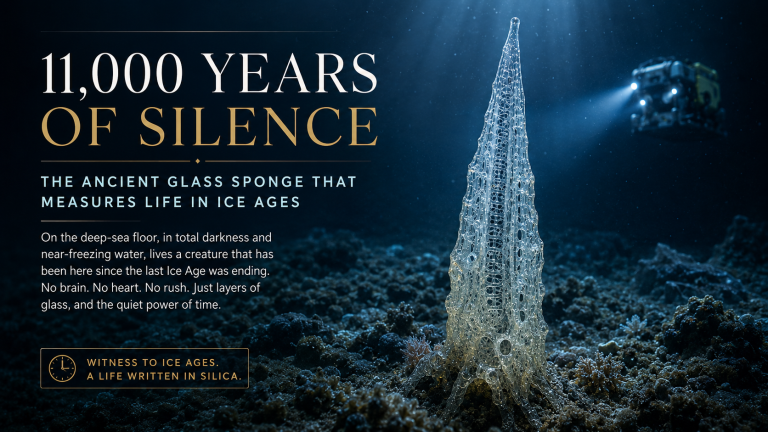
On the deep-sea floor, far beyond the reach of sunlight, stands something that looks less like an animal than a translucent spear planted in the sediment.
It has no face.
No eyes.
No brain.
No heart.
No muscles.
It cannot walk, hunt, call for a mate, protect its offspring, or flee from danger.
Yet one specimen associated with this extraordinary structure was estimated to have lived for approximately 11,000 years.
Its name is Monorhaphis chuni, a deep-sea glass sponge whose enormous silica spicule can preserve a chemical record of the ocean across thousands of years.
When this sponge began growing, the last Ice Age was ending.
The planet was warming.
Glaciers were retreating.
Sea levels were rising.
Human communities were adapting to a rapidly changing world, while some populations of woolly mammoths still survived in the far north.
Civilizations rose and disappeared.
Languages were born and forgotten.
Forests advanced across newly exposed land.
Coastlines moved.
Entire human histories unfolded.
And in the darkness beneath the ocean, the sponge continued growing.
It filtered seawater.
It extracted dissolved silica.
It added another almost imperceptible layer to its skeleton.
Then another.
And another.
Not for decades.
Not for centuries.
But potentially for millennia.
Some animals measure their lives in years.
This one appears to have measured its life in the rise and fall of ice ages.
An Animal Made of Living Tissue and Glass
Despite its strange appearance, Monorhaphis chuni is an animal.
It belongs to a group known as glass sponges, or hexactinellids, whose skeletons are constructed from silica—the same basic material associated with quartz and ordinary glass.
Glass sponges typically inhabit deep, cold marine environments. Their skeletal structures can be extraordinarily intricate, forming delicate lattices, branching frameworks, and needle-like spicules that appear almost architectural.
But Monorhaphis chuni is especially remarkable.
Its body develops around one enormous basal spicule: a single glass-like rod that can reach several meters in length. The lower portion anchors the animal into soft seafloor sediment, while the living sponge tissue surrounds part of the structure above it.
This immense spicule is not deposited all at once.
It grows gradually through the addition of extremely thin concentric layers of silica.
Imagine a tree building a trunk through annual rings—but far more slowly, beneath thousands of feet of seawater, using dissolved minerals drawn from the ocean.
Over time, the living tissue may retreat from older portions of the spicule while continuing to grow farther along it. The exposed glass rod remains behind like a skeletal history of the animal’s existence.
Within those layers, chemical signatures become trapped.
The skeleton therefore does more than support the sponge.
It remembers the ocean.
How Scientists Estimated an Age of 11,000 Years
Scientists cannot simply count birthdays in an animal that has been growing since before recorded history.
Nor do the layers in its spicule necessarily correspond to neat annual rings in the way many tree rings do.
Instead, researchers analyzed chemical variations preserved along the sponge’s giant silica structure. They examined indicators associated with the temperature and composition of the seawater in which the spicule formed.
By comparing the chemical record within the sponge to known changes in deep-ocean conditions since the end of the last glacial period, researchers estimated that the examined specimen had a lifespan of roughly 11,000 years, with an uncertainty of several thousand years.
That uncertainty matters.
Science does not establish the sponge’s age by reading a perfect date stamped inside the skeleton. It reconstructs the most plausible history from chemical evidence, growth patterns, environmental records, and biological structure.
The animal may not have been exactly 11,000 years old.
But the evidence places its existence on a timescale almost impossible to comprehend.
Later research on additional Monorhaphis chuni spicules produced estimated ages ranging from several thousand to well over 10,000 years. These specimens also showed extraordinarily slow radial growth.
The sponge does not build its glass skeleton in visible daily or seasonal leaps.
It grows in fractions of millimeters across centuries.
To a human observer, it would appear almost motionless.
But motionlessness is not the same as lifelessness.
Beneath that apparent stillness, water is moving, cells are functioning, nutrients are being processed, and silica is becoming architecture.
A Creature Without a Brain, Heart, or Muscles
To understand how extraordinary this is, we must first release our usual definition of an animal.
We often associate animal life with movement.
Animals run, swim, fly, hunt, mate, compete, communicate, and defend themselves.
Sponges do none of these things in the familiar sense.
Adult sponges are sessile, meaning they remain attached to one location. Their bodies are built around channels through which seawater circulates. Specialized cells help move water, capture microscopic food particles, exchange gases, remove waste, and maintain the body.
A sponge does not need a heart because water flows directly through its tissues.
It does not need lungs because oxygen can diffuse from the surrounding seawater.
It does not need a digestive tract because cells capture and process nutrients internally.
It does not need muscles to chase food because food comes to it.
The sponge lives through permeability.
It survives not by pursuing the world, but by allowing the world to pass through it.
Every day, seawater carries oxygen, microbes, organic particles, minerals, and chemical information through the sponge’s body.
It takes what it needs.
It releases what it does not.
And then the water continues on.
There is something almost meditative in this biology.
The sponge does not conquer its environment.
It participates in it.
The Deep Ocean Never Rushes
The environment inhabited by Monorhaphis chuni is profoundly different from the world on land.
At great depths, sunlight disappears completely.
Temperatures remain cold.
Pressure becomes immense.
The dramatic daily fluctuations familiar at the surface are greatly reduced.
There is no dawn illuminating the seafloor.
No sunset signaling the end of the day.
No summer heat or winter frost in the ordinary terrestrial sense.
Food may be limited, currents may shift, and the deep ocean is not entirely free of disturbance. But compared with many surface environments, it can remain remarkably stable over long periods.
Life there must adjust to scarcity.
When energy arrives slowly, it cannot be spent carelessly.
Many deep-sea organisms grow slowly, mature slowly, and operate with metabolic strategies suited to cold conditions and limited food availability.
For a creature such as Monorhaphis chuni, speed may offer little advantage.
There is nowhere to run.
Nothing to chase.
No sunlight toward which it must climb.
Its success depends on remaining anchored, maintaining its filtering system, repairing damage, and continuing to grow whenever conditions permit.
The deep ocean does not reward urgency.
It rewards endurance.
Longevity Through Radical Slowness
Human beings often imagine longevity as the result of increased power.
A stronger heart.
A faster metabolism.
Greater physical capacity.
Sharper cognition.
More intense intervention.
But many of the longest-lived organisms on Earth follow a very different strategy.
They conserve.
They grow slowly.
They inhabit stable environments.
They avoid unnecessary expenditure.
Their biology appears to favor maintenance over acceleration.
A Greenland shark may live for centuries while swimming slowly through cold northern waters.
An ocean quahog can remain buried in sediment for hundreds of years.
Bristlecone pines survive for millennia in harsh mountain landscapes where growth is exceptionally slow.
Certain clonal organisms may persist even longer by continuously renewing portions of themselves.
And the glass sponge adds another form of longevity to this strange collection.
It does not achieve endurance through domination.
It achieves endurance through minimalism.
Its life is reduced to a few essential processes repeated with extraordinary consistency:
Filter.
Absorb.
Build.
Repair.
Remain.
Perhaps this is one reason its existence feels so unsettling to the human imagination.
We have been taught to associate life with visible activity.
The sponge suggests that life can also be almost perfectly quiet.
Its Skeleton Is a Climate Archive
The giant glass spicule is not merely evidence of the animal’s age.
It is also a record of environmental change.
As the sponge deposits silica, the chemistry of the surrounding seawater influences the material incorporated into the growing skeleton. Scientists can examine different regions of the spicule and study variations associated with past ocean conditions.
In this sense, the sponge resembles a natural archive.
Ice cores preserve ancient atmospheres.
Tree rings preserve seasonal changes in temperature and rainfall.
Corals record marine chemistry.
Cave formations preserve traces of precipitation and climate.
Sediment layers preserve biological and geological history.
And the skeleton of Monorhaphis chuni may preserve a timeline written by the deep ocean itself.
The sponge becomes both organism and observatory.
Its body existed within history while simultaneously recording it.
It experienced environmental changes too gradual for any individual human to witness. It lived through temperature shifts, changes in ocean chemistry, and the transition from glacial conditions toward the modern Holocene world.
Every layer of glass became a page.
Every chemical variation became a sentence.
The animal did not know it was keeping a record.
It simply lived.
Yet thousands of years later, scientists learned how to read the silence.
What the Sponge Witnessed
Eleven thousand years is difficult for the human mind to hold.
Our sense of time evolved around days, seasons, generations, and individual lifetimes.
A century feels historical.
A millennium feels ancient.
Eleven millennia begins to feel geological.
When the sponge was young, the world was emerging from the final phases of the last glacial period.
Large ice sheets still shaped parts of the Northern Hemisphere.
Coastlines looked different because so much water had previously been locked in ice.
As glaciers melted, oceans rose and flooded vast stretches of land.
Human communities already existed across multiple continents, including the Americas. Some cultivated plants, formed settlements, developed tools, exchanged materials, created art, buried their dead, and adapted to shifting climates.
Over the sponge’s lifetime, agriculture expanded.
Villages became cities.
Kingdoms became empires.
The pyramids were built.
Bronze and iron transformed societies.
Religions spread.
Trade routes crossed continents.
Ships crossed oceans.
Science began mapping the laws of nature.
Industrialization altered the atmosphere.
Human beings reached the Moon.
Digital signals began circling the planet.
All of this occurred during what may have been one continuous lifespan.
The sponge remained below.
Not untouched by planetary change, but removed from the human drama unfolding above it.
It did not know the names of emperors.
It did not recognize borders.
It did not distinguish one civilization from another.
It registered history differently.
As temperature.
As mineral concentration.
As water chemistry.
As another microscopic layer of glass.
Perhaps Aging Is Partly the Cost of Constant Adaptation
The longevity of a glass sponge cannot be translated directly into a formula for human health.
We are radically different organisms.
We possess complex organs, highly active nervous systems, warm-blooded metabolism, reproductive cycles, emotional bonds, memory, movement, and consciousness.
We cannot live like deep-sea sponges, nor should we attempt to romanticize an existence without thought, sensation, relationship, or choice.
Still, the sponge raises a compelling question:
How much of aging is connected not merely to time, but to the biological cost of repeatedly adapting to instability?
Every organism must preserve internal order while responding to its environment.
In human beings, repeated stress activates hormonal, immune, cardiovascular, and neurological responses. These responses are essential for survival, but when they remain active too frequently or for too long, they can contribute to cumulative physiological strain.
Modern life exposes the body to forms of stimulation that rarely stop.
Artificial light interrupts darkness.
Notifications interrupt attention.
Noise interrupts rest.
Deadlines interrupt natural rhythm.
Information arrives faster than it can be meaningfully processed.
Social comparison travels with us through our devices.
Work enters the bedroom.
News enters the nervous system from every continent.
The body is asked to respond continually, even when no physical action can resolve what it is witnessing.
The deep-sea sponge occupies the opposite extreme.
Its environment changes slowly.
Its metabolism is conservative.
Its existence is repetitive.
Its body is not required to reinvent itself every morning.
Perhaps its longevity is supported not by a secret molecule, but by the absence of unnecessary urgency.
Stillness Is Not the Absence of Life
Modern culture often treats stillness as failure.
If we are not moving forward, we fear we are falling behind.
If growth is not visible, we assume nothing is happening.
If a season produces no external achievement, we call it wasted.
But the sponge reveals another model of growth.
Its most important work occurs microscopically.
A layer too thin to notice is added.
Then another.
For a hundred years, the difference may appear insignificant.
Across a thousand years, architecture emerges.
This is how many meaningful forms of transformation occur.
Healing often begins before symptoms change.
Trust grows through small acts repeated over time.
Skill develops through practice that appears ordinary.
Roots deepen while the surface remains still.
Character is shaped by choices no audience applauds.
The absence of visible movement does not mean life has stopped.
Sometimes it means life is building structure.
The sponge does not bloom.
It does not announce its progress.
It simply continues depositing the next layer.
The Difference Between Stillness and Stagnation
Yet the lesson of the sponge is not that we should become passive.
Stillness and stagnation are not the same.
Stagnation refuses change.
Stillness creates enough space to meet change without being destroyed by it.
The sponge is not inert.
It filters water continuously.
Its cells exchange nutrients and gases.
Its body responds to its surroundings.
Its skeleton grows.
Its apparent stillness contains constant biological participation.
Human stillness can work in the same way.
Meditation is not an escape from life. It is the cultivation of attention within life.
Rest is not the abandonment of purpose. It is part of the physiology that makes sustained purpose possible.
Silence is not emptiness. It can be the environment in which perception becomes clear.
Slowness is not laziness. It can be precision without panic.
The sponge does not teach us to do nothing.
It teaches us to stop confusing agitation with aliveness.
The Yogic Intelligence of Conservation
Yogic traditions have long recognized that life energy can be gathered or scattered.
When attention is constantly pulled outward, the mind becomes fragmented.
When the breath is shallow and irregular, the nervous system remains unsettled.
When desire multiplies without discernment, energy is consumed by endless pursuit.
The purpose of yoga is not merely to make the body flexible.
At its deepest level, yoga cultivates integration.
Breath, body, mind, and awareness are brought into relationship.
Internal fluctuations begin to settle.
Effort becomes more intelligent.
Energy no longer leaks in every direction.
Patanjali’s description of yoga points toward the stilling of mental fluctuations—not the destruction of thought, but freedom from being controlled by every thought that appears.
The Sanskrit principle of sthira refers to steadiness, stability, and grounded presence.
This is not rigid stillness.
It is living steadiness.
A tree possesses sthira while its leaves move.
A mountain possesses sthira while weather passes over it.
A meditator possesses sthira while sensations, emotions, and thoughts arise and dissolve.
And in its own biological way, Monorhaphis chuni embodies this principle.
It remains anchored while the ocean moves through it.
It is stable without being closed.
Permeable without being swept away.
Responsive without being frantic.
The Wisdom of an Anchored Life
The sponge’s single giant spicule holds it in place.
Without that anchoring structure, its delicate body could not maintain its position within the moving water.
Human beings also need anchors.
Not anchors that prevent growth, but structures that allow growth to continue without constant disorientation.
A regular sleep rhythm.
Time in silence.
A stable spiritual practice.
A nourishing home.
Honest relationships.
Work aligned with meaning.
Contact with nature.
A body that feels safe enough to rest.
Values that remain steady when circumstances change.
Without such anchors, every external current can become a crisis.
We begin rebuilding our identity in response to each opinion, disappointment, trend, invitation, conflict, or fear.
The sponge does not ask the ocean to stop moving.
It simply develops a structure strong enough to remain rooted within movement.
Perhaps resilience is not the ability to control every current.
Perhaps it is the ability to remain connected to ourselves while the currents pass.
We Have Made Speed a Moral Virtue
Modern society rarely treats speed as a neutral tool.
We treat it as evidence of worth.
Faster communication.
Faster delivery.
Faster learning.
Faster healing.
Faster productivity.
Faster transformation.
Even rest has become optimized.
We track sleep to improve output.
We meditate to become more efficient.
We take vacations so we can return to work with greater capacity.
The underlying command remains the same:
Do more.
Become more.
Produce more.
And do it quickly.
But life does not always honor speed.
Pregnancy takes time.
Grief takes time.
Trust takes time.
The nervous system takes time to relearn safety.
Forests take time to regenerate.
Wisdom takes time to ripen.
A glass sponge takes centuries to add a fraction of thickness to its skeleton.
Yet over millennia, that almost invisible growth becomes one of the largest biological silica structures on Earth.
Nature is full of processes that cannot be hurried without being damaged.
Perhaps human beings are among them.
Longevity Is Not the Same as Living
There is also an important caution within this story.
The goal of life cannot be reduced to duration alone.
A life is not automatically meaningful because it is long.
Human beings require more than biological survival.
We need intimacy, purpose, creativity, challenge, contribution, play, beauty, and love.
We need seasons of intensity as well as seasons of rest.
We need the courage to change when stability becomes confinement.
The glass sponge should not become an argument for avoiding the world.
It should become a reminder that endurance requires rhythm.
Human life is not meant to remain in perpetual darkness and stillness.
But neither is it meant to remain in perpetual acceleration.
We need both movement and rest.
Expression and silence.
Expansion and consolidation.
Risk and refuge.
The wisdom lies not in choosing one forever, but in knowing when each is required.
What This Ancient Animal May Be Asking Us
The sponge cannot offer advice.
It has no philosophy.
It did not choose simplicity as a spiritual path.
Its longevity emerged through biology, habitat, evolutionary history, and environmental circumstance.
Yet when human consciousness encounters something this ancient, meaning naturally gathers around it.
The sponge confronts us with questions we rarely pause long enough to ask.
What are we spending our lives reacting to?
How much of our exhaustion comes from genuine necessity, and how much comes from environments designed to keep us stimulated?
What would happen if we protected darkness as carefully as we pursue light?
What if consistency mattered more than intensity?
What if growth did not need to be visible to be real?
What if rest were not a reward granted after depletion, but part of the architecture that prevents depletion?
What if we stopped trying to become a new person every week and instead added one honest layer at a time?
What if longevity begins not only with what we consume, but with what we no longer allow to consume us?
Add the Next Layer
You may not have 11,000 years.
None of us knows how much time we have.
But perhaps that is not the point.
The lesson of Monorhaphis chuni is not simply to live longer.
It is to live with less unnecessary friction.
To become more deliberate about what enters our internal waters.
To create conditions in which repair can occur.
To stop demanding that every season produce visible evidence of progress.
To understand that a quiet life is not necessarily a small life.
To build something slowly enough that it becomes part of our structure.
You do not have to transform everything today.
You do not have to heal an entire history in one season.
You do not have to answer every question immediately.
You do not have to chase every current.
You may only need to remain anchored.
To filter what comes toward you.
To take in what nourishes you.
To release what does not.
And to add the next layer.
Then, when another day arrives, add another.
A breath.
A practice.
A boundary.
A page.
A prayer.
A moment of rest.
A small act of courage.
A return to what matters.
The deepest forms of growth may be nearly invisible while they are happening.
But over time, they become architecture.
Far beneath the moving surface of the world, an ancient glass sponge once remained rooted in darkness as eras passed above it.
It did not hurry.
It did not announce itself.
It simply continued.
And within its delicate skeleton, it left behind a message written without words:
Time does not only take things away.
When life is given enough steadiness, time can also build.