
Most conversations about skin aging begin and end with one word: collagen.
We’re told to drink collagen powders, apply collagen creams, or search for treatments that promise to stimulate collagen production. The implication is simple: more collagen equals younger skin.
But human biology tells a far more fascinating story.
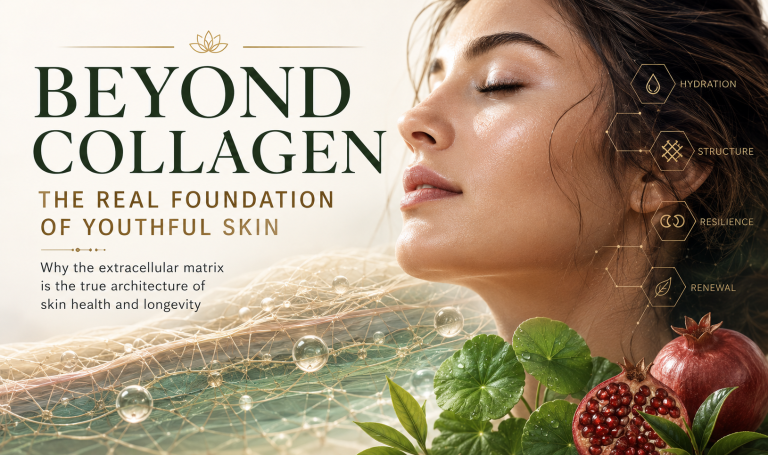
Collagen is undeniably important. It provides tensile strength, structural support, and mechanical resilience to the skin. Yet collagen is not suspended in empty space. It exists within an extraordinarily sophisticated living environment called the extracellular matrix (ECM)—a dynamic, fluid-filled architecture that determines whether collagen can actually function the way it was designed.
In many ways, collagen is like the steel framework inside a skyscraper. Steel alone cannot create a stable building. It depends upon concrete, support beams, flexible joints, hydraulic systems, and an engineered foundation working together as one integrated structure.
Your skin follows the same principle.
Youthful skin is not simply the presence of collagen.
It is the presence of a healthy extracellular matrix.
The Living Architecture Beneath Your Skin
Beneath the visible surface of the epidermis lies the dermis—a remarkable biological scaffold responsible for firmness, elasticity, hydration, and resilience.
Inside this layer, collagen fibers are woven into an intricate three-dimensional network surrounded by an abundant gel-like substance composed of:
- Hyaluronic acid
- Glycosaminoglycans (GAGs)
- Proteoglycans
- Elastic fibers
- Structural glycoproteins
- Water and dissolved minerals
Together these components form the extracellular matrix.
Far from being passive filler, the ECM functions as a living environment where cells communicate, nutrients diffuse, waste products are removed, and structural proteins remain organized.
One of its most remarkable properties is its ability to bind enormous quantities of water.
Hyaluronic acid, one of the matrix’s principal molecules, can retain many times its own weight in water. This hydration generates turgor pressure—the subtle internal fullness that keeps skin smooth, plump, and resistant to compression.
When you gently press youthful skin, it springs back almost immediately because this hydrated matrix distributes mechanical forces evenly throughout the tissue.
Without that matrix, collagen alone cannot maintain volume.
Collagen Needs an Environment to Thrive
Collagen is often described as the body’s strongest structural protein.
That description is accurate.
But strength without organization has little value.
Imagine scattering steel beams randomly across a construction site.
The material is present.
The building is not.
Collagen depends on its surrounding environment to determine:
- Fiber alignment
- Hydration
- Elastic recoil
- Mechanical stability
- Cellular signaling
- Structural organization
The extracellular matrix provides this environment.
When it remains healthy, collagen fibers stay properly aligned, hydrated, and interconnected.
When the matrix deteriorates, collagen becomes fragmented, disorganized, and mechanically ineffective—even if some collagen remains.
The visible result is what we recognize as aging.
Aging Begins Long Before Wrinkles
Most people associate aging with wrinkles.
But wrinkles are often one of the final visible expressions of a much deeper biological process.
Long before fine lines appear, the matrix begins changing.
Water-binding capacity declines.
Elastic fibers become fragmented.
Communication between cells becomes less efficient.
Structural proteins lose their orderly arrangement.
As these microscopic changes accumulate, the skin gradually loses its ability to resist gravity, repetitive facial movement, and daily mechanical stress.
You may first notice this in surprisingly ordinary moments.
Perhaps pillow lines remain etched into your face long after you wake.
Perhaps your cheeks seem slightly flatter than they did a few years ago.
Maybe your jawline feels softer, or the skin beneath your eyes appears thinner despite maintaining the same body weight.
These changes often reflect alterations in the extracellular matrix long before dramatic collagen loss occurs.
Fibroblasts: The Architects of Healthy Skin
At the center of this entire system are specialized connective tissue cells called fibroblasts.
If collagen represents the bricks of a building, fibroblasts are the architects, engineers, and construction workers combined.
These remarkable cells continuously produce:
- Type I collagen
- Type III collagen
- Elastin
- Hyaluronic acid
- Proteoglycans
- Various extracellular matrix proteins
Every day fibroblasts repair tiny injuries, replace aging proteins, reorganize structural fibers, and maintain the hydrated environment that allows the skin to remain resilient.
Healthy skin is therefore never static.
It is constantly rebuilding itself.
Even in adulthood, your dermis remains an active construction site.
The Necessary Role of Matrix Metalloproteinases
Construction alone is never enough.
Old materials must also be removed.
This responsibility belongs to a family of zinc-dependent enzymes known as matrix metalloproteinases (MMPs).
Although they are sometimes portrayed as harmful, MMPs are essential for normal tissue health.
Their primary role is quality control.
They selectively remove damaged collagen, fragmented elastin, and worn extracellular proteins, allowing fibroblasts to replace them with newly synthesized structures.
Healthy skin depends upon this continuous cycle:
Old proteins removed.
New proteins synthesized.
Architecture maintained.
Problems arise only when this balance is disrupted.
When Balance Becomes Breakdown
Throughout life, the skin is exposed to countless environmental stressors.
Ultraviolet radiation.
Air pollution.
Smoking.
Chronic psychological stress.
Inflammation.
Sleep deprivation.
Poor nutrition.
Excessive sugar intake.
Oxidative stress.
These factors activate inflammatory signaling pathways inside skin cells.
Fibroblasts begin slowing their production of collagen and hyaluronic acid.
Meanwhile, inflammatory mediators dramatically increase MMP activity.
Instead of performing careful maintenance, these enzymes begin aggressively degrading healthy structural proteins.
The balance shifts.
Destruction outpaces renewal.
Even newly synthesized collagen becomes fragmented before it can integrate into the surrounding matrix.
Gradually the once-organized scaffold becomes mechanically unstable.
Hydration declines.
Elasticity weakens.
Volume diminishes.
Wrinkles deepen.
The face begins reflecting not merely collagen loss, but architectural failure.
Why Hydration Means More Than Drinking Water
Many people assume skin hydration simply depends upon drinking enough water.
Hydration certainly matters.
But the skin’s ability to retain water depends even more upon the integrity of its extracellular matrix.
Hyaluronic acid, proteoglycans, and glycosaminoglycans function like microscopic molecular sponges.
They attract and hold water within the dermis.
This internal reservoir creates hydrostatic pressure that supports collagen fibers from every direction.
When these molecules decline, tissues become mechanically dehydrated—even if overall body hydration remains adequate.
Think of a sponge.
A healthy sponge absorbs water and remains firm.
An old sponge loses its internal structure and collapses despite being immersed in water.
The extracellular matrix behaves similarly.
The Emerging Science of Matrix Preservation
Because researchers increasingly recognize that aging reflects a failure of the extracellular matrix, attention has shifted toward compounds capable of supporting fibroblast activity while moderating excessive matrix degradation.
Several botanical compounds have attracted significant scientific interest.
Gotu Kola (Centella asiatica)
For centuries, Ayurvedic medicine has revered Gotu Kola as a rejuvenating rasayana.
Modern investigations have identified bioactive triterpenoids such as asiaticoside, madecassoside, and asiatic acid, which appear to influence pathways involved in extracellular matrix maintenance.
Rather than acting simply as an antioxidant, these compounds have been studied for their relationship with fibroblast activity and the synthesis of structural proteins that help preserve dermal architecture.
Its traditional reputation as a skin-supportive herb is increasingly being explored through the lens of modern connective tissue biology.
Pomegranate (Punica granatum)
Pomegranate contains an exceptionally rich profile of polyphenols, particularly punicalagins and ellagic acid.
These phytochemicals have attracted attention for their antioxidant properties and their interactions with cellular pathways involved in oxidative stress.
Healthy fibroblasts require an environment relatively protected from chronic inflammatory signaling.
By helping reduce oxidative burden, pomegranate’s phytochemicals may contribute to maintaining the conditions under which fibroblasts continue performing their restorative functions.
Rather than merely protecting collagen directly, the fruit appears to support the environment in which collagen is continually renewed.
Green Tea (Camellia sinensis)
Green tea’s most extensively studied catechin, epigallocatechin gallate (EGCG), has become one of the most researched plant polyphenols in dermatological science.
EGCG has been investigated for its interaction with oxidative stress pathways, inflammatory signaling, and enzymes involved in extracellular matrix remodeling.
While no single botanical can halt aging, green tea represents one example of how plant chemistry may help support the biological systems responsible for preserving structural integrity over time.
Beauty Begins Long Before the Mirror
Perhaps one of the most profound lessons from connective tissue biology is that beauty is not something applied to the surface.
It emerges from the vitality of deeper living systems.
Every wrinkle has a biochemical history.
Every change in elasticity reflects millions of microscopic cellular decisions occurring long before they become visible.
The face becomes a mirror of the extracellular matrix beneath it.
When that matrix remains hydrated, organized, nourished, and continuously renewed, the skin reflects resilience.
When that architecture deteriorates, no topical product alone can completely restore what has been lost.
The Ayurvedic Perspective
Long before collagen was discovered, Ayurveda viewed healthy skin as an expression of systemic vitality rather than isolated cosmetic appearance.
Radiance was considered the visible manifestation of Rasa Dhatu, the body’s primary nourishing fluid, and Ojas, the subtle essence associated with resilience, immunity, and longevity.
From this perspective, dry, fragile, prematurely aging skin reflects depletion occurring throughout the organism rather than merely on its surface.
Interestingly, this ancient philosophy aligns remarkably well with modern extracellular matrix biology.
Both recognize that healthy tissue depends upon nourishment, hydration, circulation, balance, and continual renewal.
Youth is not created by replacing isolated components.
It emerges when the entire living system remains coherent.
Beyond Collagen
Collagen deserves its reputation as one of the body’s most important structural proteins.
But collagen alone is not the secret to youthful skin.
The real foundation lies beneath it.
It lies within the extracellular matrix—a living network that provides hydration, organization, mechanical support, biochemical communication, and the dynamic environment that allows collagen to remain functional.
Perhaps the future of healthy aging is not asking,
“How can I produce more collagen?”
Perhaps the better question is,
“How can I preserve the living matrix that allows collagen to thrive?”
Because youthful skin is not simply built from protein.
It is built from architecture.
It is built from hydration.
It is built from cellular intelligence.
And above all, it is built from the extraordinary living ecosystem quietly working beneath the surface every single moment of our lives.