We have more access than any generation before us—yet we are no closer to freedom.
The Age of Unlimited Access… and Minimal Transformation
We are living in an unprecedented era.
What was once hidden in caves, temples, and lineages—guarded through discipline, devotion, and readiness—is now available instantly. Ancient sadhanas, sacred mantras, advanced kriyas, and esoteric teachings are streamed, shared, and consumed at the tap of a screen.
From one perspective, this is a blessing.
From another, it is a profound distortion.
Because something subtle has been lost in this explosion of access:
Reverence has been replaced by consumption.
Preparation has been replaced by curiosity.
Transmission has been replaced by information.
And so, we find ourselves in a paradox:
We are a generation wealthy in spiritual knowledge…
but bankrupt in actual liberation.
The Fundamental Error: Mistaking the Map for the Territory
At the core of this crisis is a simple but devastating misunderstanding:
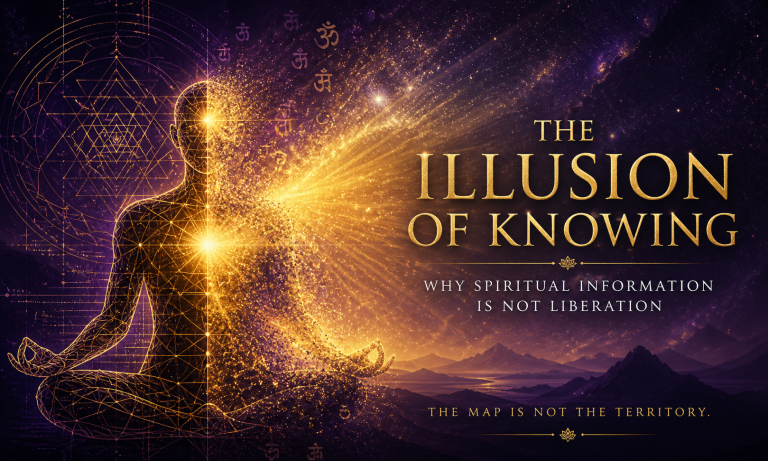
We have mistaken the map for the territory.
We read about awakening and assume proximity to it.
We learn the language of consciousness and mistake it for realization.
We collect practices, teachings, and philosophies—believing accumulation will somehow lead to transcendence.
But no map, no matter how detailed, has ever been the terrain itself.
You can study every description of fire…
and still remain cold.
You can memorize every scripture…
and still remain bound.
The Ego’s Greatest Trick: Becoming the Seeker
The ego is not easily defeated.
It does not resist spirituality—it adapts to it.
It takes on a new identity:
“I am the seeker.”
“I am the one walking the path.”
“I am evolving.”
And just like that, the same mechanism that once chased money, success, and validation now chases enlightenment.
The Divine becomes another goal.
Awakening becomes another achievement.
Spirituality becomes another layer of identity.
This is where the distortion deepens.
Because the Infinite is not something you can acquire.
It is what remains when the one who wants to acquire dissolves.
Spirituality as Consumption vs. Spirituality as Dissolution
Modern spirituality often operates within the same paradigm as consumer culture:
- Learn more
- Do more
- Experience more
- Become more
But authentic sadhana moves in the opposite direction:
- Unlearn
- Release
- Simplify
- Dissolve
This is not a path of accumulation—it is a process of subtraction.
Not becoming something new…
…but seeing clearly what you are not.
What True Jnana Actually Is
There is a widespread misconception that jnana—true knowledge—is about acquiring rare or advanced insights.
It is not.
True jnana is not informational—it is transformational.
It is not an expansion of content—it is a collapse of illusion.
It is the moment perception itself reorganizes.
Where life is no longer experienced from the narrow lens of “me,” but from the vast field in which the “me” appears.
Until that shift happens, even the most profound teachings remain ornamental.
Beautiful.
Inspiring.
But ultimately ineffective.
The Quiet Misallocation of a Human Life
There is a deeper tragedy playing out silently.
We invest enormous time, energy, and attention into things that cannot survive death:
- Wealth
- Status
- Recognition
- Possessions
And yet, the one treasure that does transcend death—the realization of our true nature—remains untouched.
Ignored.
Postponed.
Or reduced to a secondary priority.
This is not ignorance in the intellectual sense.
This is avidya—a misplacement of attention.
A life lived outward, while the source remains unseen.
The State of “Living Death”
From the outside, life appears full:
Movement. Activity. Emotion. Thought.
But inwardly, something essential is missing.
There is no direct knowing.
No experiential clarity.
No stable awareness beyond the fluctuations of mind and body.
This is what can be called a kind of living death:
To exist without truly knowing existence.
To function without awakening.
To move through life mechanically, without ever touching its essence.
What Is Actually Required
If liberation were simply a matter of learning, it would have already happened.
What is required is far more demanding—and far more honest.
1. Steady Attention
Not occasional practice, but sustained awareness woven into daily life.
2. Humility
Recognizing that second-hand knowledge cannot replace direct experience.
3. Discomfort
The willingness to face dissolution—not just improvement.
4. Sincerity
The most underrated quality on the path.
Not intensity.
Not performance.
Not identity.
But a quiet, unwavering commitment to truth—no matter what it dismantles.
The Reality of the Infinite
The soul’s infinity is not poetic language.
It is not metaphor.
It is not belief.
It is a living reality—closer than breath, more intimate than thought.
But it remains obscured by constant identification with:
- The body
- The mind
- The narrative of “me”
You do not need to become infinite.
You need to stop mistaking yourself for what is limited.
When Spirituality Becomes a Lifestyle Accessory
Today, spirituality is often used to:
- Feel better
- Appear evolved
- Build identity
- Create belonging
But when spirituality serves identity, it cannot dissolve it.
It becomes decoration.
A refined illusion.
A more sophisticated distraction.
The Urgency of This Human Birth
This life is not casual.
It is not random.
It is a narrow window—an opening through which realization becomes possible.
Not guaranteed.
Possible.
And like all openings, it can close.
Time will pass.
Opportunities will fade.
And the question will remain:
Did you merely learn the path…
or did you walk it?
The Real Gap
The gap is not between ignorance and knowledge.
It is between:
- Knowing the path and walking it
- Speaking truth and surrendering to it
- Collecting practices and being transformed by them
Authentic sadhana begins where self-deception ends.
And for most, that is the real threshold.
A Final Reflection
You are not lacking teachings.
You are not lacking access.
You are not lacking information.
What is missing is total involvement.
Because the moment involvement becomes total—
when attention is no longer divided,
when seeking is no longer ego-driven,
when practice is no longer optional—
something shifts.
Not gradually.
But fundamentally.
The map dissolves.
The search collapses.
And what remains…
is not something you attain—
but something you have always been.