
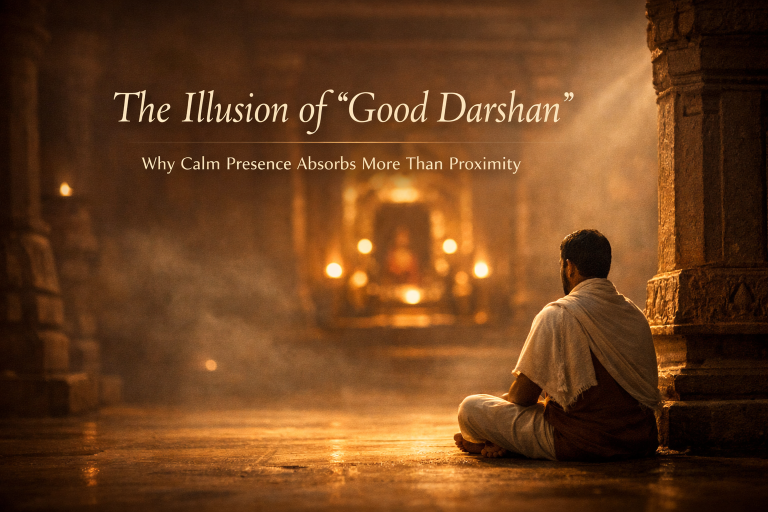

There is a subtle irony that plays out in powerful temples every single day.
People travel for hours — sometimes days — to stand before the murthi. They wait in long, winding queues. They rehearse their prayers mentally. They calculate how long they might get in front of the deity.
And then it happens.
They reach the sanctum.
They strain forward.
They try to stretch the moment.
They resist the temple attendant who gently (or not so gently) moves them along.
They fight for an extra second.
And they leave either exhilarated… or frustrated that they didn’t get a “good darshan.”
But here is something most people miss:
Spiritual energy is not confined to a 3-foot radius around the murthi.
What Is Darshan — Really?
Darshan is not a physical event.
It is not measured in seconds.
It is not measured in proximity.
Darshan literally means seeing — but spiritually, it means being seen.
It is a moment of alignment between your inner state and the presence of the Devata.
If the mind is agitated, competitive, restless, calculating…
You may stand 3 feet away and receive nothing.
If the mind is calm, surrendered, open…
You may sit 50 feet away, separated by a wall — and receive everything.
The Temple as an Energy Field
In truly powerful temples — ancient sthalas where mantra, yajna, and devotion have accumulated for centuries — the energy does not sit only in the sanctum.
It permeates.
It radiates.
It saturates the air.
Just as fragrance fills a room long after incense has burned, spiritual charge fills the pranganam, the corridors, the very stones of the structure.
When you enter such a temple, you enter an energetic ecosystem.
You do not need to “grab” it.
You need to attune to it.
Stress Blocks Absorption
Let us be very practical.
When you are:
-
Irritated by the crowd
-
Anxious about being pushed
-
Competing for space
-
Trying to prolong your moment
Your nervous system is in activation.
Fight.
Flight.
Subtle aggression.
In that state, absorption is minimal.
The mind is contracted.
The body is tense.
The breath is shallow.
You may technically see the deity — but energetically, you are closed.
Now imagine stepping outside the inner rush.
Sitting quietly in a corner.
Leaning against a pillar.
Closing your eyes.
Breathing slowly.
Chanting one name.
Contemplating one quality of the Devata.
Now the nervous system softens.
The breath deepens.
The mind stabilizes.
In that state, the temple begins to work on you.
Rina, Sthala, Kaala — The Subtle Variables
How much one absorbs from a temple is not random.
There are unseen variables:
-
Your karmic connection (rina) with that Devata
-
Your karmic tie with that sthala (sacred place)
-
The timing (kaala) of your visit
-
Your internal state
Sometimes the impact is immediate and overwhelming.
Sometimes it is subtle.
Sometimes it unfolds weeks later.
But absorption is rarely determined by how many seconds you stood in front of the murthi.
The Mistake of Spiritual Consumerism
Modern minds approach temples like transactions:
“I traveled. I waited. I deserve a good darshan.”
This mindset turns pilgrimage into acquisition.
But pilgrimage was never about acquisition.
It was about regulation.
Pilgrimages, pujas, sadhana — these were designed to:
-
Calm the overactive mind
-
Stabilize scattered energy
-
Reduce internal noise
-
Increase receptivity
If the visit increases agitation, comparison, frustration, or entitlement — the purpose has been inverted.
The Temple Is Not a Photograph
Many people want a moment they can mentally frame:
“I saw clearly.”
“I touched the murthi.”
“I was close.”
But spiritual transmission is rarely visual.
Often it happens when:
-
You sit quietly.
-
You chant softly.
-
You contemplate deeply.
-
You surrender fully.
The Devata is not measuring distance.
The Devata responds to alignment.
A Different Way to Visit a Temple
Next time you go:
-
Do your darshan calmly.
-
Do not resist being moved.
-
Do not fight for extra seconds.
-
Do not compare your experience to others.
Then…
Step aside.
Sit somewhere in the temple premises.
Close your eyes.
Chant one mantra 108 times.
Contemplate one divine quality.
Let your breath lengthen.
Stay longer in stillness than you did in front of the murthi.
You may discover something surprising:
The most powerful part of the visit was not the moment you saw the deity.
It was the moment you stopped trying.
The Basic Thing to Remember
Friends, remember one simple truth:
Pilgrimages, pujas, sadhana — these are meant to calm and stabilize a busy, overactive, stressed mind.
They are not meant to increase it.
If your temple visit makes you more reactive, more impatient, more competitive — something in the approach needs refinement.
The temple does not need your effort.
It needs your receptivity.
And receptivity begins with stillness.
Not proximity.