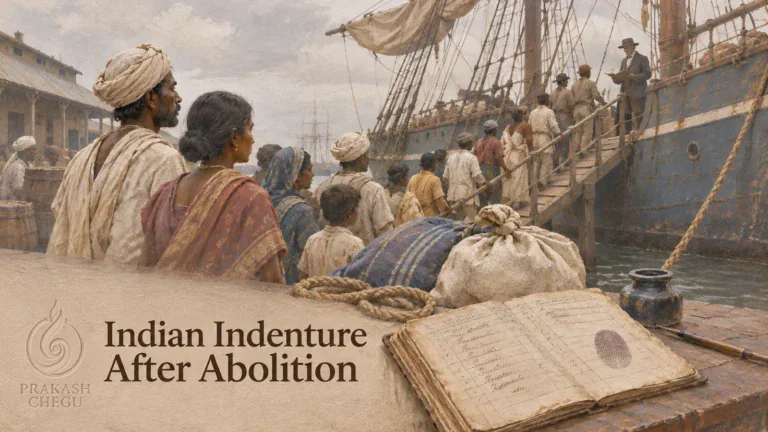
How Britain’s sugar colonies used five-year contracts to control the lives of more than a million Indian workers.
In September 1834, a group of men from Chota Nagpur went looking for work in Calcutta. They were told about a place called Mirich Dwip, the island we know as Mauritius. In the historian Brij V. Lal’s account, the recruiters made it sound close enough to Bengal that the men could earn some money and return before their absence was much noticed back home. A magistrate explained the agreement. The men put their thumbprints on it. The record could now say that they had agreed to go.
The thumbprints are the detail I keep coming back to. The men really were looking for work. They could have wanted everything the recruiters offered and still have had very little idea what they were agreeing to. A magistrate could record their assent in Calcutta. He could not travel with them to the plantation and enforce the terms they imagined.
What emancipation changed for the sugar colonies
The Slavery Abolition Act of 1833 ended legal ownership of enslaved people across much of the British Empire. It excluded the East India Company’s territories, Ceylon, and Saint Helena. In many of the colonies it did cover, adults who had been enslaved were compelled to keep working for their former owners under a system called apprenticeship, which ended in 1838. Parliament also allocated £20 million to compensate slaveholders for the loss of what the law had treated as their property.
Once free to decide, many formerly enslaved people withdrew their labour from the estates or sought better terms. Their choices get described in colonial accounts as a labour shortage. Read the phrase from the other side of the estate gate. People who had spent years working under compulsion could now refuse what the planter offered. The planters then looked for workers who could be bound by contract — and they looked to India.
The scale of the system
The major destinations give a sense of the scale.
| Destination | Approximate number of Indian indentured migrants |
|---|---|
| Mauritius | 453,000 |
| British Guiana (now Guyana) | 239,000 |
| Natal (now part of South Africa) | 152,000 |
| Trinidad | 144,000 |
| Fiji | 61,000 |
| Dutch Suriname | 34,000 |
Figures are rounded from published destination counts; compilations use different date ranges and sometimes give different totals, and other destinations included Jamaica and Réunion. Historians such as David Northrup estimate the total at about 1.4 million indentured Indian migrants over the life of the system.
There is a revealing overlap in the dates. In January 1877, imperial heralds at the Delhi Durbar proclaimed Victoria Empress of India. During that same decade, the Inland Customs Line with its stretches of living hedge was still enforcing duties on salt, and ships were still carrying contract workers out of Calcutta and Madras.
What the contract meant once they arrived
On paper, it was regulated and it was voluntary. The contract ran five years. Return passage came after five years at the labourer’s own expense, or free after ten. Recruits had to stand before a magistrate and declare they were going of their own will. Ships had to carry a surgeon and meet rules on space and diet. Wages were set by law.
In practice, recruiters worked famine districts, the declaration was a formality for people who could not read the contract, and once a worker arrived the colonial laws could treat absence, refusal to work, or desertion as criminal offences rather than civil ones. In Trinidad, as the historian Bridget Brereton explains, imprisonment for breaches of the indenture laws was a central form of legal coercion. The overseer who reported an absence could set in motion a process ending in a jail sentence. The plantation could call on the power of the state to discipline a worker it described as free.
In Mauritius, the restrictions could outlast the agreement. In 1872, a British minister confirmed in the House of Commons that workers whose indentures had expired were still required to hold a licence costing £1 a year, for the stated purpose of identification and the prevention of vagrancy. Sugar planters faced no such requirement. Mauritius’s Truth and Justice Commission records arrests under vagrancy laws of immigrants who declined to renew their employment with the same employer.
A new system of slavery
The historian Hugh Tinker called his study A New System of Slavery. The title asks us to look at how much power the plantation carried from one labour system into the next. Chattel slavery made people legally ownable and could pass enslaved status from mother to child. Indenture bound a worker for a stated term and promised wages. That legal difference mattered enormously to the people living under each system. It also makes the particular wrong of indenture easier to see: colonial governments could recognise a worker as a legal person and still give an employer extraordinary power over where that person went and what happened if they refused to work.
The people inside the registers
In 1903, a young Indian woman named Sujaria boarded a ship in Calcutta for British Guiana. A century later, her descendant, the writer Gaiutra Bahadur, went looking for her in Coolie Woman. Bahadur’s search makes clear how unevenly the record preserves a life. An immigration register can show where a woman landed, where she was sent to work, and how the authorities classified her. The questions her descendants might most want to ask her can be the very questions the officials had no reason to record.
When the colonial administration sought to increase the proportion of women on ships to the sugar colonies, it could express the policy as forty women for every hundred men. It takes a different kind of history to see what life was like for those forty women. They were wage earners and migrants in their own right — raising families, forming relationships, and helping sustain religious life under difficult circumstances. They also faced sexual exploitation and violence. Both belong in an account of how communities came to exist in places the recruiters had presented as a short trip.
The end of the system
Ending recruitment and releasing people already bound by contracts were separate acts, achieved through India’s own nationalist campaign and sustained political pressure. Fiji cancelled its remaining Indian indentures on 1 January 1920. Elsewhere there were different timelines, including an exceptional shipment to Mauritius as late as 1925.
The homes people made across the ocean
In Fiji, the English word agreement became girmit. Those who lived under it became known as girmitiyas. The new word carried the memory of a contract and, eventually, the memory of the people who had lived through it. Communities grew around farms, shops, schools, temples, and mosques. Across Fiji, Mauritius, Guyana, Trinidad, and Suriname, their descendants belong to societies their families helped build. What had crossed the ocean as a remembered story became something a new community could do together — a child might learn it in the company of neighbours whose parents had come from different parts of India.
I think again of the men at the magistrate’s office. The question the official needed answered was whether they agreed to go. A fuller account of their freedom would have had to ask what they understood, what they could refuse once they arrived, and how they could get home if they changed their minds. Those questions would have taken more time than a thumbprint. The workers and their families spent years living out the answers.
— Prakash Chegu
Frequently Asked Questions
What was the system of Indian indenture?
After the abolition of slavery, Britain’s sugar colonies turned to indentured labor — binding more than a million Indian workers to multi-year contracts (often five years) to work on plantations far from home. Recruited with promises of work and return, many signed agreements (sometimes with just a thumbprint) and were transported to distant colonies like Mauritius and across the empire.
Why do the thumbprints matter in this history?
Because they reveal how consent was recorded and controlled. Men genuinely seeking work put their thumbprints on contracts they often did not fully understand, after recruiters downplayed the distance and hardship. The record could then say they had agreed to go — a formality that masked misleading recruitment and the coercive realities of the system that followed.
What does this history teach us?
It illuminates how, even after slavery’s abolition, legal contracts could be used to control and exploit vulnerable people — shaping the lives of over a million workers and the diverse societies their descendants built across the world. Remembering this history honors those workers and deepens our understanding of empire, migration, labor, and the long human cost behind official records.