Across the sacred stories of India, the ancient rishi is rarely described as possessing very much.
He may live in a forest hermitage, sleep beneath a tree, wear bark or a simple cloth, eat roots and fruits, and own almost nothing. Yet certain objects appear beside him again and again: a staff, a mala, perhaps a bundle of darbha grass—and a small vessel of water known as the kamandalu.
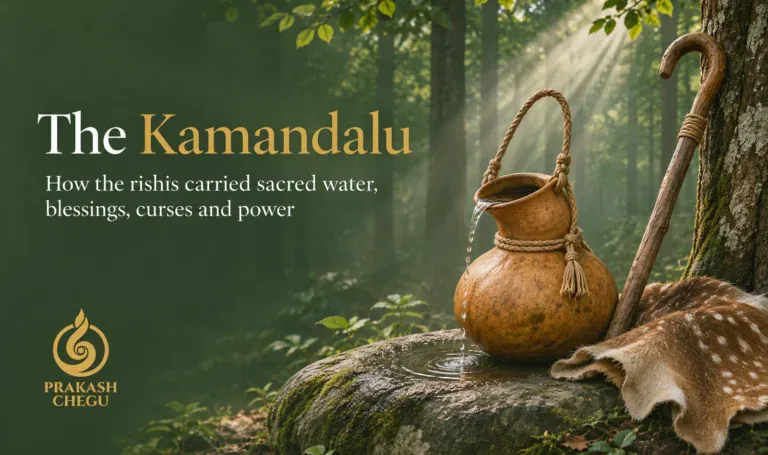
At first glance, the kamandalu appears to be an ordinary water pot. It might be made from a hollowed gourd, coconut shell, clay, wood, copper or brass. It was light enough for a wandering ascetic to carry and practical enough to provide water for drinking, washing and daily ritual. Historical examples appear not only in Hindu ascetic traditions but also among Buddhist and Jain renunciants. Impart’s study of the kamandalu describes it as a vessel used since antiquity for drinking water and ritual ablutions.
But within the spiritual imagination of India, the kamandalu was far more than a portable water bottle.
It was a container of consecrated consciousness.
The water it held could be used for purification, worship, vows, offerings, initiation, healing, protection, blessing—and, in some narratives, to seal a curse. A rishi might take water into his palm before declaring an irrevocable sentence. A deity might sprinkle kamandalu water upon hostile forces. A sacred river might emerge from a divine vessel. A king might pour water to confirm a gift whose consequences would transform the three worlds.
Why did water possess such extraordinary significance? And why was the kamandalu considered an almost inseparable companion of the rishis?
The answer lies in the ancient understanding that water receives, carries and transmits intention.
More Than a Vessel
The Sanskrit word is generally rendered as kamaṇḍalu, with regional forms such as kamandala or kamandalam. It refers to the small water vessel carried by ascetics, brahmacharins, sages and certain deities.
Its simplicity was itself a teaching.
The rishi who carried a kamandalu was declaring that very little was necessary for a sacred life. Water sustained the body, maintained ritual purity and made daily worship possible. A person who had renounced houses, wealth, storage and elaborate possessions could still carry one small vessel containing the element upon which all life depends.
The kamandalu therefore represented:
-
simplicity and voluntary restraint;
-
purity of body, mind and conduct;
-
self-sufficiency;
-
the conservation of life-force;
-
readiness for worship wherever one might be;
-
detachment from unnecessary possessions;
-
the ability to carry sacredness rather than depend upon a fixed temple.
A hollowed gourd offered an especially beautiful metaphor. Its inner pulp and seeds had to be removed before it could hold pure water. In the same way, the aspirant emptied himself of ego, agitation and accumulated identity so that he could become a vessel for divine consciousness.
The kamandalu was therefore both something the rishi carried and an image of what the rishi had become.
The purified sage was himself a living kamandalu.
Why Water Was Considered Sacred
The ancient rishis did not view water merely as a chemical substance. Water was jala tattva, one of the five great elements. It nourished the body, carried fertility, cleansed impurity, cooled excessive heat and connected heaven, atmosphere and earth through rain, rivers, springs and oceans.
The waters are praised in the Vedic tradition as healing, maternal and purifying. Long before a mantra was placed into water, the water was already understood to be alive with cosmic significance.
Water also possesses several qualities that made it a natural ritual medium.
It receives.
It carries.
It penetrates.
It cleanses.
It assumes the shape of its container.
It moves between visible and invisible states.
It descends as rain, flows as a river, rests in a vessel and rises again as vapour.
For the rishis, these were not merely physical properties. They revealed how consciousness itself moves through creation.
A mantra is vibration. A sankalpa is directed intention. Tapas is accumulated spiritual force. Water could become the meeting place of all three.
This does not necessarily mean that every cup of water possessed supernatural power. The power described in the scriptures did not belong to the liquid alone. It arose through the conjunction of:
-
the purity of the person;
-
the spiritual energy accumulated through tapas;
-
the authority of dharma;
-
the precision of mantra;
-
the intensity of intention;
-
and the receptivity of water as the ritual carrier.
The kamandalu was the vessel in which these forces converged.
The Rishi’s Portable Altar
For a wandering ascetic, the kamandalu made almost any place suitable for spiritual practice. The rishi did not need to return to a palace, temple or permanent fire altar before beginning his worship.
With a little water, he could perform ācamana, the ritual sipping of water for inner purification. He could wash his hands and feet, purify ritual implements, sprinkle the ground, offer arghya, make a sankalpa or prepare himself for japa, homa and meditation.
Water might be used to:
-
cleanse the body before worship;
-
purify the mouth before mantra recitation;
-
sanctify a place;
-
invoke sacred rivers;
-
offer hospitality to a guest;
-
honour ancestors;
-
consecrate ritual objects;
-
accompany a vow;
-
seal a gift or promise;
-
bless a disciple;
-
protect a person or hermitage;
-
restore balance after impurity or disturbance.
This made the kamandalu something like a portable field of sacred order.
Wherever the rishi travelled, the basic possibility of ritual travelled with him.
Water as the Witness of a Sankalpa
One of the most important functions of water in Indian ritual is to accompany a sankalpa—a solemn intention, vow or declaration.
When water is taken into the palm while stating a commitment, the action gives the words ritual gravity. The water may then be released onto the earth, symbolising that the declaration has passed from private thought into the fabric of the world.
The water becomes a witness.
This helps us understand many scriptural scenes in which a king, sage or deity takes water before granting a boon, making a donation or pronouncing a curse. It was not always imagined that the water itself performed the action. Rather, the handling and release of water gave visible and ritual form to an invisible decision.
Once the water had been poured, the sankalpa had been released.
The act could no longer be treated as a casual statement.
King Bali, Vamana and the Water That Sealed a World-Changing Gift
One of the most famous examples of water sealing a vow appears in the story of Vamana and Mahabali.
Vamana, the dwarf incarnation of Vishnu, approached the generous king Bali and requested as much land as he could cover in three steps. Bali agreed. The formal donation, however, had to be ratified through the pouring of water.
Bali’s guru, Shukracharya, recognised Vamana’s divine identity and understood that the apparently modest request would cost Bali his entire kingdom. In later retellings, Shukracharya entered or obstructed the spout of the ritual vessel to prevent the water from flowing and thereby prevent the gift from being completed.
Vamana cleared the obstruction, the water flowed, and Bali’s promise became irrevocable.
Vamana then expanded into the cosmic Trivikrama form. With one step he covered the earth, with another the heavens, and for the third Bali offered his own head.
The crucial point is easy to overlook: Bali’s gift did not become sacred merely because he thought about it. The pouring of water transformed generosity into covenant.
The flowing water said:
“This promise has entered dharma. I cannot take it back.”
Blessing Through the Kamandalu
The most familiar use of consecrated water is blessing.
A sage might chant a mantra over water and sprinkle it upon a disciple, child, king, home, battlefield or ritual space. The outer action was simple, but the water represented the transmission of an inner state.
To bless someone was not merely to wish them well. A true blessing—āśīrvāda or anugraha—was understood as the directed outflow of spiritual merit, clarity and grace.
The kamandalu provided a physical medium through which this invisible transmission could be enacted.
Water might be used to bless:
-
a newborn child;
-
a disciple entering spiritual study;
-
a king assuming responsibility;
-
a marriage or sacred vow;
-
a journey;
-
a yajña;
-
a person recovering from illness;
-
someone seeking protection;
-
a land suffering from imbalance;
-
an object being dedicated to divine service.
In such contexts, the water did not replace mantra, prayer or tapas. It carried them.
Brahmani and the Kamandalu as Divine Power
The Devī Māhātmya gives the kamandalu an especially powerful role.
When the great Mother manifests the Mātṛkās—the divine feminine powers corresponding to different gods—Brahmani, the shakti of Brahma, appears carrying a rosary and kamandalu. During the battle, she sprinkles water from her vessel upon the opposing forces, draining or neutralising their vitality.
Here the kamandalu is not merely peaceful or ornamental. Its water becomes an expression of brahma-shakti, the power that creates, orders and dissolves manifestation.
The same water that gives life can withdraw disordered power.
This is important because sacred water in Hindu tradition is not merely soft, soothing or sentimental. Water nourishes, but it can also flood. It purifies, but purification may involve the dismantling of what cannot remain.
The kamandalu therefore contains both compassion and spiritual authority.
Why Water Was Used When Pronouncing a Curse
Popular retellings often depict an angry rishi lifting his kamandalu, taking water into his palm and pronouncing a terrible curse. The water is then thrown or released, and the curse takes effect.
This has led to the impression that the kamandalu contained some kind of magical ammunition.
The deeper principle is more subtle.
A śāpa, or curse, spoken by a spiritually accomplished rishi was believed to possess power because the rishi had cultivated vāk-siddhi—the potency of speech arising from truthfulness, mantra and tapas. A person who had restrained speech, preserved energy, lived austerely and spoken truth for decades was understood to have words that no longer dispersed meaninglessly.
His speech had become concentrated.
When such a person declared a consequence while holding ritual water, the water served as the vehicle and witness of that concentrated speech. It ritualised the pronouncement in much the same way that water ritualised a donation or vow.
The Rāmāyaṇa includes an instructive example in the story of King Saudasa. When he intends to retaliate against Sage Vasishtha with a curse, he takes water into his hand. His wife restrains him, reminding him that Vasishtha is their preceptor. Unable simply to discard the charged act, Saudasa directs the water upon his own feet, and the curse rebounds upon his life. The translated passage preserves the significant detail that he had taken water in hand before attempting the curse.
The implication is profound: once speech, intention and ritual action have united, their force must go somewhere.
The water was not an independent weapon. It was the embodied carrier of a karmically charged sankalpa.
The Curse Was Not Supposed to Be a Tantrum
Many modern people read stories of rishis cursing kings, gods and householders and wonder: if these sages were enlightened, why were they so easily angered?
Sometimes the scriptures themselves raise precisely this question.
Not every tapasvin was portrayed as fully liberated. A person could accumulate enormous spiritual power while still carrying pride, anger, attachment or sensitivity to insult. Tapas amplifies capacity, but it does not automatically guarantee wisdom.
This is one of the great warnings hidden within the curse narratives.
Spiritual power and spiritual maturity are not always the same thing.
A rishi’s curse might represent several different realities:
-
A declaration of karmic consequence
The sage did not arbitrarily create the result but revealed the destiny already set in motion by an adharmic act. -
A protective boundary
A curse defended a hermitage, vow, sacred being or spiritual law from violation. -
The expenditure of tapas
Pronouncing a curse could consume some of the spiritual merit accumulated by the sage. This was one reason anger was considered dangerous even for powerful practitioners. -
A narrative instrument of destiny
In the epics and Purāṇas, a curse frequently becomes the mechanism through which a divine incarnation, pilgrimage, separation, purification or eventual liberation occurs. -
A warning about unmastered emotion
Some stories show that even a person possessing siddhis may misuse power when provoked.
A śāpa was therefore not always simply evil, nor was it always justified. It could be karmic justice, spiritual protection, uncontrolled anger—or a mysterious vehicle through which destiny unfolded.
When a Curse Became a Blessing
A striking pattern in Hindu sacred literature is that curses often contain a hidden door to transformation.
A being may be cursed to lose a heavenly position, take birth upon earth, become separated from a beloved, live as an animal, forget divine powers or endure a limited period of suffering. Yet that very descent creates the conditions for purification, divine encounter or liberation.
The curse establishes the karmic condition. Grace establishes its limit.
Often the person who pronounces the curse later softens it:
-
the curse will last only for a particular number of years;
-
it will end when a divine person arrives;
-
remembrance will return at the necessary moment;
-
earthly birth will become an opportunity for liberation;
-
suffering will ultimately serve a cosmic purpose.
Ahalya’s story is a well-known example of this broader structure. Her curse is not eternal; it contains the possibility of release through the arrival of Rama. The Vālmīki Rāmāyaṇa’s account presents Rama’s entry into the hermitage as the turning point in her restoration.
Theologically, this suggests that divine order does not deny consequence, but neither does it abandon the soul within consequence.
A curse may close one form of life while secretly opening another.
Sacred Rivers and the Kamandalu
The relationship between the kamandalu and sacred rivers is another recurring theme.
In many traditions, Brahma’s kamandalu is associated with primordial or celestial waters. The descent of the Ganga is linked with cosmic realms, divine feet, Brahma and Shiva before the river reaches the earth. Regional sacred narratives also connect rivers such as the Kaveri with water released from the vessel of a sage.
In the beloved Kaveri legend, the river is contained in Sage Agastya’s kamandalu. Ganesha, taking the form of a crow, overturns the vessel, releasing the waters so they may flow across the land and nourish the world.
Whether approached devotionally, symbolically or geographically, the image is extraordinary:
A river is held inside a sage’s vessel until the right moment for its release.
The disciplined consciousness of the rishi gathers and contains power. Divine intervention then liberates that power for the benefit of the world.
The kamandalu here symbolises not only renunciation but containment without possession. The sage does not ultimately own the water. What has been preserved through tapas must eventually flow toward life.
The Kamandalu as a Container of Tapas
Why should water carried by a rishi be different from water taken from an ordinary pot?
The traditional answer would be sannidhi—the transforming influence of presence.
The kamandalu remained near the rishi during meditation, mantra, silence, austerity and prayer. It belonged to a life organised around concentrated awareness. Water placed within it could be consciously consecrated, but it was also continually associated with the energetic field of the practitioner.
The rishi’s life was one of conservation.
He conserved speech.
He conserved sexual energy.
He conserved attention.
He conserved possessions.
He conserved food.
He conserved movement.
He conserved prana.
The kamandalu reflected this discipline. It held only a limited quantity of water, reminding the ascetic to use resources carefully. Yet that small amount, rightly used, could purify an entire ritual space.
This was the paradox of the rishi:
He possessed almost nothing, but what he possessed was filled with power.
A Symbol of the Mind
The kamandalu can also be understood as a map of the human mind.
The vessel is the individual consciousness.
The water is prana and awareness.
The handle is discipline.
The opening is receptivity.
The pouring is intention expressed through action.
If the vessel is dirty, even clear water becomes contaminated. If it is cracked, the water continually leaks. If it is shaken, the water cannot reflect anything clearly. If it is filled with yesterday’s stagnant water, there is no room for a fresh current.
This is also true of the mind.
A mind filled with unresolved resentment cannot carry blessing without distortion. A mind full of holes—constant distraction, compulsive speech, scattered desire—cannot retain prana. A restless mind cannot reflect truth. An ego already full of itself has no space to receive the sacred.
The rishi’s kamandalu therefore asks an intimate question:
What is your consciousness carrying?
Is it carrying fear?
Grievance?
Blessing?
Clarity?
An unspoken curse?
A sankalpa that has not yet been released?
Every human being is pouring something into the world.
Blessing and Cursing in Everyday Life
Most of us will never take water from a kamandalu and pronounce a formal śāpa. Yet we bless and curse one another constantly through speech.
A parent repeatedly telling a child, “You will never succeed,” is creating something like a psychological curse.
A teacher saying, “I see extraordinary potential in you,” may offer a blessing that shapes an entire life.
A spouse who continually speaks contempt into a relationship charges its emotional waters with injury. A healer who speaks hope without denying reality may help restore a person’s inner direction.
The ancient stories dramatise a principle that remains entirely relevant:
Words spoken with emotion, authority and repetition enter deeply into consciousness.
The greater a person’s authority, the greater the responsibility carried by their speech. The words of a parent, guru, teacher, physician, leader or beloved can become internal realities in the person who receives them.
We may not possess the vāk-siddhi of the ancient rishis, but speech still carries prana. Every day, we fill the invisible kamandalu of relationship with what we say.
Can Water Really Hold Intention?
From a traditional spiritual perspective, water can be consecrated through mantra and sankalpa. This principle remains alive in tīrtha, abhiṣeka water, kalasha worship, temple prasāda, baptismal rites, holy wells and sacred-water ceremonies across many cultures.
From a modern scientific perspective, claims that water permanently records specific thoughts or emotions remain controversial and have not been established through robust, reproducible evidence.
The spiritual use of water need not depend upon exaggerated scientific claims.
Ritual can powerfully organise attention, emotion, memory, behaviour and communal meaning. When a practitioner holds water, chants a mantra, clarifies an intention and consciously releases it, the act creates a profound alignment between body, speech and mind.
Traditional theology may describe this as consecration. Psychology may describe it as embodied intention. A devotee may experience it as grace.
These interpretations need not be carelessly collapsed into one another.
The sacred meaning of the kamandalu is already deep enough without manufacturing scientific proof.
The Ethical Lesson of the Kamandalu
The kamandalu represents power under restraint.
The sage carries water, but he does not pour it carelessly. He possesses mantra, but he does not speak constantly. He may have the capacity to bless or curse, yet the highest discipline is knowing when to remain silent.
In this sense, the greatest rishi is not necessarily the one whose curse terrifies kingdoms. It is the one whose consciousness has become so clear that anger no longer commandeers spiritual power.
To carry a kamandalu responsibly is to ask:
-
Is my intention pure?
-
Is my speech necessary?
-
Am I acting from dharma or wounded pride?
-
Will this action restore order or merely discharge my anger?
-
Have I accumulated enough clarity to direct energy wisely?
-
Am I blessing life, or unconsciously poisoning the waters around me?
The vessel does not decide what it will carry.
The consciousness holding it decides.
Becoming the Kamandalu
The deepest meaning of the kamandalu may not be found in the object at all.
The human body is largely water. The mind receives impressions. The nervous system carries vibration. Speech releases intention. Every person is already a moving vessel through which consciousness enters the world.
The spiritual path asks us to become like the rishi’s water pot:
Empty enough to receive.
Clean enough to preserve.
Steady enough to reflect.
Strong enough not to leak.
Humble enough to serve.
Wise enough to pour only at the right moment.
The ancient rishis carried the kamandalu because water was necessary for survival and spiritual practice. Sacred literature then expanded this practical vessel into a profound symbol of tapas, purity, authority and transmission.
Its water could cleanse because consciousness had blessed it.
It could protect because dharma had directed it.
It could seal a vow because truth had entered it.
It could carry a curse because anger and tapas had concentrated within speech.
It could release a river because spiritual power was never meant to remain imprisoned in the vessel.
The kamandalu reminds us that power does not always arrive with noise, weapons or grandeur. Sometimes it rests quietly in the hand of a nearly possessionless sage—a small vessel filled with clear water, waiting for the precise moment when intention, mantra and destiny meet.
And perhaps its final teaching is this:
Whatever we carry long enough becomes charged by our consciousness. Whatever we pour repeatedly becomes the world around us.
May we therefore become careful vessels.
May the waters we carry be clear.
And may what flows from us become a blessing.
Frequently Asked Questions
What is a kamandalu?
The kamandalu is the small water vessel carried by rishis and ascetics, traditionally made from a dried gourd and sometimes from clay, wood or metal. But within the spiritual imagination of India it was never just a water bottle. It was treated as a container of consecrated consciousness, holding water set apart for sacred use.
Why was the water in it considered so powerful?
Because water was understood to receive, carry and transmit intention. The water from the same vessel could be used to purify, to bless, to initiate, to heal, to confirm a vow or a gift, and in some stories even to seal a curse. A rishi taking water into his palm before speaking was not a casual gesture, the water was thought to hold and carry the weight of what was declared over it.
Does the kamandalu still mean anything for practice today?
I think it does, even if most of us will not carry a gourd through the forest. It is a reminder to treat the ordinary, water, breath, a simple object, as capable of holding intention. When you pour or drink water with real attention you are touching the same understanding the kamandalu points to, that consciousness and care can be carried in the simplest vessel.