Ram Dass, Psychedelics, and the Difference Between a Glimpse and a Life Transformed
In 1967, before he became known to the world as Ram Dass, Richard Alpert attempted to explain the psychedelic experience through a beautifully simple metaphor.
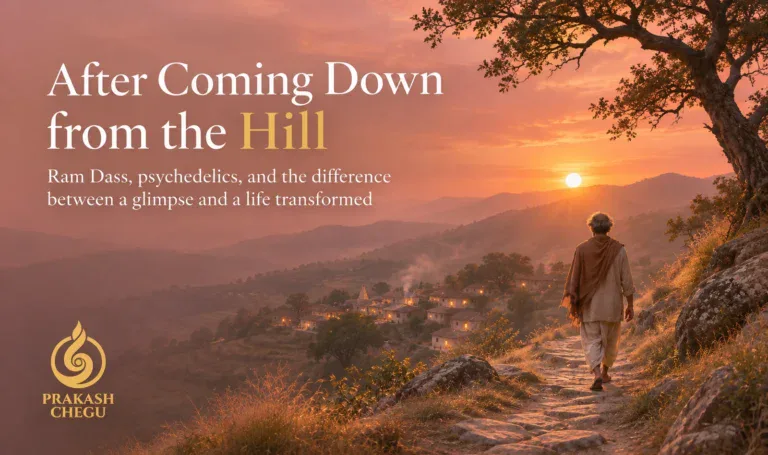
Imagine that you have spent your entire life in a small village surrounded by hills.
You know every road, every house and every familiar face. You understand the customs of the village, its conflicts, alliances and unspoken rules. Because you have never seen anything beyond it, you naturally assume that this village is the whole world.
Then, one day, someone takes you to the top of a hill.
For the first time, you see your village from above.
You recognise the house in which you live, but now you see how small it is within the larger landscape. You notice that roads you thought were separate are connected. You see patterns that were invisible from the ground. You recognise the boundaries of your village—and perhaps, for the first time, understand that they are boundaries rather than the limits of reality itself.
Then you look farther into the distance.
Beyond the surrounding hills are other villages, each filled with people absorbed in their own dramas, identities, fears, ambitions and beliefs. Every village imagines itself to be the centre of the world. Every person is living inside a reality that feels complete when viewed from within it.
For a moment, from the summit, you can see the entire arrangement.
And then you must walk back down the hill.
Nothing in the village has necessarily changed. The same houses remain. The same people are waiting. Your debts, relationships, responsibilities, wounds and habits have not disappeared.
But you have seen the village from above.
And because you have seen it, you cannot entirely return to the innocence of believing that the village is all there is.
That may be one of the clearest explanations ever offered for the psychedelic experience.
Yet it also leaves us with a far more important question:
What do you do after coming down from the hill?
The Medicine of Perspective
A profound psychedelic experience can temporarily loosen the structures through which we ordinarily interpret reality.
The identity we have spent years constructing—our name, profession, history, wounds, preferences and social position—may suddenly appear less absolute. The boundaries between self and world can become porous. Time may lose its familiar shape. Long-suppressed emotions may arise. The natural world may appear intensely alive. Love may be experienced not merely as a personal emotion, but as something fundamental to existence itself.
A person may see that many of their lifelong struggles have been organised around a story:
I am not enough.
I am alone.
I must control everything.
I am what happened to me.
I must keep performing in order to be loved.
From the hilltop, these stories may suddenly look like paths running through the village rather than laws governing the universe.
This change in perspective can be enormously meaningful.
But seeing the pattern is not the same as becoming free from it.
A person may understand, with extraordinary clarity, that resentment is poisoning their life—and still become angry with their partner three days later. They may experience the unity of all beings and still speak cruelly to their family. They may encounter unconditional love and then return to the same addictions, evasions and relational patterns.
The glimpse may be real.
The transformation may still be incomplete.
A Glimpse Is Not Yet Realisation
This distinction has always been understood within serious spiritual traditions.
In Yoga, Tantra, Vedanta and Buddhism, an extraordinary state of consciousness is not automatically regarded as enlightenment. Visions, bliss, expanded awareness, energetic phenomena and temporary experiences of egolessness may arise along the path, but they are not necessarily its culmination.
A state comes and goes.
Realisation must become stable.
There is a difference between temporarily experiencing silence and becoming inwardly silent. There is a difference between feeling universal love for several hours and learning to love a difficult human being over many years. There is a difference between seeing through the ego and no longer being unconsciously governed by it.
In Sanskrit, we might distinguish between an experience that briefly reveals something and the process through which that recognition becomes embodied as wisdom.
A psychedelic experience may open a door.
It does not necessarily teach us how to walk through that door, remain conscious on the other side or bring what we discovered back into ordinary life.
This is why spiritual traditions do not rely only upon peak experiences. They establish disciplines: meditation, mantra, ethical restraint, breath, prayer, seva, self-inquiry, devotion, study and the presence of a teacher or community.
The purpose of these practices is not merely to produce an altered state.
It is to transform the person who returns from it.
Richard Alpert Goes to India
Richard Alpert had already explored extraordinary states of consciousness extensively. He had been a Harvard psychology professor and, alongside Timothy Leary and others, became one of the best-known figures associated with early psychedelic research and experimentation.
But the central limitation remained: however high he travelled, he eventually came down.
In 1967, Alpert travelled to India. There he met the teacher Neem Karoli Baba, affectionately known as Maharaj-ji, who became his guru and gave him the name Ram Dass—“servant of Ram” or “servant of God.” Ram Dass’s official biography
The significance of this encounter was not simply that Alpert exchanged psychedelics for an Indian religion. It was that he encountered a different possibility.
He had learned how to visit expanded states. In India, he met people whose consciousness seemed to have been transformed through devotion, surrender, service and spiritual practice.
The question was no longer:
How can I get high enough to escape my ordinary consciousness?
It became:
How can I become free enough to meet ordinary life without losing my awareness?
This was a profound shift—from experience to embodiment, from transcendence to practice, from seeking another state to transforming one’s relationship with every state.
Ram Dass later spoke openly about both the promise and the pitfalls of psychedelics. They could reveal dimensions of consciousness that a person had never imagined. But if the experience became another possession, achievement or identity—my awakening, my vision, my superior consciousness—the ego could quietly absorb even the experience of egolessness. Be Here Now Network
The ego is remarkably adaptable.
It can be proud of wealth.
It can be proud of renunciation.
It can be proud of intellectual knowledge.
And it can be proud of having dissolved.
The Temptation to Keep Climbing the Hill
Once someone has seen the village from above, ordinary life may feel unbearably small.
The dishes still need to be washed. The body still gets tired. Money must still be earned. Relationships require patience. Parents age. Children interrupt meditation. The person who experienced cosmic unity still has unanswered emails and unresolved childhood wounds.
It can be tempting to conclude that the answer is simply to return to the hilltop again and again.
Another ceremony.
Another retreat.
Another breakthrough.
Another teacher.
Another medicine.
Another experience intense enough to make ordinary life disappear.
But spiritual maturity is not measured by how frequently we leave the village.
It is revealed by how consciously we live when we return.
Can we remember the wider landscape while standing in the marketplace?
Can we retain compassion during disagreement?
Can we recognise another person’s humanity when they do not give us what we want?
Can we remain truthful when deception would be easier?
Can we bring presence into work, money, sexuality, illness and family life?
If the hilltop vision does not gradually change how we behave in the village, we may have had an extraordinary experience without undergoing a corresponding transformation.
Integration Is Where the Real Work Begins
The word integration is now used frequently in psychedelic conversations. Yet integration is more than talking about what happened or writing down the insights before they fade.
True integration asks the experience to become visible in the architecture of one’s life.
If you saw that your body is sacred, how will you care for it?
If you recognised that you have been emotionally unavailable, whom must you speak to?
If you understood that your career is destroying your vitality, what must change?
If you felt the suffering caused by your addiction, what support will you seek?
If you experienced the interdependence of all life, how will that affect the way you eat, consume, work and relate to the Earth?
If you encountered unconditional love, can you offer a little more patience to the person who irritates you tomorrow?
The vision may arrive in a moment.
Living it may require years.
This is not a failure of the experience. It is the natural movement from revelation into embodiment.
A seed can fall into the soil in a single second. That does not mean the tree appears the following morning.
Five Movements of Genuine Integration
1. Remember What Was Revealed
Write down the essential insight without exaggerating it.
Avoid turning the experience into a grand identity: I have awakened. I have been chosen. I now understand the universe.
Instead, ask:
What did I see that is immediately relevant to the way I live?
The most transformative insight may not be a cosmic theory. It may be something painfully simple:
I need to forgive my father.
I have not been honest in my relationship.
I am exhausted because I do not know how to say no.
I need to stop abandoning myself.
The truth that changes a life is often quieter than the vision that revealed it.
2. Regulate Before You Interpret
Not every intense experience should be immediately interpreted as prophecy, enlightenment or divine instruction.
Give the nervous system time to settle. Sleep. Eat grounding food. Spend time in nature. Reduce stimulation. Practise gentle breathing rather than immediately chasing another altered state.
A person can encounter something meaningful while still misunderstanding parts of it. Humility protects revelation from inflation.
If distress, confusion, paranoia, prolonged insomnia or difficulty functioning continues after an experience, seek qualified professional support. Spiritual language should never be used to avoid necessary psychological or medical care.
3. Translate Insight into One Concrete Action
Every important insight should eventually take form.
Not twenty new resolutions. One honest action.
Make the call.
End the deception.
Begin the daily practice.
Apologise without defending yourself.
Establish the boundary.
Ask for help.
Change the habit that directly contradicts what you were shown.
An insight becomes embodied when it enters behaviour.
4. Establish a Practice That Does Not Depend on Peak Experience
Meditation, pranayama, mantra, prayer, journaling, contemplative movement and seva can help stabilise what was briefly revealed.
The right practice is not necessarily the one that creates the most spectacular state. It is the one that makes you more present, more truthful, more compassionate and more capable of meeting your life.
The hilltop may reveal the landscape.
Practice teaches you to walk through it consciously.
5. Let Relationships Become the Testing Ground
It is relatively easy to feel universal love while alone in an expanded state.
It is more difficult to love one particular human being with needs, wounds, habits and opinions different from our own.
Relationships reveal whether the awakening has reached the body.
Can we listen without preparing our defence?
Can we recognise when we have caused harm?
Can we remain present when shame arises?
Can we make a repair instead of protecting our spiritual self-image?
The people closest to us often know whether our consciousness has truly expanded. They experience the difference—or the absence of it—in the way we speak, listen, apologise and take responsibility.
The Guru Is Waiting in the Village
There is a subtle fantasy that awakening exists somewhere else: on the mountain, in the ashram, inside the ceremony, during the retreat or in the presence of an extraordinary teacher.
But eventually the path brings us back to the village.
The village is not the interruption of spiritual life.
It is where spiritual life is tested.
The demanding child is part of the practice.
The ageing parent is part of the practice.
The difficult conversation is part of the practice.
The unpaid bill, the tired body, the wounded relationship and the ordinary morning are all part of the practice.
The hilltop gives us perspective.
The village gives us embodiment.
Perhaps this is why Ram Dass’s life gradually became less concerned with describing extraordinary states and more devoted to presence, compassion and service. The movement was not simply from psychedelics to spirituality. It was from seeking experiences to becoming available to life.
The destination was not permanent escape from the human condition.
It was learning how to inhabit it with an open heart.
From “Be High” to “Be Here Now”
The enduring power of Ram Dass’s teaching can be found in the movement contained within three simple words:
Be here now.
Not only there, on the summit.
Not only then, during the revelation.
Here—in this body.
Now—in this relationship.
Here—in the imperfect village.
Now—while the insight can still become an action.
The question is not whether the hilltop was real. Perhaps it revealed something more real than our ordinary habits allow us to perceive.
The question is whether we can allow that wider vision to change the way we walk when the path descends.
Do we become kinder?
More honest?
Less defended?
More capable of serving?
More willing to take responsibility for the energy we bring into a room?
Less fascinated by appearing awakened—and more committed to relieving suffering?
These are not glamorous questions. They rarely produce visions. But they may tell us far more about spiritual development than the intensity of any extraordinary experience.
The Real Journey Begins on the Way Down
A psychedelic experience can reveal that the village is not the entire world.
A spiritual path asks us to return to that village without forgetting what we saw.
It asks us to live among familiar people without becoming trapped in familiar consciousness. It asks us to honour the glimpse without worshipping the method that produced it. It asks us to stop measuring awakening by the altitude of our experiences and begin measuring it by the quality of our presence.
Nearly sixty years after Richard Alpert described the view from the hill, the question remains as urgent as ever:
What do you do after coming down?
Perhaps the answer is not to spend the rest of your life trying to remain on the summit.
Perhaps the answer is to descend carefully, return to the village and become a different kind of villager.
To remember that there are other villages.
To recognise that everyone is living within a partial view.
To hold your own dramas a little more lightly.
To serve where you can.
To love more consciously.
And, even while standing at the bottom of the hill, to never completely forget the vastness you once saw from above.
Frequently Asked Questions
What is the hill metaphor about?
Imagine living your whole life in a village surrounded by hills, assuming it is the entire world. Then one day someone takes you to the top of a hill and, for the first time, you see your village from above, small, held within something vastly larger. That first glimpse of a wider reality is powerful. But the story does not end on the hilltop; eventually you have to come down.
What is the difference between a glimpse and a transformed life?
A glimpse, whether from a peak experience or, as the piece discusses around Ram Dass and psychedelics, a chemically opened window, can genuinely show you that there is more than the village. But seeing it once is not the same as living differently. The real work is what happens after you come down: integrating the insight into ordinary life, day after day, so it becomes a changed way of being rather than a memory you visit.
Why do profound experiences so often fade?
Because insight that is not integrated tends to dissolve back into old patterns. The view from the hill is real, but ordinary life has gravity. Without patient grounding, practice, honesty, relationship, time, the glimpse becomes a story you tell rather than a life you live. The difference is never the height of the experience; it is the quality of the descent.