Why Did Ancient Yogis Consider a Small Flame So Powerful?
The Sacred Fire Code · Part 1 of 15
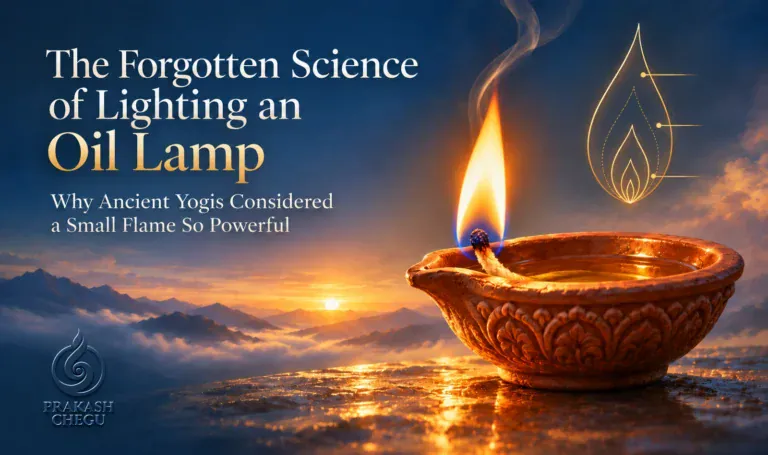
There is something extraordinary about a small flame.
Not a forest fire. Not the blazing heat of the summer sun. Not the enormous fire that powers an industrial furnace.
Just a little flame, rising quietly from a cotton wick soaked in oil.
For thousands of years, across Indian homes, temples, monasteries, and sacred spaces, someone has been lighting this flame.
Before meditation.
Before prayer.
Before welcoming a guest.
Before beginning a ceremony.
Before opening a new chapter in life.
And frequently, before doing anything else at the beginning of the day.
We have inherited this practice so naturally that few of us stop to ask a rather important question:
Why?
Why would a civilization with such extraordinary philosophical sophistication place so much importance on something as simple as lighting a lamp?
Was it merely because electricity had not yet been invented?
Was it an offering to a deity?
Was it a symbol of hope?
Or did the ancient practitioners understand something about fire, perception, the human mind, and the environment that deserves a closer examination?
As someone who came into the yogic sciences with the curiosity of an engineer, I find these questions irresistible.
Engineering teaches us to examine mechanisms.
Yoga teaches us to examine experience.
And sometimes, the most interesting discoveries begin when we stop assuming that these two methods of inquiry must be enemies.
Let us begin with the flame itself.
1. Before There Was a Temple, There Was Agni
One of the most remarkable facts about Vedic literature is how the Rigveda begins.
Its very first hymn invokes Agni.
अग्निमीळे पुरोहितं यज्ञस्य देवमृत्विजम्।
होतारं रत्नधातमम्॥
Agnim īḷe purohitaṃ yajñasya devam ṛtvijam,
hotāraṃ ratnadhātamam.
— Rigveda 1.1.1
A close rendering of its meaning is:
I praise Agni, the divine priest of the sacrifice, the invoker and bestower of treasures.
Consider the significance.
This foundational Vedic collection does not begin with an abstract theological argument.
It begins with fire.
But Agni in Vedic understanding is not simply the chemical process of combustion.
Agni is a deity, a sacred presence, a mediator between the human and divine worlds, and the central principle through which offerings are transformed and conveyed.
In the Vedic ritual imagination, fire connects worlds.
An offering placed into the fire is not understood as merely disappearing.
It is transformed.
This transformation gives us a profound philosophical insight.
The significance of fire is not merely that it consumes. It is that it changes the form of whatever enters it.
Wood becomes heat, gases, ash, and light.
Food becomes nourishment through digestion.
Experience can become wisdom through conscious reflection.
These are different processes, of course. Yet the traditional language of Agni allows us to contemplate them through a common metaphor of transformation.
In Ayurveda, this symbolism takes on another dimension through Jatharagni, the digestive fire.
In yogic practice, the language of tapas describes the transformative intensity of disciplined effort.
And in the spiritual life, fire becomes an invitation to ask:
What within me remains untransformed?
What am I still carrying that could become something wiser, clearer, and more compassionate?
The outer flame becomes a reminder of an inner possibility.
2. Deepa and Jyoti: The Difference Between a Lamp and Light
Two Sanskrit words are particularly important here.
Dīpa (दीप) refers to a lamp or light.
Jyotis (ज्योतिस् / ज्योतिः) means light, radiance, or luminosity, and may carry spiritual significance depending on its context.
The lamp is the vessel.
The light is what becomes visible through it.
This distinction is worth contemplating.
A lamp requires several conditions to function.
There must be a vessel capable of holding fuel.
There must be oil or ghee.
There must be a wick.
There must be oxygen.
And there must be ignition.
Remove any necessary component and the ordinary oil lamp can no longer sustain its flame.
Is this not also an interesting way of examining human life?
The body provides the structure.
Food and rest sustain biological energy.
Breath participates in metabolism.
Attention gives direction to our actions.
And consciousness makes experience possible.
I am not suggesting that human consciousness is literally a combustion reaction. That would be a serious philosophical and scientific oversimplification.
Rather, I am inviting us to notice why the flame has survived as such a meaningful symbol.
A flame is a visible example of life sustained through relationship.
It cannot exist independently of its conditions.
Neither can we.
The practice of lighting a lamp can therefore become something more meaningful than the repetition of an inherited custom.
It can become an act of remembering our dependence upon the countless conditions supporting our existence.
The earth that produced the oil.
The plant that supplied the cotton.
The air surrounding the flame.
The person who prepared the lamp.
And the awareness with which we approach it.
Even one small flame can remind us that we are not separate from life.
3. From Darkness to Light: What the Upanishads Actually Teach
Among the most familiar Sanskrit prayers is:
तमसो मा ज्योतिर्गमय।
Tamaso mā jyotir gamaya.
Lead me from darkness to light.
This line appears in the Brihadaranyaka Upanishad, 1.3.28.
The complete threefold invocation reads:
असतो मा सद्गमय।
तमसो मा ज्योतिर्गमय।
मृत्योर्मामृतं गमय॥
Asato mā sad gamaya.
Tamaso mā jyotir gamaya.
Mṛtyor māmṛtaṃ gamaya.
Lead me from the unreal to the real.
Lead me from darkness to light.
Lead me from death to immortality.
In its original Upanishadic context, this is not simply an instruction to replace physical darkness with illumination.
The text itself interprets darkness in relation to death and light in relation to immortality.
The prayer concerns a transformation in our fundamental condition of existence.
That gives the familiar practice of lighting a lamp a much richer symbolic possibility.
When we light a diya, we are not required to pretend that the flame has magically eliminated ignorance.
We can instead use the action as a deliberate reminder of the direction in which our lives are moving.
From confusion toward understanding.
From mechanical reaction toward awareness.
From unconscious habit toward freedom.
From fear toward a deeper relationship with existence.
We sometimes speak of spiritual life as though extraordinary experiences are necessary.
But perhaps a meaningful spiritual life begins with a simpler question.
Am I becoming more conscious of how I live?
If lighting one lamp helps us remember that question each morning, the ritual has already acquired value.
4. Why Oil? Why Not Simply Switch on an Electric Light?
This question becomes particularly interesting in the modern world.
If the purpose of lighting a lamp were only illumination, an electric bulb would be more efficient, safer in many settings, and often better for indoor air quality.
Yet a traditional oil lamp creates an experience quite different from most artificial lighting.
Its flame moves.
It responds to air currents.
It changes shape continuously.
It has a particular spectrum of light.
It creates a small region of warmth.
And because it requires tending, it invites participation.
You cannot light an oil lamp with quite the same indifference with which you flip a switch.
You must prepare the wick, supply the fuel, establish the lamp securely, and bring a flame into contact with it.
There is a sequence.
And a sequence performed consciously becomes a ritual.
This distinction matters.
A ritual is not necessarily valuable because it produces a supernatural result.
It can also be valuable because it changes how we participate in an ordinary action.
Consider how differently we experience a meal when we eat hurriedly while looking at a screen, compared with eating in silence and gratitude.
The food may be identical.
The digestive physiology does not suddenly become mystical.
Yet our attention, behavior, sensory experience, and memory of the meal may be profoundly different.
Likewise, the way we approach light can change our relationship with the moment.
An electric light illuminates the room.
A consciously lit lamp may also invite us to become aware of the act of illumination.
The difference is not necessarily in what the flame does to us.
It may also be in what we allow ourselves to do in its presence.
5. The Traditional Oils: Sesame, Ghee, Groundnut, Coconut and Castor
Across different Indian traditions, particular fuels have acquired ritual significance.
Among the commonly encountered options are sesame oil, ghee, groundnut oil, coconut oil, mustard oil, and castor oil.
The specific choice varies by region, family tradition, deity, and ritual lineage.
It is important not to impose one supposedly universal rule upon an extraordinarily diverse culture.
Sesame Oil — Tila Taila
Sesame oil is particularly significant in many Indian ritual traditions.
Sesame seeds are associated with offerings, purification practices, ancestral rites, and numerous regional customs.
Sesame oil is also used in Ayurvedic external applications, including forms of Abhyanga, although applying oil to the skin and burning oil as a lamp are entirely different uses.
Sesame oil has a longstanding place in South Indian lamp-lighting traditions.
From a combustion perspective, however, we should avoid the simplistic claim that sesame oil is automatically cleaner or healthier than every alternative.
How much soot an oil lamp produces depends on the fuel, the wick, the air supply, the lamp geometry, and the conditions of combustion.
The traditional significance of sesame oil is real as a cultural and ritual practice.
Claims about special measurable energy fields require separate scientific evidence.
Ghee — Ghṛta
Ghee holds an important place in Vedic ritual offerings and domestic worship.
It is used as a fuel and as an offering in various forms of homa and yajna.
It would be incorrect to suggest that animal-derived fats have no place in traditional sacred fire practices.
Ghee, which is derived from milk fat, is one of the most recognizable substances associated with Vedic offerings.
The spiritual significance assigned to ghee should also be distinguished from claims about air purity.
Burning ghee produces combustion emissions. It is not automatically free from particulate pollution simply because it is ritually revered.
Groundnut, Coconut, Mustard and Castor Oils
These oils appear in differing household and regional traditions.
Their behavior in lamps is not identical.
Some are more viscous.
Some are more prone to particular kinds of wick behavior.
Some can produce more visible smoke under certain conditions.
The type of wick and the height of the flame also matter.
This raises an important point.
A traditional preference for a particular oil is not the same as a scientifically demonstrated health advantage.
Both questions are worth examining, but they require different methods.
The first requires careful study of living traditions and historical sources.
The second requires controlled measurement.
Confusing them does a disservice to both.
6. The Blue Flame, the Yellow Flame, and What Combustion Science Actually Says
Sadhguru has spoken about the importance of using particular oils and about the blue and yellow regions of an oil-lamp flame.
This observation gives us an excellent opportunity to investigate a small flame more carefully.
A typical luminous oil-lamp flame may contain different combustion regions.
Near the wick, liquid fuel is drawn upward through capillary action.
Heat causes portions of the fuel to vaporize and decompose.
The resulting gases react with oxygen.
Depending on local conditions, combustion produces heat, light, carbon dioxide, water vapor, and other compounds, including pollutants when combustion is incomplete.
The familiar yellow-orange luminosity of many diffusion flames is strongly associated with hot soot particles emitting light.
Bluish regions arise from different flame chemistry and light-emitting excited species.
But the presence of a larger blue region does not, by itself, prove that an oil has a higher smoke point or that the flame produces fewer harmful emissions.
Smoke Point Is Not Flame Color
The smoke point of an oil is the temperature at which it begins to produce visible smoke under specified heating conditions.
It is relevant to cooking and thermal degradation.
A wick flame, however, is governed by a much more complex interaction of liquid-fuel transport, vaporization, oxygen supply, flame temperature, and combustion chemistry.
We should therefore distinguish three separate measurements:
Smoke point: When heated oil begins visibly smoking.
Flame appearance: The light produced by different regions of combustion.
Pollutant emissions: The actual substances released into the surrounding air.
None of these can be reliably inferred from the others using flame color alone.
This is precisely where an engineer’s curiosity becomes useful.
If a traditional teaching claims that one fuel is superior, we can ask what superiority means.
A longer burning time?
Less soot?
A more stable flame?
A more pleasant experience?
A particular symbolic association?
Or an effect on perception?
These are distinct questions, each deserving its own investigation.
7. The Akashic Circle: Is There Something Around the Flame We Cannot See?
Now we arrive at one of the most intriguing claims in contemporary yogic explanations of oil lamps.
Sadhguru describes a subtle etheric or Akashic sphere surrounding a flame and suggests that this may support receptivity and perception.
He also associates certain forms of fire with greater accessibility to Akasha, the fifth element.
This interpretation belongs to a spiritual framework in which the elements are not limited to the categories used by modern chemistry and physics.
In classical Indian philosophical systems, the five great elements, Pancha Mahabhuta, are generally described as:
-
Prithvi: Earth
-
Apas or Jala: Water
-
Agni or Tejas: Fire
-
Vayu: Air
-
Akasha: Space or ether
They represent more than ordinary physical substances in their traditional philosophical contexts.
For example, Akasha is associated with the possibility of sound in several classical systems.
It should not simply be identified with empty space in modern physics, nor with the historical luminiferous ether that physics eventually abandoned.
The conceptual vocabularies are different.
Can We Scientifically Measure an Akashic Circle?
A flame certainly influences its immediate surroundings.
It creates temperature gradients.
It drives convection.
It releases electromagnetic radiation in the form of light and heat.
It changes local air composition.
It produces chemical emissions.
These effects are physically measurable.
However, there is currently no established scientific method demonstrating the existence of a distinct Akashic field around an oil-lamp flame, or confirming the particular dimensions sometimes attributed to it.
This does not require us to dismiss the subjective experiences described by practitioners.
It requires us to be precise about what we know.
A person may genuinely experience a change in attention, stillness, or perceptual sensitivity while sitting near a lamp.
That experience is meaningful as an experience.
But its occurrence does not establish that an independently measurable etheric sphere caused it.
I find this distinction liberating rather than disappointing.
We do not have to manufacture scientific certainty to explore spiritual life.
The integrity of the investigation matters more than our desire to confirm a preferred explanation.
8. Why Firelight Feels Different: The Neuroscience of Illumination
There is an interesting body of scientific research on how light influences human physiology.
Light is not merely something that allows us to see.
It also supplies information to biological systems involved in regulating our internal rhythms.
Specialized retinal pathways contribute to the regulation of circadian timing, alertness, and melatonin secretion.
The effects depend on several variables, including:
-
Light intensity
-
Spectral composition
-
Time of exposure
-
Duration of exposure
-
Previous light exposure
-
Individual biological differences
Research has demonstrated that ordinary indoor lighting in the evening can influence melatonin timing.
Other experiments have found that reducing the short-wavelength component of evening light can diminish melatonin suppression under certain conditions.
This is important when considering traditional evening environments.
A home illuminated primarily by a few dim, warm lamps would have offered a different light environment from a brightly lit modern living room.
That does not prove that oil lamps themselves have special healing properties.
It suggests something more specific:
The quality and timing of light exposure can influence human biological rhythms.
There is a crucial seasonal distinction here.
Dim evening light may be appropriate for supporting the transition toward sleep.
But people experiencing winter-related mood difficulties may benefit from adequate morning daylight or clinically guided bright-light therapy.
A warm diya is not a substitute for medically indicated light therapy.
It is equally important to understand that an electric light can be designed with low intensity and an appropriate evening spectrum.
We should not confuse the benefits of dimmer lighting with evidence that combustion is necessary to obtain those benefits.
The Psychology of a Moving Flame
There is also the matter of attention.
A flame is neither entirely static nor completely unpredictable.
It has continuity and movement.
For a practitioner who sits quietly, the flame can become a convenient visual anchor.
Instead of following a hundred competing thoughts, attention begins to return to one simple point of reference.
The practitioner may become more aware of distraction.
Of restlessness.
Of the urge to move.
Of the tendency to interpret every sensation.
And eventually, perhaps, of a stillness that was always available beneath this movement.
This is where the study of the lamp leads naturally into the traditional practice of Trataka.
9. Trataka: When the Flame Becomes a Tool for Concentration
Trataka is described in the Hatha Yoga Pradipika, chapter 2, verses 31–32.
The central instruction appears in verse 2.31:
निरीक्षेन्निश्चलदृशा सूक्ष्मलक्ष्यं समाहितः।
अश्रुसम्पातपर्यन्तमाचार्यैस्त्राटकं स्मृतम्॥
Nirīkṣen niścala-dṛśā sūkṣma-lakṣyaṃ samāhitaḥ,
aśru-sampāta-paryantam ācāryais trāṭakaṃ smṛtam.
The verse describes focused, steady gazing at a small target.
Although contemporary practitioners frequently associate Trataka with candle or lamp gazing, the verse itself does not require that the object be a flame.
This is an important textual distinction.
The traditional description also involves maintaining the gaze until tears arise. That is not something I recommend that beginners force themselves to reproduce without appropriate guidance.
Modern eye care requires us to consider dryness, sensitivity, discomfort, and existing visual conditions.
The purpose of the practice is not to prove how long we can resist blinking.
The deeper value lies in understanding attention.
What Does Research Say?
A 2026 randomized controlled study examined eight weeks of Jyoti Trataka practice in 120 healthy young adults.
The intervention group showed improvements in measured reaction time and in performance on a visual-perception task compared with a no-intervention control group.
These findings are interesting, but they do not establish that the flame itself produces an Akashic effect.
The comparison also cannot fully isolate the benefits of Trataka from other factors such as sustained attention training, expectation, and regular practice.
Nevertheless, this research opens a worthwhile field of inquiry.
What happens when a person deliberately trains visual attention?
What changes through repetition?
How might attentional discipline influence perception outside formal meditation?
These are researchable questions.
They also remind us that traditional practices can have different layers of meaning.
A practice may hold ritual significance.
It may train particular skills.
It may shape subjective experience.
And it may also contain claims that remain scientifically unverified.
We do not need to collapse these layers into a single explanation.
10. The Lamp as a Preparation for Meditation
The Bhagavad Gita offers a useful perspective on preparing a space for inner practice.
In chapter 6, verse 11, Krishna describes establishing a stable seat in a clean place.
शुचौ देशे प्रतिष्ठाप्य स्थिरमासनमात्मनः।
Śucau deśe pratiṣṭhāpya sthiram āsanam ātmanaḥ.
The instruction continues with specifications for a traditional meditation seat.
The important point for our discussion is that the environment is acknowledged as part of preparation.
The verse does not instruct practitioners to create an oil-lamp ritual.
Nor does it claim that meditation depends upon fire.
It recognizes the practical significance of choosing and preparing a suitable place.
I consider this a foundational principle for anyone developing a consistent Sadhana.
A space that is clean, stable, quiet, and associated with regular practice can become a powerful support for attention.
Not because an elaborate arrangement automatically creates spiritual accomplishment.
But because repeated practice establishes familiarity.
You begin to recognize that particular place as one where you do not have to perform.
Where you do not have to solve every problem.
Where you do not have to justify your existence.
Where you may simply sit.
The oil lamp can become one of the signals that marks this transition.
It tells the body and mind:
The activities of the world can continue without my immediate participation.
For a little while, I am available to something deeper.
11. Why Ritual Without Awareness Becomes Mechanical
There is a question that inevitably arises when we discuss traditional practices.
If the purpose of yoga is inner realization, why do we need external rituals at all?
It is a valid question.
And I think the answer requires maturity.
A ritual is not a replacement for consciousness.
It is a possible support for consciousness.
We can light a thousand lamps and remain entirely absorbed in resentment, comparison, and fear.
We can perform the most elaborate ceremony and never truly encounter ourselves.
We can memorize hundreds of Sanskrit verses without allowing a single one to transform how we live.
On the other hand, a person may light one small lamp with genuine presence and find the action deeply meaningful.
The decisive distinction is not always the complexity of the ritual.
It is the quality of participation.
The Bhagavad Gita 4.24 offers a profound vision of sacrifice in which the offering, the instrument of offering, the fire, and the one making the offering are all understood in relation to Brahman.
The verse presents a contemplative understanding of yajna that moves beyond a merely external transaction.
The ritual becomes a way of perceiving unity.
This is the direction in which meaningful spiritual practice should move.
From outer action toward inner understanding.
From repetition toward awareness.
From symbolism toward realization.
And eventually, perhaps, toward the point where a separate external reminder is no longer necessary.
The lamp has fulfilled its purpose when it helps us discover the light of awareness within ourselves.
12. Deepavali: When an Entire Civilization Lights the Darkness
Imagine India during Deepavali.
Homes illuminated by rows of diyas.
Temple entrances adorned with lamps.
Families gathering.
Courtyards cleaned and decorated.
Stories retold.
Offerings prepared.
Communities celebrating the presence of light.
Deepavali does not have a single uniform interpretation across all regions and traditions.
It is associated variously with Rama’s return to Ayodhya, Lakshmi worship, Krishna and Narakasura narratives, Kali Puja, Jain commemorations, Sikh observances, and regional traditions.
The name itself evokes rows of lamps.
Yet it would be a mistake to reduce the festival to one universal spiritual explanation.
The richness of Deepavali comes partly from the way different communities have invested the festival with their histories, memories, and theological meanings.
Still, the shared act of illumination offers something worth contemplating.
As nights lengthen in much of the Northern Hemisphere, communities create occasions for gathering, generosity, celebration, and light.
The broader relationship between seasonal darkness, human rhythms, and ritual celebration deserves careful attention.
The seasonal timing of Deepavali follows a lunisolar religious calendar and does not correspond to exactly the same environmental conditions in every place.
So we should avoid claiming that the festival was scientifically designed as a treatment for winter depression.
But we can ask whether communal rituals of light may help people cultivate a sense of connection, continuity, and meaning during seasonal transitions.
We can also ask what has been lost when human beings spend almost every evening surrounded by high-intensity illumination and constant digital stimulation.
Perhaps the problem is not that we have too little light.
Perhaps, at times, we have too little relationship with light.
That is a very different question.
13. A Simple Lamp-Lighting Practice for the Modern Home
I would like to offer a simple contemplative practice inspired by traditional lamp lighting.
It is not presented as an ancient, lineage-specific ceremony or as a medical treatment.
It is a practical way to combine a meaningful ritual with mindful attention.
Preparation
Choose a clean, comfortable, well-ventilated space.
If you use a real diya, place a single small lamp inside a stable, heat-resistant holder on a noncombustible surface. Keep it well away from cloth, curtains, paper, offerings made from dry grains, pets, and children.
If ventilation is poor, there is an elevated fire risk, or anyone in the home has respiratory vulnerability, use a flameless lamp instead.
The practice does not depend upon filling a room with smoke or maintaining a flame for hours.
Step 1 — Arrive
Sit comfortably.
Allow the spine to rise naturally.
Feel the points of contact between the body and the earth.
Notice the breath without trying to control it.
Give yourself a moment to arrive before beginning.
Step 2 — Establish an Intention
Before lighting the lamp, or activating a flameless alternative, inwardly acknowledge your intention.
It might be clarity.
Gratitude.
Courage.
Patience.
Or simply the willingness to be present.
You do not need an elaborate declaration.
A sincere intention is sufficient.
Step 3 — Light the Lamp
If using an actual flame, light it carefully.
Observe the process without rushing.
Notice that a small amount of fuel, a wick, oxygen, and ignition are sufficient to produce visible light.
Allow the simplicity of this transformation to capture your attention.
Step 4 — Contemplate
Sit at a comfortable distance.
You may keep your gaze soft and indirect or close your eyes.
There is no need to stare into the flame or suppress blinking.
Become aware of the movement of attention.
How quickly does the mind look for stimulation?
How frequently does it return to unfinished conversations?
How often do you feel compelled to do something?
You do not need to fight these movements.
Simply recognize them.
Step 5 — Remember the Teaching
You may silently reflect on the Upanishadic invocation:
Tamaso mā jyotir gamaya.
Lead me from darkness to light.
Let the words become a personal inquiry.
What is the darkness I am unwilling to recognize?
Where am I confusing habit with truth?
What would greater awareness ask of me today?
Do not force an answer.
Allow the question to remain open.
Step 6 — Sit in Silence
Remain quiet for a few minutes.
There is nothing to achieve.
Nothing to prove.
Nothing to announce.
At the end of the practice, extinguish any real flame safely before leaving the space.
Then carry one small quality of the practice into the day.
Perhaps it is patience in a difficult conversation.
Perhaps it is clarity about an unresolved decision.
Perhaps it is a greater willingness to listen.
The value of the ritual is not measured by the number of lamps we light, but by whether greater awareness begins to illuminate how we live.
14. What the Science Does—and Does Not—Support
Before concluding, I want to make one distinction especially clear.
A serious exploration of traditional knowledge should not require us to choose between unquestioning belief and automatic dismissal.
Both are forms of intellectual laziness.
We can approach the subject with respect and discrimination.
Here is what the evidence allows us to say.
Light affects human physiology.
Its spectrum, intensity, timing, and duration influence circadian responses and melatonin regulation.
Attentional practices can influence measured performance.
Some research on Trataka and related practices suggests promising effects on particular measures of attention and visual performance, although the quality, scope, and controls of individual studies matter.
Rituals can organize behavior and create meaningful psychological experiences.
Their effects depend on the practice, context, individual, and outcome being studied.
Oil lamps also produce pollutants.
A 2024 laboratory study reported substantial elemental-carbon emissions from sesame-oil lamps under its tested conditions.
A separate study comparing ghee and peanut-oil lamps reported lower carbon monoxide emissions for ghee in that experimental setup, without significant differences across most other measured pollutants.
Neither finding justifies describing oil-lamp combustion as universally beneficial for indoor air quality.
The conclusions must remain specific to the measurements.
A distinct Akashic field surrounding a flame has not been scientifically demonstrated.
That claim remains part of a particular spiritual interpretation.
Likewise, no controlled evidence establishes that simply burning an oil lamp cures depression, improves immunity, or heals illness.
This does not make the cultural and contemplative practice meaningless.
It means we should be honest about the kinds of knowledge we are discussing.
Traditional wisdom deserves accurate interpretation.
Scientific evidence deserves accurate representation.
And personal experience deserves thoughtful examination.
There is room for all three.
15. The Deepest Meaning of the Flame
I would like to return to the simple act with which we began.
One little lamp.
One cotton wick.
A little oil.
A small flame.
What is the actual purpose of lighting it?
Perhaps there is no single answer.
For one person, it is an offering to the Divine.
For another, an act of gratitude to the ancestors.
For another, the continuation of a family tradition.
For a meditator, it may become a support for concentration.
For someone passing through a difficult period, it may symbolize the courage to begin again.
For a child, it may be the first experience of wonder before an elemental force.
For a scientist, the flame may inspire questions about chemistry, energy, radiation, and perception.
And for a yogi, it may become a reminder of the extraordinary mystery of being alive.
I find the last possibility particularly beautiful.
The flame does not need to persuade anyone.
It does not announce its importance.
It does not struggle to become the sun.
It simply burns according to its nature, sustained by the conditions that make its existence possible.
And it illuminates what surrounds it.
Perhaps there is a teaching for us here.
We spend so much of our lives trying to become something.
More successful.
More admired.
More secure.
More spiritual.
Yet the deepest transformation may begin when we recognize what is already available within our consciousness.
The capacity to observe.
The capacity to understand.
The capacity to love.
The capacity to bring awareness into our actions.
The lamp becomes a reminder, not a substitute.
The outer flame is temporary. The invitation to become conscious is renewed every moment.
So the next time you light a diya, do not be in a hurry.
Give yourself a few moments.
Observe what is happening.
Remember the countless forces supporting your life.
And ask one simple question:
Am I merely lighting a lamp, or am I allowing something within me to become illuminated?
That question may be more valuable than a thousand lamps lit without awareness.
A Note on Safety and Tradition
This article explores historical, philosophical, contemplative, and scientific aspects of lamp lighting. It does not establish medical benefits from inhaling lamp emissions or exposure to purported subtle energy fields.
For practical use, one small, attended lamp is more appropriate than prolonged burning of numerous lamps indoors. Maintain ventilation, use fire-resistant surfaces, and keep flames away from combustible materials. Traditional practices should be adapted responsibly to modern living environments.
Continue Exploring The Sacred Fire Code
This is Article 1 in a 15-part research series exploring Agni, Akasha, the five elements, sacred geometry, yogic perception, and the inner meaning of ritual.
Coming next:
-
Article 2: Deepavali — The Festival That Was Designed to Keep Humanity Illuminated
-
Article 3: Akasha — The Fifth Element and the Forgotten Dimension of Perception
-
Article 4: Panchagni — How to Create a Sacred Meditation Space in Your Home
-
Article 6: Bhuta Shuddhi — The Ancient Art of Purifying the Five Elements
-
Article 13: The Flame and the Brain — What Happens When We Meditate by Firelight?
Part of The Sacred Fire Code series by Prakash Chegu.
Sources and Further Reading
Classical texts
-
Rigveda 1.1.1 — Opening hymn to Agni. Text: https://dhee.apratiratha.in/scriptures/rigveda/excerpts/1.1.1
-
Brihadaranyaka Upanishad 1.3.28 — The invocation from darkness to light. https://upanishads.org.in/u/brihadaranyaka/p/1.3.28
-
Bhagavad Gita 4.24 — Brahman and the transformative understanding of sacrifice. https://heritage.iitk.ac.in/SBG/4.24
-
Bhagavad Gita 6.11 — Preparation of the meditation seat and environment. https://heritage.iitk.ac.in/SBG/6.11
-
Hatha Yoga Pradipika 2.31–32 — Traditional description of Trataka. https://www.sanskrit-trikashaivism.com/en/hatha-yoga-pradipika-shatkarma-and-pranayama/624
Traditional and contemporary interpretation
-
Isha Foundation — The Significance of Lighting Oil Lamps. https://isha.sadhguru.org/en/wisdom/article/significance-lighting-oil-lamps
-
Isha Foundation — The Fire Element and Four Types of Agni. https://isha.sadhguru.org/en/wisdom/article/fire-element-four-types-of-agni
Scientific research
-
Giménez et al. (2022). Predicting melatonin suppression by light in humans. Journal of Pineal Research. https://pubmed.ncbi.nlm.nih.gov/34981572/
-
Study of evening ambient light spectra and melatonin suppression. https://pmc.ncbi.nlm.nih.gov/articles/PMC5536841/
-
Gooley and colleagues (2011). Exposure to Room Light before Bedtime Suppresses Melatonin Onset and Shortens Melatonin Duration in Humans. https://pmc.ncbi.nlm.nih.gov/articles/PMC3047226/
-
Yadav et al. (2026). Effects of Jyoti Trataka Practice on Reaction Time and Visual Perception in Young Adults: A Randomized Controlled Trial. https://pubmed.ncbi.nlm.nih.gov/42553878/
-
Carbonaceous aerosol emissions from secondary lighting sources: Emission factors and optical properties (2024). https://www.sciencedirect.com/science/article/abs/pii/S1309104224002861
-
Reduced Carbon Monoxide Emission in Ghee Lamp than Peanut Oil Lamp (2022). https://ijyr.dsvv.ac.in/ijyr/article/view/271
-
National Fire Protection Association — Candle and Open-Flame Safety. https://www.nfpa.org/education-and-research/home-fire-safety/candles
Research note: The Sanskrit references above establish the philosophical and historical points for which they are cited. They should not be interpreted as direct textual endorsements of modern claims about measurable Akashic fields.
Series Navigation
View the Complete Sacred Fire Code series
Next: Part 2 · Deepavali: The Festival That Keeps the Inner Fire Alive
Frequently Asked Questions
Why do we light a lamp before meditation or prayer?
In the tradition the lamp is not decoration, it marks a threshold. Lighting it before you begin is a way of gathering your attention and telling yourself that this moment is set apart from ordinary activity. The Rigveda itself opens by invoking Agni, fire, as the priest who carries every offering. When I light a lamp before practice I am not performing a superstition, I am giving the mind one clear, living point to settle on before anything else begins.
What does the oil lamp actually symbolize?
A flame is life sustained through relationship. It cannot burn on its own, it needs the oil, the wick, the air and the hand that lit it, and that is exactly our situation too. So the lamp becomes a quiet reminder that we are never separate from the conditions that hold us up: the earth that gave the oil, the plant that gave the cotton, the people and the awareness around us. “Tamaso ma jyotir gamaya”, lead me from darkness to light, is really a prayer about that remembering.
Does the type of oil or wick matter?
Traditionally yes, ghee or sesame oil and a clean cotton wick were preferred, and there is real care in how the lamp is prepared. But I would gently warn against turning it into a rulebook. The attentiveness you bring to preparing and lighting the lamp matters more than chasing the correct ingredients. A simple lamp lit with full presence does more than an elaborate one lit absent-mindedly.