Artificial intelligence may become the greatest productivity tool humanity has ever created.
Or it may become the greatest cognitive crutch we have ever willingly adopted.
The difference has nothing to do with the technology itself.
It has everything to do with how you choose to use it.
Today, millions of people begin their mornings by asking AI what to write, what to eat, what to say, how to respond to emails, how to solve problems, what to learn, and even what to think about current events. Every day, another small piece of mental effort is quietly delegated to a machine.
It feels efficient.
It feels intelligent.
But beneath that convenience lies an important question:
What happens to a brain that slowly stops exercising the very abilities that made it extraordinary?
The Brain Evolves Through Effort
Your brain is not like a hard drive.
It is a living organ that continuously remodels itself according to how you use it.
Every difficult decision strengthens neural pathways.
Every problem you wrestle with builds new connections.
Every time you organize your own thoughts, argue both sides of an issue, remember information without looking it up, or write something from scratch, your nervous system becomes slightly more sophisticated.
Thinking is exercise.
Reasoning is training.
Creativity is resistance training for the mind.
Just as muscles weaken when they are never challenged, the cognitive systems responsible for memory, attention, judgment, and imagination also depend on repeated use.
The principle is known as neuroplasticity.
The brain literally reshapes itself according to what it repeatedly does.
Convenience Comes With Hidden Costs
Recent research has begun exploring what happens when people increasingly rely on generative AI for intellectual work.
Some early studies have observed reduced brain activity during AI-assisted writing tasks, lower recall of material that participants had supposedly “written,” and concerns about declining critical thinking when people habitually accept AI-generated answers without deeply engaging with them. Researchers emphasize that these findings are still preliminary, and larger studies are needed before drawing broad conclusions. (Hindustan Times)
This doesn’t prove AI damages the brain.
But it highlights something we’ve known for centuries:
Skills that aren’t practiced begin to fade.
No one becomes physically stronger by watching someone else lift weights.
Likewise, no one becomes a better thinker simply by reading beautifully generated answers.
Cognitive Offloading Isn’t New
Human beings have always invented tools.
Writing allowed us to store knowledge.
Calculators reduced arithmetic.
Maps reduced navigation.
Search engines reduced memorization.
Every technology has outsourced some aspect of cognition.
Psychologists call this cognitive offloading.
The problem isn’t using external tools.
The problem arises when we begin outsourcing the very processes that develop wisdom:
- independent reasoning
- judgment
- creativity
- reflection
- decision-making
Those abilities cannot simply be downloaded.
They must be cultivated.
AI Is an Extraordinary Assistant
But It Is a Terrible Replacement for Consciousness.
AI can summarize thousands of pages in seconds.
It can organize information.
Generate ideas.
Rewrite text.
Translate languages.
Explain difficult concepts.
Find patterns humans may overlook.
These are incredible gifts.
The mistake is believing that because AI can generate an answer…
…you no longer need to understand the question.
Knowledge is not wisdom.
Information is not discernment.
Fluency is not understanding.
A beautifully written paragraph can still be completely wrong.
AI still hallucinates facts, misinterprets context, and confidently presents inaccuracies, which is why experts continue to recommend human verification rather than blind trust. (Hindustan Times)
Creativity Doesn’t Come From Prediction
Generative AI works by predicting what words are statistically likely to come next.
Humans create differently.
We connect memories.
Emotions.
Trauma.
Dreams.
Intuition.
Contradictions.
Lived experience.
Your greatest ideas rarely arrive because they were statistically probable.
They arrive because your consciousness suddenly sees relationships that never existed before.
That is something no language model truly experiences.
When people allow AI to produce every first draft, every caption, every opinion, and every solution, something subtle begins to happen.
Their own creative muscles stop initiating.
The machine becomes the starting point.
Eventually, it becomes the destination.
Use AI Like a Mentor, Not an Oracle
The healthiest relationship with AI is surprisingly similar to the healthiest relationship with a teacher.
A good teacher doesn’t do your thinking for you.
They challenge it.
The best use of AI isn’t asking:
“Give me the answer.”
It’s asking:
“What assumptions am I missing?”
“Argue against my position.”
“What would an expert criticize?”
“Show me three alternative perspectives.”
“What evidence would change my mind?”
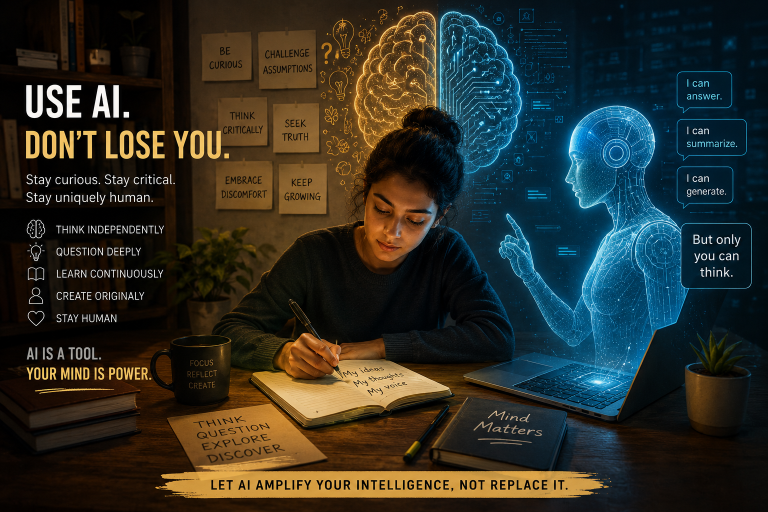
Used this way, AI becomes an intellectual sparring partner rather than a substitute for thinking.
It expands awareness instead of replacing it.
Keep Your Brain Strong
Think first.
Prompt second.
Write your own rough draft before asking AI to improve it.
Solve the problem yourself before checking the answer.
Read books that require sustained attention.
Memorize important ideas.
Practice boredom.
Spend time thinking without immediately searching.
Allow your own mind to wrestle with uncertainty.
That discomfort is where intelligence grows.
The Spiritual Dimension
From a yogic perspective, consciousness evolves through awareness.
Not automation.
Meditation is not valuable because it gives us more information.
It is valuable because it strengthens the witness.
The capacity to observe.
Discern.
Remain present.
AI can organize your thoughts.
It cannot cultivate awareness.
It can generate spiritual language.
It cannot experience stillness.
It can explain enlightenment.
It cannot awaken.
That journey remains uniquely human.
The Future Belongs to People Who Can Think
Artificial intelligence is not making human intelligence obsolete.
It is making independent thinking more valuable than ever.
When everyone has access to the same machine…
Original insight becomes the competitive advantage.
Discernment becomes the rare skill.
Wisdom becomes priceless.
The future won’t belong to the people who ask AI the most questions.
It will belong to the people who ask the questions AI never thought to answer.
Because the greatest technology you will ever possess is still the one that sits quietly between your ears.
Train it.
Protect it.
Challenge it.
And let artificial intelligence amplify your humanity—
Never replace it.