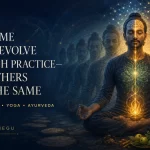

Along the ancient banks of the Ganges in Varanasi, one of the most fascinating spiritual experiments of recent years quietly unfolded.
A YouTuber known as Dakota of Earth, together with Mexican shaman Jose, offered 5-MeO-DMT—often called sapo because it is traditionally associated with the secretion of the Sonoran Desert toad—to several Indian sadhus.
The question was profound.
What happens when one of the world’s most powerful psychedelic substances meets a spiritual tradition that has spent more than two thousand years exploring consciousness without chemical assistance?
The answers were far more nuanced than many expected.
Some participants described overwhelming visions.
One sadhu, Baba Raendra, reportedly wept after experiencing what he described as a fully manifest vision of Lord Vishnu sustaining the entire universe.
Another practitioner, an Aghori Mataji, simply smiled and said:
“Success. Success.”
Yet it was the response of one elder Aghori, Bavani Baba, that perhaps revealed the deepest teaching.
The Man Who Lived in the Cremation Grounds
Bavani Baba was not an ordinary seeker.
As an Aghori practitioner, his life was already dedicated to confronting impermanence directly.
He meditated among funeral pyres.
He practiced where most people feared to even stand.
His spiritual path was built upon dissolving fear, ego, attachment, and the illusion of separation—not through extraordinary experiences, but through extraordinary discipline.
When offered the psychedelic, he accepted.
He reportedly took an exceptionally large dose.
Those around him expected astonishment.
Instead…
He sat completely motionless.
No dramatic movements.
No emotional outburst.
No overwhelming reaction.
Just silence.
Five minutes later he opened his eyes and calmly asked:
“Are you happy now?”
It may be one of the most profound responses ever given after a psychedelic experience.
“The Experience Is Real…”
Bavani Baba did not dismiss what had happened.
He acknowledged that the experience was genuine.
He recognized the power of what he had witnessed.
But then he offered an important distinction.
He reportedly said:
“Sapo is one five-minute light, but it goes. Sadhu means light forever.”
In one sentence he summarized an entire philosophy of spiritual development.
The experience itself was not false.
It simply was not permanent.
Mystical Experiences Are Not Enlightenment
Modern culture often equates intensity with transformation.
The stronger the experience…
The deeper the awakening must be.
But nearly every authentic contemplative tradition teaches something very different.
A powerful experience may change your perspective.
It may inspire your journey.
It may remove doubt.
It may even reveal dimensions of consciousness that you never imagined existed.
Yet an experience—even a profoundly meaningful one—is not the same as realization.
One happens to you.
The other becomes who you are.
That distinction changes everything.
Borrowed Consciousness vs Cultivated Consciousness
There is an important difference between visiting a mountain and building a home there.
A helicopter can place you on the summit for a few minutes.
You may witness breathtaking views.
But once the fuel runs out…
You descend.
Climbing the mountain yourself changes something different.
Every step reshapes your lungs.
Your muscles.
Your endurance.
Your relationship with gravity itself.
The summit becomes part of you because the journey transformed you.
Spiritual practice works much the same way.
A psychedelic may temporarily dissolve the ordinary sense of self.
Years of meditation gradually transform the very mechanisms that create that self.
One offers a glimpse.
The other rewires identity.
What the Yogic Traditions Have Been Saying for Millennia
In the Yogic tradition, enlightenment has never been defined by visions.
Many practitioners experience visions.
Many never do.
Neither determines realization.
Patañjali’s Yoga Sutras repeatedly warn practitioners not to become attached to extraordinary experiences or siddhis.
The goal is freedom from identification.
Not accumulation of mystical phenomena.
Similarly, Advaita Vedanta asks a simple but devastating question:
Who is the one witnessing the experience?
Not:
What did you see?
Not:
How intense was it?
But:
Who remains when the experience ends?
That question cannot be answered by chemicals alone.
It becomes clear only through sustained observation, inquiry, and inner refinement.
Neuroplasticity Needs Repetition
Modern neuroscience offers an interesting parallel.
One powerful experience can certainly alter brain activity.
Research suggests psychedelics may temporarily reduce rigid patterns of activity associated with the brain’s default mode network, allowing unusual states of perception and cognition.
However, lasting behavioral change typically depends on what happens afterward.
Neural pathways strengthen through repeated practice.
Meditation.
Breathwork.
Ethical living.
Emotional regulation.
Compassion.
Daily habits.
Experience may open a door.
Practice determines whether you actually move into the house.
Why the Sadhus Were So Calm
Many viewers expected the sadhus to have the strongest psychedelic experiences ever recorded.
Instead, several appeared surprisingly stable.
Why?
Perhaps because they had already spent decades practicing the dissolution of the ego without external substances.
If someone has repeatedly entered deep meditative absorption, witnessed thoughts arise and dissolve, contemplated death, and loosened attachment to identity, an altered state may not feel entirely unfamiliar.
For such practitioners, the psychedelic may simply accelerate access to terrain they already know rather than reveal an entirely new landscape.
Whether or not that interpretation applies to every individual, it reflects an important principle: training matters.
The Seduction of Peak Experiences
There is nothing inherently wrong with profound altered states.
Many people describe them as deeply meaningful.
Some credit them with helping them overcome addiction, depression, or existential despair when used in appropriate therapeutic or ceremonial contexts.
But there is also a subtle danger.
We begin chasing the next experience.
The next ceremony.
The next revelation.
The next peak.
Meanwhile, ordinary consciousness—the place where we actually live our lives—remains unchanged.
We may become collectors of extraordinary moments while neglecting the patient work of becoming extraordinary human beings.
The Real Test
Spiritual maturity is rarely measured during peak states.
It is measured on ordinary Tuesday mornings.
How do you respond when someone insults you?
How do you treat your family?
Can you remain peaceful when plans collapse?
Can you forgive?
Can you love without needing recognition?
Can you sit quietly without reaching for distraction?
That is where realization is tested.
Not during five minutes of transcendence.
But during decades of ordinary life.
The Difference Between Seeing and Being
Dakota of Earth later reflected that there is a profound difference between seeing something in an altered state and becoming it through sustained practice.
That observation echoes one of the oldest teachings in Yoga.
Anyone can occasionally touch stillness.
Few become stillness.
Anyone can witness unconditional love.
Few embody unconditional love.
Anyone may glimpse unity.
Few consistently live as though separation has ended.
That transformation cannot be inhaled.
It must be integrated.
Moment by moment.
Breath by breath.
Choice by choice.
The Eternal Light
Perhaps Bavani Baba’s words deserve to be remembered far beyond this experiment.
“Sapo is one five-minute light, but it goes.”
“Sadhu means light forever.”
Whether one chooses meditation, prayer, yoga, contemplation, service, or other sincere paths of inner development, the invitation is the same.
Do not merely seek extraordinary experiences.
Become the kind of person whose ordinary presence radiates peace.
Because the highest goal of spirituality is not simply to visit enlightenment for a few minutes.
It is to become someone who carries that light into every conversation, every relationship, every challenge, and every breath.
The brightest light is not the one that flashes brilliantly for a moment.
It is the one that never needs to be relit.