
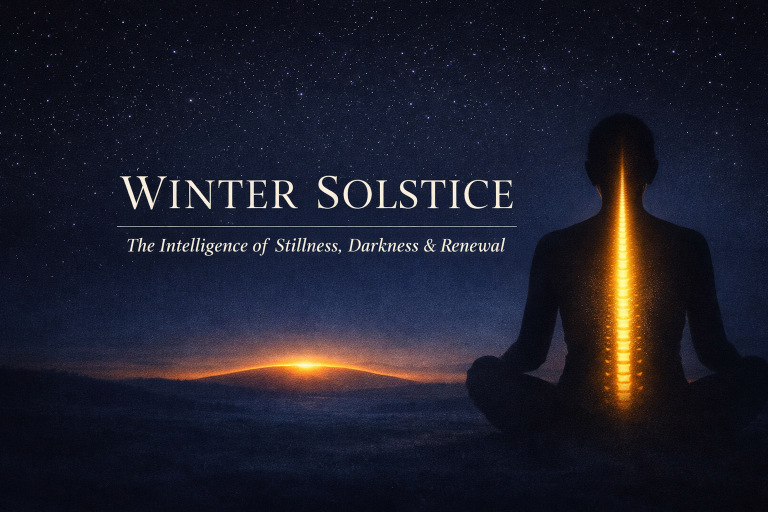
The Winter Solstice is often described poetically as the return of the light.
But that phrase, while beautiful, barely touches the depth of what this moment actually represents.
The Winter Solstice is not simply a date on the calendar.
It is a structural turning point in the relationship between the Earth, the Sun, and the human nervous system.
It marks a moment of maximum inward pull—gravitationally, neurologically, hormonally, and psychologically.
To understand the Winter Solstice fully, we must look at it through multiple lenses at once:
-
Astronomy
-
Neurobiology
-
Endocrinology
-
Yogic physiology
-
Seasonal wisdom
-
Consciousness studies
Only then does its true power become clear.
1. What the Winter Solstice Actually Is (Astronomically)
Astronomically, the Winter Solstice occurs when the Earth’s axial tilt positions the Sun at its lowest apparent point in the sky for a given hemisphere.
In the Northern Hemisphere, this happens around December 21–22.
Key facts:
-
The Earth is tilted at approximately 23.5°
-
On the Winter Solstice, the Sun’s rays strike the Tropic of Capricorn
-
This creates:
-
The shortest day
-
The longest night
-
The lowest solar arc across the sky
-
From this point forward, daylight begins to increase—slowly, almost imperceptibly at first.
This is not a dramatic shift.
It is a subtle reversal.
And subtle reversals are the most powerful kind.
2. Stillness Before Expansion: Why the Solstice Is a Pause, Not a Push
One of the most misunderstood aspects of the Winter Solstice is the idea that it is a time to launch.
In reality, the Solstice represents:
-
Suspension
-
Equilibrium
-
Neurological pause
The Sun does not immediately rise higher.
For several days, it appears almost motionless on the horizon.
Ancient cultures noticed this.
They called it “the Sun standing still” — solstitium.
Biologically and psychologically, this mirrors what the human system needs:
-
A pause
-
A reset
-
A recalibration
This is why forcing resolutions, goals, or massive outward action at this time often backfires.
The body is not ready yet.
3. Winter Solstice & the Nervous System
From a nervous system perspective, the Winter Solstice represents a dominant parasympathetic window.
Key shifts include:
-
Reduced external sensory stimulation
-
Increased melatonin secretion
-
Heightened interoception (internal sensing)
-
Increased cerebrospinal fluid (CSF) circulation during rest
-
Greater access to subconscious material
This is why winter dreams are often more vivid.
Why emotions surface unexpectedly.
Why fatigue and introspection increase.
This is not dysfunction.
It is biological intelligence.
The nervous system is prioritizing:
-
Repair
-
Memory consolidation
-
Emotional processing
-
Structural recalibration
When we override this with constant stimulation, productivity pressure, or forced positivity, we create seasonal nervous system conflict.
4. Melatonin, Darkness, and Consciousness
Darkness is not the enemy.
Darkness is information.
During the Winter Solstice period:
-
Melatonin secretion is naturally higher
-
Circadian rhythms shift inward
-
The pineal gland becomes more active
Melatonin is not just a sleep hormone.
It is:
-
A powerful antioxidant
-
A regulator of immune function
-
A modulator of consciousness
In yogic traditions, the pineal gland is associated with Ajna Chakra—the seat of inner vision.
This is why:
-
Meditation can feel deeper in winter
-
Inner imagery becomes stronger
-
Intuition sharpens when the system is rested rather than stimulated
Darkness is not absence.
It is depth.
5. Winter Solstice in Yogic Physiology: The Spine & Sushumna
In Kundalini Yoga, the spine is not merely structural.
It is directional.
Winter corresponds to:
-
Downward and inward pranic flow (Apana)
-
Reduced outward dispersion of energy
-
Increased potential for Sushumna activation—but only when the system is calm
This is why winter practices emphasize:
-
Grounding
-
Stillness
-
Gentle spinal alignment
-
Breath that regulates rather than excites
Trying to force high-energy Kundalini techniques in winter often destabilizes the nervous system.
Winter is not for ignition.
It is for alignment.
6. Ayurveda: Why Winter Is the Season of Repair
From an Ayurvedic perspective, Winter is dominated by:
-
Vata (cold, dry, subtle)
-
Kapha (heavy, slow, stabilizing)
The Solstice marks the deepest Vata point.
This is why the body requires:
-
Warmth
-
Oil
-
Regular routine
-
Nourishing foods
-
Emotional safety
Winter Solstice is the moment to:
-
Seal leaks
-
Repair tissues
-
Restore Ojas (vital essence)
Ignoring this leads to:
-
Anxiety
-
Insomnia
-
Burnout
-
Immune depletion
Honoring it builds long-term resilience.
7. Psychological Meaning: The Descent Into the Unconscious
Psychologically, the Winter Solstice represents a collective descent into the unconscious.
Carl Jung spoke of this phase as necessary for:
-
Integration
-
Shadow digestion
-
Soul renewal
This is the time when unresolved material rises—not to punish you, but to be processed.
If you feel:
-
More emotional
-
More reflective
-
Less outwardly motivated
You are not regressing.
You are integrating.
The psyche needs darkness to reorganize itself.
8. Ancient Cultures & Solstice Wisdom
Nearly every ancient civilization marked the Winter Solstice:
-
Stonehenge
-
Newgrange (Ireland)
-
Egyptian temples
-
Andean traditions
-
Vedic rituals
They understood something we’ve forgotten:
Life does not grow in straight lines.
It pulses.
Contracts.
Expands.
The Solstice was honored as a threshold, not a celebration of brightness, but of continuity.
The light returns because the dark was honored.
9. Why the Days After the Solstice Matter More Than the Day Itself
The Solstice is a pivot, not a peak.
The days immediately following are critical because:
-
The nervous system begins subtle reorientation
-
Intention becomes more potent when seeded gently
-
The psyche starts reorganizing toward future expression
This is why practices done in the days after the Solstice often land deeper than those done on the exact date.
Integration beats intensity.
10. How to Work With the Winter Solstice (Practically)
The most intelligent way to honor the Winter Solstice is not through grand declarations, but through precision.
Support your system by:
-
Creating silence
-
Reducing stimulation
-
Prioritizing warmth and rest
-
Practicing gentle spinal alignment
-
Regulating breath
-
Listening rather than deciding
This is not the time to demand answers.
It is the time to create conditions where answers emerge.
Closing Reflection: The Gift of the Dark
The Winter Solstice reminds us of something deeply uncomfortable for modern culture:
Growth does not begin with visibility.
It begins with stability in the dark.
Seeds do not sprout in light.
They sprout underground.
The Solstice is not asking you to shine yet.
It is asking you to be still enough to realign.
From that stillness, the next cycle is born—naturally, inevitably, and without force.