One of the most persistent misunderstandings in spiritual life is the belief that karma is a moral punishment system—a cosmic scorekeeper tallying good and bad deeds. The scriptures say something far more subtle, and far more liberating.
Karma does not bind action.
Karma binds unconsciousness.
Action performed without awareness creates residue.
Action performed with awareness dissolves it.
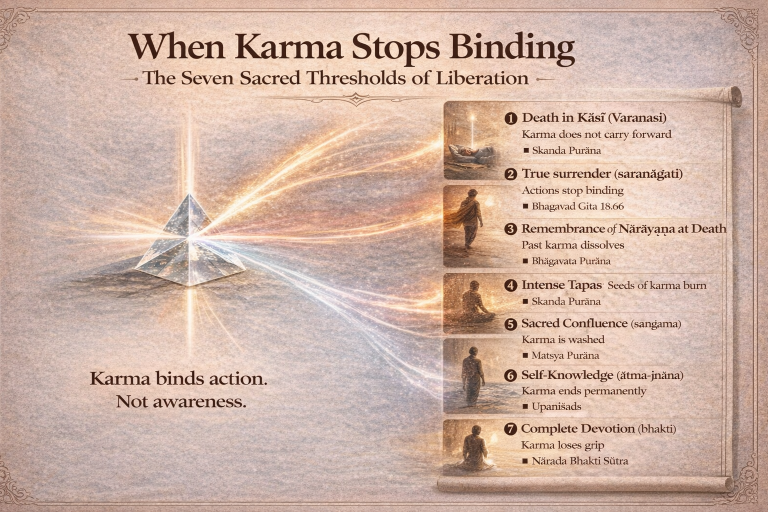
Across the Purāṇas, Upaniṣads, and the Bhagavad Gītā, there are specific moments—threshold states of consciousness—where karma is said to loosen, burn, wash away, or cease entirely. These are not loopholes. They are states of alignment so complete that karma no longer finds anything to attach itself to.
Let us walk through these seven moments—not as mythology, but as living spiritual technology.
1. Death in Kāśī: When the Soul Is Released from Return
The Skanda Purāṇa states that one who dies in Kāśī (Varanasi) does not carry karma forward.
This is not because of geography alone. Kāśī represents a perpetual field of liberation—a place where consciousness is continually oriented toward Shiva, the dissolver. Death there is not unconscious collapse, but often accompanied by mantra, remembrance, and surrender.
Symbolically, Kāśī represents any inner state where:
-
Identity is released
-
Fear of death dissolves
-
Awareness remains intact at transition
Karma requires continuity of identification.
Where identity ends, karma cannot continue.
2. True Surrender (Śaraṇāgati): When Action Loses Its Chains
In the Bhagavad Gītā (18.66), Krishna says:
“Abandon all dharmas and take refuge in Me alone. I shall liberate you from all sin.”
Śaraṇāgati is not passivity.
It is action without authorship.
When actions are no longer claimed as “mine,” there is no doer to bind. The same actions may continue—work, relationships, service—but they no longer create karmic debt because the egoic center has stepped aside.
Karma binds the doer, not the deed.
3. Remembrance of Nārāyaṇa at Death: The Final Thought Matters
The Bhāgavata Purāṇa emphasizes remembrance of the Divine at the moment of death.
Why?
Because the final thought reveals the deepest conditioning of the mind.
A life spent in remembrance trains consciousness to rest in the eternal, not cling to the temporary. When awareness dissolves into Nārāyaṇa—the sustaining intelligence of existence—past karmic momentum loses its anchor.
The mind exits through what it has practiced entering.
4. Intense Tapas: Burning the Seeds Before They Sprout
Tapas is often misunderstood as punishment or self-denial. In truth, tapas means conscious friction—the heat generated when awareness stays present inside discomfort.
According to the Skanda Purāṇa, intense tapas burns the seeds of karma before they fructify.
Karma is not only past action—it is stored potential.
Tapas dries the soil in which those seeds grow.
This includes:
-
Breath discipline
-
Vows
-
Sustained meditation
-
Ethical restraint lived consciously
Tapas does not erase memory.
It removes compulsion.
5. Sacred Confluence (Saṅgama): When Rivers—and Lives—Merge
The Matsya Purāṇa speaks of saṅgama—holy river confluences—as places where karma is washed.
Water has always symbolized flow without resistance. A saṅgama is not just where rivers meet, but where:
-
Past and future converge
-
Identity loosens
-
Flow overtakes control
Externally, this may be pilgrimage.
Internally, it is when opposing currents within you finally merge.
Karma cannot bind what no longer resists life.
6. Self-Knowledge (Ātma-Jñāna): When Karma Ends Entirely
The Upaniṣads are unequivocal:
With realization of the Self, karma ends permanently.
Why?
Because karma requires misidentification.
When you know yourself as the witnessing consciousness—not the body, not the mind, not the story—there is no locus for karma to land.
Actions continue, but they are like lines drawn on water.
Liberation is not improved destiny.
It is freedom from destiny altogether.
7. Complete Devotion (Bhakti): When Love Dissolves the Ledger
The Nārada Bhakti Sūtra teaches that in complete devotion, karma loses its grip.
Bhakti is not emotional dependence.
It is love so total that separation disappears.
When love is absolute:
-
Fear dissolves
-
Control relaxes
-
حساب (accounting) becomes meaningless
Karma thrives on transaction.
Bhakti ends transaction.
The Thread That Unites All Seven
Each of these moments shares one common element:
The dissolution of the separate self.
Whether through surrender, devotion, knowledge, austerity, sacred space, or the moment of death—karma falls away when the “I” that claims, resists, or fears dissolves.
So the teaching is simple, but uncompromising:
Karma binds action.
Not awareness.
Cultivate awareness—not to escape life, but to meet it fully.
And in that fullness, karma quietly releases its hold.