What if awareness begins not with thought, but with the body’s ability to enter coherence?
Most of us have been taught to think of consciousness as something that happens inside the brain.
We associate consciousness with thought, memory, identity, reasoning, language, self-awareness, and the private voice that seems to narrate our lives. We imagine that the brain processes information, assembles a picture of reality, and then produces the experience of being a person.
First the brain computes.
Then consciousness appears.
But what if that sequence is incomplete?
What if consciousness does not begin with thought?
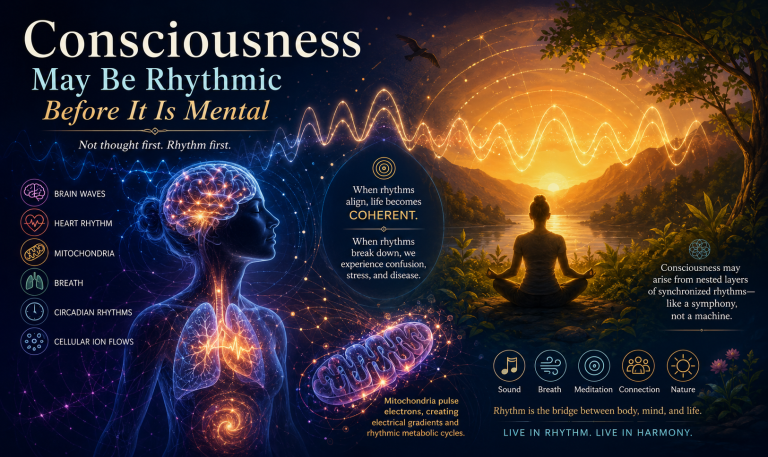
What if thought is one of the later expressions of a much deeper process—one that begins with rhythm, synchronization, and biological coherence?
Before the mind forms a sentence, the heart is already beating.
Before a memory is recalled, neurons are already oscillating.
Before we recognize ourselves as a separate identity, the lungs are expanding and contracting, hormones are moving in cycles, cells are exchanging ions, and mitochondria are pulsing electrons through their membranes.
Life does not begin as an idea.
Life begins as movement.
It begins as repetition, rhythm, timing, exchange, and relationship.
Perhaps consciousness is not simply something the brain produces. Perhaps it is something the whole living system becomes capable of expressing when its many rhythms become sufficiently organized.
Not thought first.
Rhythm first.
The Body Is Not a Machine. It Is an Orchestra
The human body is often described as a biological machine.
The heart is compared to a pump. The brain is described as a computer. The lungs function like bellows. The joints resemble hinges. The digestive system is imagined as a processing plant.
These comparisons can be useful, but they are also limited.
A machine can contain many parts without those parts sharing a meaningful relationship. A clock continues to function because its components interact mechanically. A living body, however, is not simply a collection of parts.
It is a coordinated field of rhythms.
Every system in the body moves in cycles.
The brain produces electrical oscillations across different frequency ranges. The heart beats with subtle variations from moment to moment. Breathing rises and falls. Blood pressure changes throughout the day. Hormones are released in pulses. Body temperature follows a circadian pattern. Sleep unfolds in repeating stages. Cells open and close ion channels. Muscles alternate between contraction and release.
Even at the smallest levels of biology, life is rhythmic.
Cells do not merely contain chemicals. They coordinate events in time.
Molecules bind and release. Membranes change their electrical charge. Genes become more or less active. Proteins fold, move, communicate, and break down. Metabolic processes accelerate and slow according to changing conditions.
The body is not merely asking, “Do we have the correct substances?”
It is also asking, “Are these processes happening at the right time, in the right sequence, and in relationship with one another?”
This is why health cannot be reduced to good chemistry alone.
Health is also synchronized timing.
A hormone may be beneficial at one time and disruptive at another. Cortisol helps us wake in the morning and respond to danger, but chronically elevated cortisol can disturb sleep, immunity, digestion, and mood. Melatonin supports sleep at night, but its timing matters. Insulin is essential, yet its rhythmic relationship with meals, movement, sleep, and circadian biology influences metabolic health.
The body does not only require the right signal.
It requires the right signal at the right moment.
That is rhythm.
What Happens When Rhythm Breaks Down?
Many forms of physical and psychological suffering involve some degree of lost timing.
Sleep disorders disrupt the rhythms of repair and restoration. Chronic stress changes the relationship between heart rate, breathing, digestion, and hormonal regulation. Jet lag temporarily confuses the body because internal clocks no longer match the external environment. Depression may alter sleep architecture, activity cycles, appetite, and daily hormonal rhythms. Anxiety can make the heart, breath, and nervous system behave as though danger is constantly approaching.
The person may still be alive, but the orchestra is no longer playing together.
One section accelerates.
Another falls behind.
Some signals become too loud, while others can barely be heard.
This does not mean that every illness is simply a rhythm problem. Disease is complex and can involve genetics, infection, injury, environment, nutrition, trauma, social conditions, and many other factors.
Yet rhythm is often part of the picture.
The body may have all the necessary instruments, but if they are not coordinated, the music becomes unstable.
We recognize this intuitively.
After several nights of poor sleep, thinking becomes slower. Emotions become more reactive. Hunger changes. Motivation declines. The world itself may appear darker or more threatening.
Nothing about our identity may have objectively changed, yet our experience of reality changes because the body’s rhythms have become disturbed.
This suggests that consciousness is not separate from biological timing.
The quality of awareness may be shaped by the quality of synchronization within the organism.
When rhythms are regulated, we may feel more present, clear, grounded, and connected.
When rhythms become fragmented, consciousness itself may feel fragmented.
The Mitochondrial Insight
Mitochondria are usually introduced as the powerhouses of the cell.
They help convert nutrients and oxygen into usable cellular energy. Without them, complex life as we know it would not be possible.
But mitochondria may be far more dynamic than the familiar textbook description suggests.
They are not motionless batteries sitting quietly inside cells. Mitochondria change shape, move, divide, merge, respond to stress, communicate with the nucleus, influence inflammation, participate in cell death, and adapt to the energetic needs of the organism.
Their activity is electrical as well as chemical.
Inside mitochondria, electrons move through the electron transport chain. This movement helps create a gradient across the inner mitochondrial membrane. That gradient is then used to produce ATP, one of the main forms of usable cellular energy.
This process does not occur as a perfectly static stream.
Mitochondrial activity can fluctuate. Membrane potentials can change. Metabolic states can oscillate. Reactive oxygen species can act not only as signs of damage, but also as signaling molecules when kept within appropriate ranges.
These rhythmic changes may help cells coordinate their behavior.
A single mitochondrion is part of a larger cellular environment. A cell is part of a tissue. A tissue belongs to an organ. Organs operate inside a body that is constantly responding to the world.
The smallest rhythms may therefore participate in larger rhythms.
Mitochondrial oscillations may influence cellular activity. Cellular activity may shape tissue behavior. Tissue behavior may affect the nervous system, hormones, immune function, perception, and mood.
This creates the possibility of nested organization.
Rhythms within rhythms.
The pulse of electrons within mitochondria.
The electrical activity of cells.
The coordinated behavior of organs.
The rhythm of the heart and breath.
The oscillations of neural networks.
The cycles of sleeping and waking.
The person’s relationship with sunlight, food, community, seasons, and environment.
Consciousness may not emerge from one isolated location. It may depend upon the coordinated relationship between many levels of living activity.
Life Is Chemical, Electrical, and Possibly Luminous
Biology is often explained primarily through chemistry.
Molecules interact. Neurotransmitters are released. Hormones bind to receptors. Enzymes accelerate reactions. Nutrients are broken down and rebuilt.
All of this is true.
But life is also electrical.
Every nerve impulse depends on changing electrical charges across cellular membranes. The heart’s activity is electrical enough to be measured through an electrocardiogram. Brain rhythms can be recorded through an electroencephalogram. Muscles contract through electrochemical signaling. Cellular membranes maintain voltage differences that are essential for communication and survival.
Life may also involve extremely faint light emissions sometimes described as biophotons.
Living cells can emit ultra-weak photons as a by-product of metabolic and oxidative processes. Researchers continue to investigate whether these emissions play any meaningful role in cellular communication or biological organization.
It is important not to exaggerate what is currently known.
The existence of ultra-weak light emissions does not prove that cells communicate through light in the way people sometimes imagine. It also does not prove that consciousness is a quantum field, that the body creates mystical light, or that mitochondria alone generate awareness.
Those ideas remain speculative.
Yet the broader insight is still compelling.
Living systems are not simply bags of chemicals.
They are dynamic, electrical, responsive, rhythmic, and relational.
Their activity unfolds across multiple scales at once.
This is precisely why consciousness may require a wider model than the image of a brain calculating data.
Consciousness as Resonance
Consider a musical instrument.
A violin does not create music merely because it contains wood, strings, and glue. It creates music because those materials are arranged in a way that allows vibration, resonance, and relationship.
The string moves.
The body of the violin amplifies the movement.
The surrounding air begins to vibrate.
The ear receives the pattern.
The nervous system interprets it.
Music emerges through relationship.
What if consciousness is similar?
Not a substance stored in the brain.
Not an object hidden inside the skull.
Not a single signal produced by a single structure.
But a living resonance created through the organized interaction of many processes.
A standing wave does not exist as an isolated object. It appears when patterns of movement reinforce one another. A symphony does not belong to one instrument. It emerges through timing, harmony, variation, tension, silence, and collective organization.
Consciousness may also be emergent in this way.
Neurons matter.
The brain matters.
But so do the signals arriving from the heart, lungs, gut, immune system, hormones, muscles, and sensory organs. The brain is continuously receiving information from the body. Much of what we call emotion, intuition, mood, and presence may be shaped by this ongoing communication.
The mind is not floating above the body.
It is embedded within it.
What we experience as “I” may therefore depend upon the stability of many synchronized systems.
When those systems cooperate, awareness may become more unified.
When they conflict, awareness may become noisy, scattered, or disoriented.
Perhaps consciousness is not located in one rhythm, but in the relationship among rhythms.
The Brain as Conductor—or Participant?
It is tempting to describe the brain as the conductor of the body’s orchestra.
There is some truth in this. The brain coordinates movement, interprets sensory information, regulates attention, helps control hormones, and participates in nearly every aspect of conscious experience.
But the conductor metaphor can still place too much authority in one location.
The brain is not directing the body from outside it.
The brain is also being directed.
The heartbeat changes neural activity. Breathing influences brain states. Gut signals shape mood and appetite. Hormones affect attention, energy, and emotion. Immune activity can change motivation and perception. Inflammation may influence cognition. Sleep deprivation transforms how the brain processes threat, reward, and memory.
The conductor is listening to the orchestra while conducting it.
In fact, the distinction between conductor and orchestra may be artificial.
The brain, body, and environment form a continuous feedback system.
Sunlight affects circadian timing.
Circadian timing affects hormones.
Hormones affect brain function.
Brain function affects behavior.
Behavior determines exposure to light, movement, food, relationships, and stress.
The system is circular rather than linear.
Consciousness may emerge through this ongoing loop.
We do not merely observe the world.
We are changed by what we observe.
We do not simply control the body.
The state of the body shapes who we believe ourselves to be.
Why Breath Changes Consciousness
Breathing is one of the clearest examples of the relationship between rhythm and awareness.
The breath is automatic, yet it can also be consciously influenced.
Most bodily rhythms are not available to direct voluntary control. We cannot simply command the heart to beat at a particular rate or instruct mitochondria to produce a precise amount of ATP.
But we can alter the rhythm of breathing.
We can slow it.
Deepen it.
Pause it.
Lengthen the exhalation.
Coordinate it with movement, mantra, or prayer.
Because breathing is connected to the nervous system, changes in breath can influence arousal, attention, heart rhythm, and emotional state.
Rapid, shallow breathing can accompany fear, agitation, or panic. Slower breathing can support calm and regulation. Rhythmic breathing can help shift the body from defensive activation toward a greater sense of safety.
This may be one reason spiritual traditions across the world have given breath such importance.
Pranayama in yoga.
Breath awareness in Buddhism.
Rhythmic breathing in contemplative prayer.
Sufi breathing practices.
Chanting synchronized with the breath.
Breath is not merely oxygen exchange.
It is a bridge between voluntary and involuntary life.
When we work with the breath, we are working directly with rhythm.
And when rhythm changes, consciousness often changes with it.
Mantra, Chanting, and the Architecture of Repetition
Mantra can appear irrational from a purely informational perspective.
Why repeat the same sound again and again?
If the purpose of speech is to communicate new information, repetition seems unnecessary.
But mantra is not primarily informational.
It is rhythmic.
The repetition of sound organizes attention. The breath becomes more regular. The mouth, tongue, throat, and nervous system participate in a recurring pattern. The mind is given a stable object. The person enters a different relationship with time.
Chanting can also synchronize groups.
When people sing, pray, breathe, or move together, their individual rhythms may begin to align. The shared pattern creates belonging. The nervous system receives signals of participation and social safety. The boundary between individual and collective experience may temporarily soften.
This is not proof of a mystical consciousness field.
It is, however, evidence that rhythm profoundly shapes human experience.
Ancient practices may have discovered this without needing modern instruments to measure it.
They knew that repetition changes the mind.
They knew that sound changes the body.
They knew that shared rhythm can create unity.
They knew that silence after sustained chanting feels different from ordinary silence.
The tradition may have used spiritual language.
Modern science may use the language of neural entrainment, autonomic regulation, attention, synchronization, and social bonding.
The vocabulary changes.
The experience remains recognizable.
Meditation Is Not Only About Stopping Thought
Meditation is often described as a technique for quieting the mind.
But this can create the impression that thoughts are the main problem and mental silence is the main goal.
A deeper understanding may be that meditation reorganizes rhythm.
When a person sits still, reduces sensory input, follows the breath, repeats a mantra, or maintains attention on a single object, the usual patterns of activity begin to change.
The breathing may slow.
The heart may become more regulated.
Muscular tension may decrease.
Attention becomes less scattered.
The nervous system receives fewer competing demands.
The inner experience begins to shift from fragmentation toward coherence.
Thoughts may still arise, but they are no longer pulling the whole system in multiple directions.
Meditation therefore may not be the destruction of thought.
It may be the restoration of timing.
The thoughts become like individual instruments within a larger composition rather than musicians playing different songs at once.
Stillness is not the absence of rhythm.
It is rhythm without unnecessary disturbance.
Drumming, Dance, and Collective Consciousness
Long before modern neuroscience, communities used drumming, dancing, singing, and ritual to alter states of consciousness.
A drum creates predictable repetition.
The body hears it, but it also feels it.
Movement begins to synchronize with sound. Breath follows movement. Attention narrows. The ordinary perception of time may shift. In collective settings, individuals begin to move together.
This can create emotional release, social bonding, trance, devotion, or a sense of unity.
Again, we should be careful not to turn every powerful experience into proof of an extraordinary scientific claim.
But we should also avoid dismissing what human cultures have repeatedly discovered.
Rhythm changes consciousness.
It can calm or excite.
Unify or destabilize.
Heal or manipulate.
A lullaby soothes an infant through voice, repetition, and relationship. Military marching uses rhythm to create unity and obedience. Music can awaken memories in people who struggle to access them through ordinary conversation. Collective singing can produce belonging among strangers.
Rhythm is not neutral.
It can regulate consciousness because consciousness is embodied.
The Rhythm of Relationship
Human beings do not regulate themselves alone.
From infancy, nervous systems learn through relationship.
A baby cannot independently regulate hunger, fear, temperature, or distress. The caregiver’s voice, face, touch, heartbeat, and breathing become part of the child’s regulatory environment.
The infant is not simply receiving food.
The infant is receiving rhythm.
The timing of response.
The repetition of comfort.
The rise and fall of the caregiver’s voice.
The predictability of presence.
The body learns whether the world is safe partly through these repeated relational patterns.
This continues throughout life.
A calm person can help settle another person. An agitated environment can make the body more vigilant. Eye contact, conversation, affectionate touch, music, shared meals, and communal prayer all create forms of interpersonal timing.
We often think of connection as an emotion.
But connection is also synchronization.
Two people listen and respond.
One speaks, the other pauses.
Breathing shifts.
Facial expressions mirror.
Tone changes.
Attention moves back and forth.
A healthy relationship has rhythm.
There is closeness and space.
Giving and receiving.
Speech and silence.
Action and rest.
When relationship loses rhythm, even love can become exhausting. One person pursues while the other withdraws. One speaks without being heard. Conflict escalates without repair. There is no return to calm.
The problem may not always be a lack of love.
Sometimes the system has lost its timing.
Circadian Rhythm and the Conscious Self
Among the most powerful biological rhythms is the circadian cycle.
The body does not experience every hour in the same way.
Morning light influences the internal clock. Hormones follow daily patterns. Alertness rises and falls. Digestion changes throughout the day. Body temperature fluctuates. Sleep pressure accumulates.
Yet modern life often asks us to behave as though time does not matter.
We eat late at night, expose ourselves to bright screens after sunset, work across time zones, sleep at irregular hours, and expect the mind to remain consistently clear.
But consciousness is not independent of the clock.
A person awake at 3 a.m. after several nights of poor sleep may interpret life differently from the same person after restorative rest and morning sunlight.
The beliefs may feel completely real in both moments.
Yet the state of the organism has changed.
This raises an important question:
How much of what we call personality is actually state?
How much despair is intensified by exhaustion?
How much confusion is worsened by irregular sleep?
How much emotional reactivity is shaped by hunger, hormonal timing, inflammation, or overstimulation?
This does not reduce human experience to biology.
It makes our understanding of the human being more compassionate.
Sometimes the mind does not need another argument.
It needs the body to return to rhythm.
Goethe and the Living Process
Johann Wolfgang von Goethe was not satisfied with understanding nature only by separating it into pieces.
He was interested in metamorphosis—how living forms change, develop, and reveal patterns through time.
For Goethe, the living world could not be fully understood as dead matter arranged into mechanisms. Life had to be approached through process, relationship, movement, and transformation.
A plant was not merely a collection of structures.
It was an unfolding.
Its leaf, flower, fruit, and seed were expressions of a changing form.
The organism had to be understood through its becoming.
This perspective has profound relevance to consciousness.
A thought is not a fixed object. It arises, develops, and disappears.
An emotion moves through phases.
Identity evolves.
Awareness expands and contracts.
The self is not a statue.
It is a process.
If consciousness is rhythmic, then it cannot be completely understood through static snapshots. Measuring one moment may miss the pattern unfolding across time.
To understand a melody, we cannot examine one note alone.
We must listen to the movement between notes.
Rudolf Steiner and the Importance of Rhythm
Rudolf Steiner also emphasized rhythm in human life, education, agriculture, health, and spiritual development.
His work remains controversial, and not all of his claims align with modern scientific standards. Yet his emphasis on the living relationship between repetition, development, environment, and consciousness continues to provoke meaningful questions.
Steiner saw the human being not merely as a physical mechanism, but as a living process shaped by cycles.
Breathing in and breathing out.
Sleeping and waking.
Activity and rest.
Expansion and contraction.
Learning and integration.
He understood that repetition does not have to mean lifeless routine. When repetition is conscious, it can become rhythm. And rhythm can create the conditions for development.
This distinction matters.
Routine can imprison us when it becomes unconscious.
Rhythm can support us when it remains responsive and alive.
A healthy rhythm is not rigid.
The heart does not beat with perfect mechanical sameness. Healthy heart rhythms contain variation. Breathing changes according to movement, emotion, and need. Nature repeats seasons, but no spring is identical to the one before it.
Living rhythm contains both order and variation.
Coherence is not uniformity.
Harmony does not require every instrument to play the same note.
Quantum Biology: Promise, Mystery, and Caution
Quantum biology explores whether quantum phenomena contribute meaningfully to biological processes.
Research has examined quantum effects in areas such as photosynthesis, enzyme activity, magnetoreception, and possibly other forms of biological organization.
This is an exciting field, but it is also one that attracts exaggerated claims.
The fact that quantum effects occur in biology does not automatically mean consciousness is quantum. It does not prove that thoughts directly control physical reality. It does not validate every idea involving energy fields, manifestation, or nonlocal awareness.
The relationship between quantum phenomena and consciousness remains uncertain and deeply debated.
It is therefore important to distinguish possibility from proof.
We can say that living systems may use forms of organization more subtle than classical mechanical models once assumed.
We can say that biological processes involve oscillation, synchronization, electrical gradients, and complex interactions across scales.
We can say that consciousness appears closely related to coordinated brain and bodily activity.
But claiming that mitochondrial rhythms generate consciousness, or that consciousness is a quantum resonance field, goes beyond what has been firmly established.
Still, speculative questions have value when they are held honestly.
Science advances by asking whether the current model is complete.
The purpose is not to replace one rigid belief with another.
It is to remain open without abandoning discernment.
Coherence Is Not Perfection
The word coherence can easily become another spiritual ideal.
We may begin to believe that a coherent person is always peaceful, regulated, positive, and harmonious.
But living coherence does not mean the absence of disturbance.
A healthy system must be able to respond to danger.
The heart must accelerate during exertion.
The nervous system must mobilize when action is needed.
Grief must be allowed to disrupt ordinary rhythm.
Anger may create the energy necessary to protect a boundary.
Fear can sharpen attention.
The goal is not permanent calm.
The goal is flexibility.
A coherent system can become activated and then recover.
It can move into effort and return to rest.
It can experience conflict and find repair.
It can face uncertainty without permanently losing organization.
The problem is not that rhythm changes.
The problem is when the system becomes trapped.
Chronic activation.
Chronic collapse.
Chronic sleeplessness.
Chronic suppression.
Chronic overstimulation.
The healthiest rhythm is not one that never changes.
It is one that can change without losing the capacity to return.
Healing as the Restoration of Rhythm
This perspective changes how we might approach healing.
We often begin with content.
What am I thinking?
What belief must I change?
What story am I telling myself?
These questions matter.
But sometimes the body is too dysregulated to think clearly.
A person may understand intellectually that they are safe while their nervous system continues to behave as though danger is present.
In such moments, healing may begin not with a better thought, but with a steadier rhythm.
Regular sleep.
Morning light.
Nourishing meals.
Breathing practices.
Gentle movement.
Chanting.
Walking.
Time in nature.
Consistent human connection.
Periods of silence.
Predictable rituals.
These practices may appear simple, but simplicity does not mean insignificance.
Rhythm creates safety through repetition.
The body learns through experience.
One regulated breath may not transform a life. But thousands of conscious breaths can gradually teach the system a different way of being.
One night of sleep may not repair years of exhaustion. But a reliable relationship with rest can reshape mood, metabolism, attention, and resilience.
One mantra may not silence the mind. But sustained repetition can create an inner pathway that becomes easier to return to.
Healing is rarely one dramatic moment.
It is often the patient restoration of timing.
The Spiritual Meaning of Rhythm
Spiritual traditions have long understood the universe through cycles.
The movement of the sun.
The phases of the moon.
The seasons.
The tides.
Birth and death.
Inhalation and exhalation.
Sound and silence.
Creation and dissolution.
Rhythm reminds us that nothing living exists in isolation.
Every inhale depends on the atmosphere.
Every meal depends on soil, sunlight, water, and countless forms of life.
Every heartbeat is inherited from an unbroken lineage of living bodies.
Consciousness may feel private, but the conditions that support it are relational.
We awaken because light enters the eyes.
We calm because another person speaks gently.
We remember because a scent returns us to childhood.
We feel sacred because a sound, place, person, or ritual reorganizes our awareness.
The spiritual insight is not necessarily that rhythm proves a cosmic theory.
It is that rhythm reveals relationship.
We are not separate observers standing outside life.
We are participants within its movement.
Perhaps the Self Is a Song
What we call the self may be less solid than it appears.
The body changes.
The cells change.
Beliefs change.
Relationships change.
Memories change each time they are recalled.
Even the sense of identity shifts according to context.
We are not exactly the same person when frightened, rested, in love, ashamed, inspired, grieving, or deeply present.
Yet something continues.
Not as an unchanging object, perhaps, but as a recognizable pattern.
A song can be played on different instruments and remain the same song.
Its tempo can change.
Its key can change.
Its interpretation can change.
Still, something essential is preserved through relationship and structure.
Perhaps the self is like that.
Not a fixed thing.
A pattern continually being recreated.
A rhythm maintained through the interaction of body, brain, memory, relationship, environment, and awareness.
Consciousness may be the experience of that pattern from within.
Learning to Listen Before Trying to Control
Modern culture teaches us to manage life through force.
Optimize the body.
Control the mind.
Increase productivity.
Override fatigue.
Suppress emotion.
Push through resistance.
But an orchestra cannot be tuned through violence.
It must be listened to.
What is too loud?
What has disappeared?
Which rhythm is rushing?
Which part has not rested?
What is the breath doing?
What is the heart communicating?
When does the body feel most alive?
Which environments create expansion?
Which relationships create contraction?
Healing may begin when we stop demanding that the body obey the mind and begin allowing the mind to listen to the body.
This does not mean blindly following every impulse.
The body carries wisdom, but it also carries conditioning, trauma, habit, and fear.
Listening requires discernment.
Still, the body often reveals what the conscious mind has ignored.
Exhaustion reveals unsustainable effort.
Tension reveals guardedness.
Restlessness reveals unprocessed activation.
Numbness reveals overload.
The body’s rhythms are not enemies to conquer.
They are messages to understand.
A More Rhythmic Way of Living
To live rhythmically does not require abandoning modern life.
It means recognizing that the body is not endlessly adaptable without consequence.
It means creating repeated points of return.
Waking at a relatively consistent time.
Receiving natural light in the morning.
Eating with awareness rather than constant distraction.
Making space between stimulation and sleep.
Breathing consciously before reacting.
Creating rituals around work, rest, prayer, and connection.
Allowing the week to contain both effort and recovery.
Following seasons where possible.
Respecting periods of inwardness rather than demanding constant productivity.
Returning to practices not only when life falls apart, but because repetition builds stability.
Rhythm is not another achievement.
It is a relationship.
It cannot be forced into existence through perfectionism.
It is built gradually through listening, consistency, and responsiveness.
Not Thought First. Rhythm First.
Thought is extraordinary.
It allows us to imagine, plan, communicate, question, and create. It gives consciousness language and reflection.
But thought may not be the foundation.
Beneath every thought is a living body.
Beneath every idea is a nervous system.
Beneath every memory are electrical and metabolic processes.
Beneath the story of who we are are countless rhythms that must remain sufficiently coordinated for the story to be experienced at all.
Consciousness may therefore be less like software running inside a biological computer and more like music arising from a living instrument.
The brain is part of the instrument.
The heart is part of the instrument.
The breath, cells, mitochondria, senses, hormones, relationships, and environment all participate.
When these rhythms move into greater coherence, awareness may become clearer.
When they lose relationship, the mind may become fragmented.
This does not solve the mystery of consciousness.
But it gives us a different way to approach it.
Not as a thing hidden somewhere inside the brain.
Not only as thought, memory, or identity.
But as a living event.
A resonance.
A continually renewed harmony between countless processes.
Perhaps consciousness is not simply what the brain computes.
Perhaps it is what the whole system becomes capable of experiencing when life begins to listen to itself.
And perhaps healing is not always about creating a new thought.
Sometimes healing begins by returning to the oldest intelligence in the body:
the intelligence of rhythm.
Reflection
What if your mind is not the sole creator of your experience, but one voice within a much larger orchestra?
What if clarity depends not only on what you think, but also on how you sleep, breathe, move, eat, connect, and rest?
What if meditation works not because it helps you escape the body, but because it helps the body remember coherence?
What if prayer is a rhythm of return?
What if mantra is a form of inner tuning?
What if consciousness is less like a computer processing information and more like a musical instrument maintaining harmony?
Before trying to change the next thought, pause.
Feel the breath.
Listen to the heart.
Notice the rhythm beneath the story.
The mind may speak in words.
But life speaks first in pulses.