
Could an ancient fermented food offer a biological defense against one of modern life’s newest pollutants?
For generations, kimchi has occupied a sacred place at the Korean table.
It was never merely cabbage preserved with salt. It was a living food—transformed through fermentation, shaped by season, region, family tradition, temperature, time, and microbial intelligence.
Long before humanity understood probiotics, the microbiome, or bacterial metabolites, people understood something through experience: fermentation could preserve nourishment, deepen flavor, support digestion, and sustain communities through difficult seasons.
Now scientists have discovered something inside kimchi that its creators could never have anticipated.
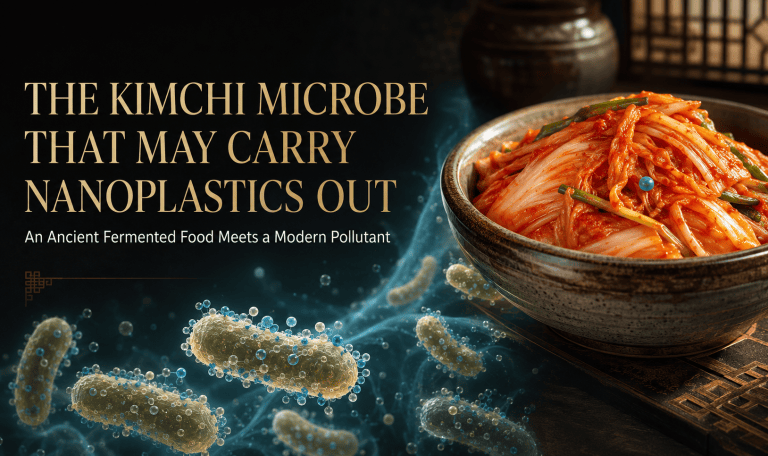
A particular bacterium isolated from kimchi appears capable of attaching itself to nanoplastic particles inside the digestive environment—and helping carry those particles out through the stool.
The finding does not yet prove that eating kimchi can cleanse plastic from the human body. The research involved laboratory experiments and germ-free mice, not human clinical trials.
Yet the discovery is genuinely remarkable.
It suggests that the microbial world preserved within traditional fermented foods may possess protective capacities that modern science is only beginning to recognize.
And perhaps even more poetically, it raises a profound possibility:
One of the biological answers to the pollution created by modern industrial life may already be living inside an ancient jar of fermented vegetables.
Plastic Has Entered the Human Body
Plastic pollution is no longer confined to oceans, beaches, landfills, and wildlife.
Plastic is now part of the human environment—and increasingly, part of the human body.
Larger plastic objects gradually break down through sunlight, heat, friction, weathering, and chemical degradation. They become smaller fragments known as microplastics. Those fragments can continue breaking apart into even smaller particles called nanoplastics.
Nanoplastics are generally described as plastic particles smaller than one micrometer—less than one-thousandth of a millimeter.
At this scale, plastic behaves differently.
A visible piece of plastic may remain outside the body or pass through the digestive system. A nanoplastic particle, however, may be small enough to interact with cells, biological membranes, proteins, and tissues.
Human exposure may occur through drinking water, food, food packaging, household dust, synthetic fabrics, cosmetics, industrial pollution, and the gradual degradation of plastic materials throughout the environment.
Researchers are investigating whether some of these extremely small particles can cross the intestinal barrier, enter the circulation, and reach tissues beyond the digestive tract. Experimental research has raised concerns about possible accumulation in organs such as the liver, kidneys, and brain, although scientists are still determining how exposure levels, particle size, plastic type, and surface chemistry affect human health.
The concern is not merely that plastic enters the digestive system.
The deeper concern is that some particles may be small enough to move beyond it.
What the body cannot prevent from entering, it must somehow neutralize, isolate, transform, or eliminate.
That is where one unusual kimchi-derived bacterium becomes especially interesting.
Meet Leuconostoc mesenteroides CBA3656
Kimchi contains a dynamic community of microorganisms that changes throughout fermentation.
Among these are lactic acid bacteria—microbes that help convert carbohydrates in vegetables into organic acids and other compounds. These microorganisms contribute to kimchi’s characteristic acidity, aroma, preservation, and flavor.
Researchers at the World Institute of Kimchi in South Korea examined a strain called Leuconostoc mesenteroides CBA3656.
The strain had been isolated from kimchi, but the scientists were not studying it merely for its role in fermentation. They wanted to know whether it could interact with polystyrene nanoplastics.
Their findings, published in Bioresource Technology, revealed an unexpectedly powerful binding capacity.
Under standard laboratory conditions, CBA3656 adsorbed approximately 87% of the polystyrene nanoplastics tested.
“Adsorption” is an important word here. It does not mean that the bacterium absorbed or digested the plastic. Instead, the plastic particles attached to the bacterium’s outer surface.
Imagine microscopic pieces of plastic encountering bacterial cells whose surfaces function almost like biological Velcro. Chemical structures on the bacterial cell wall appear to attract and hold the particles.
The plastic is not necessarily destroyed.
It is captured.
That distinction matters because breaking nanoplastics into even smaller fragments may not solve the biological problem. Binding them into a larger microbe–plastic complex, however, could make them less likely to pass freely across the intestinal barrier and more likely to travel through the digestive tract.
The bacterium may therefore act not as a plastic-eating organism, but as a microscopic carrier.
The Real Test Was the Intestinal Environment
Many materials bind contaminants in a controlled laboratory dish. Far fewer continue doing so under the complex conditions found inside a living digestive system.
The human intestine is not a calm container of water.
It contains digestive enzymes, bile salts, varying acidity, food compounds, minerals, mucus, immune molecules, and an enormous population of competing microorganisms. A bacterial strain that captures plastic under ideal laboratory conditions may release it when exposed to the gut.
To investigate this, the researchers tested CBA3656 in a solution designed to simulate aspects of the human intestinal environment.
They also tested a comparison strain, Latilactobacillus sakei CBA3608.
Under ordinary laboratory conditions, the two strains performed similarly: CBA3656 showed an adsorption efficiency of 87%, while the reference strain reached approximately 85%.
Under simulated intestinal conditions, however, their behavior diverged dramatically.
The binding efficiency of the comparison strain fell to around 3%.
CBA3656 retained an adsorption level of approximately 57%.
That resilience may be the most important part of the laboratory findings. CBA3656 did not simply attach to plastic in a favorable environment. It continued holding a substantial proportion of the particles under conditions intended to resemble those encountered in the intestine.
Something about the composition of its cell wall allowed it to maintain its grip.
The study identified several chemical functional groups on the bacterial surface that may participate in this interaction. Rather than acting as literal mechanical hooks, these surface structures create weak chemical attractions that collectively help the nanoplastics adhere to the bacterium.
One interaction may be small.
Thousands of interactions across the bacterial surface may be enough to keep the particle attached.
What Happened in the Mice?
The researchers then moved beyond the laboratory dish.
They tested CBA3656 in germ-free mice—animals raised without the conventional community of microorganisms normally present in the gut. Using germ-free mice allowed the team to examine the interaction between this particular bacterial strain and the nanoplastics with less interference from other microbes.
Both male and female mice that received CBA3656 excreted more than twice the amount of nanoplastics in their feces compared with mice that did not receive the bacterium.
In simple terms, more plastic was leaving through the stool.
This result supports a plausible biological mechanism:
- CBA3656 enters the intestinal environment.
- Nanoplastic particles attach to the surface of the bacterial cells.
- The combined bacteria–plastic complexes remain within the digestive tract.
- The particles are carried forward and eliminated through feces.
The findings do not yet establish every step of that mechanism conclusively. The researchers detected greater fecal excretion, but the study did not measure whether the treated mice had correspondingly lower concentrations of nanoplastics in their organs.
Greater plastic in the stool strongly suggests improved removal from the gut, but it does not automatically prove that tissue accumulation or toxicity was reduced.
Even so, the result provides something important: living-animal evidence that microbial adsorption may promote nanoplastic excretion.
This was not merely a reaction observed in a test tube.
The interaction continued inside a biological system.
Does This Mean Eating Kimchi Will Remove Plastic From Your Body?
Not yet.
This is where enthusiasm must remain connected to accuracy.
The researchers studied an isolated and identified strain of Leuconostoc mesenteroides. They did not conduct a human trial in which people ate ordinary kimchi and were shown to eliminate more nanoplastics.
Several important questions remain unanswered.
Not every kimchi is microbiologically identical
Kimchi is an ecosystem, not a standardized pill.
Its microbial composition depends on the vegetables, salt concentration, seasonings, fermentation temperature, duration, preparation method, geographic region, storage conditions, and whether the final product has been pasteurized.
A jar of kimchi may contain Leuconostoc mesenteroides, but it may not contain the specific CBA3656 strain. Even when related bacteria are present, they may not exist in the concentration used in the experiment.
The experiments used polystyrene nanoplastics
Plastic is not one substance.
Polystyrene, polyethylene, polypropylene, polyethylene terephthalate, polyvinyl chloride, nylon, and other polymers have different structures and surface characteristics. A bacterium that binds one kind of nanoplastic may not bind every other kind with equal efficiency.
The particles encountered in real life may also carry dyes, plasticizers, metals, proteins, environmental contaminants, or biological coatings that change how they interact with microbes.
Germ-free mice do not have an ordinary microbiome
A conventional human intestine contains trillions of microorganisms competing for nutrients and attachment sites.
Those microbes could strengthen, weaken, or alter the performance of CBA3656. The bacterium may not survive in sufficient numbers, may behave differently, or may interact with existing microbial communities in ways that cannot be predicted from a germ-free mouse model.
Human dosing has not been established
Researchers do not yet know how much of the strain a person would need, how frequently it would need to be consumed, how long it would remain active, or whether it could meaningfully change nanoplastic excretion in humans.
There is therefore no scientifically established “kimchi plastic detox” protocol.
The accurate conclusion is not that kimchi has been proven to purge plastic from the human body.
The accurate conclusion is that a bacterium isolated from kimchi has demonstrated an unusual ability to bind polystyrene nanoplastics and increase their fecal excretion in an early animal model. The published study is available through Bioresource Technology, and the World Institute of Kimchi’s research announcement summarizes the laboratory and animal findings.
That conclusion is more cautious—but still extraordinary.
The Cell Wall as a Living Detoxification Surface
The word “detox” has become so loosely used that it often obscures more than it explains.
The body already possesses sophisticated systems of detoxification and elimination. The liver transforms many compounds. The kidneys filter the blood. The intestines help prevent unwanted substances from entering and carry waste out of the body. The lungs, lymphatic system, skin, immune system, and microbiome all participate in maintaining internal balance.
What makes this study fascinating is that the bacterium may contribute through a straightforward physical process.
It does not need to “know” that plastic is harmful.
It does not need to metabolize the particle or convert it into a beneficial compound.
Its surface simply binds the plastic.
This is known as biosorption: the passive attachment of a substance to biological material. Bacteria, fungi, algae, and plant materials have all been studied for their capacity to adsorb environmental contaminants.
The kimchi strain suggests that biosorption may also be relevant inside the digestive tract.
If a potentially absorbable particle becomes attached to a much larger bacterial cell, its biological journey could change. Instead of moving independently toward the intestinal wall, it may remain associated with the microbial mass traveling toward elimination.
The bacterium becomes a temporary vehicle.
Its cell wall becomes a protective surface.
The digestive tract becomes not only a place of absorption, but a place where environmental contaminants may be intercepted before they enter more deeply into the body.
Fermented Foods as an Ancient Biological Partnership
Fermentation is one of humanity’s oldest collaborations with the invisible world.
Long before microscopes revealed bacteria and yeast, cultures across the world learned how to invite microorganisms into food:
- Kimchi in Korea
- Sauerkraut in Central and Eastern Europe
- Kanji, idli, dosa, and fermented pickles in India
- Miso, natto, and traditional soy ferments in Japan
- Curtido in Central America
- Fermented dairy throughout Central Asia, the Middle East, and Europe
- Injera in Ethiopia
- Fermented cassava preparations across Africa and South America
These traditions were not built from microbial theory. They emerged from observation, relationship, patience, and repetition.
People discovered that properly fermented foods could last longer, become easier to digest, develop richer flavors, and sometimes remain safer through seasonal scarcity.
Modern science later revealed that fermentation can alter nutrients, produce organic acids and bioactive compounds, reduce certain antinutrients, and introduce living microorganisms—provided the food remains unpasteurized and the organisms survive storage and digestion.
Now another dimension is emerging.
Microbes in fermented foods may interact not only with nutrients and the human microbiome, but also with pollutants created by the modern environment.
This does not mean every fermented food captures nanoplastics. Nor does it mean traditional communities secretly understood plastic toxicology centuries ago.
It means that living biological systems frequently possess capacities beyond the single purpose for which humans have valued them.
A bacterium involved in preserving cabbage may also have a surface capable of capturing a synthetic particle that did not exist during most of human evolution.
Life improvises.
And sometimes ancient biological relationships offer unexpected tools for entirely new problems.
Is Kimchi Still Worth Eating?
Yes—if it suits your body, dietary needs, and tolerance—but not because it has been proven to remove plastic.
Kimchi is rich in vegetables and fermentation-derived compounds. Depending on how it is made and stored, it may contain living microorganisms. It can add plant diversity, fiber, acidity, flavor, and microbial variety to a meal.
Traditional kimchi is not always vegetarian. Some recipes contain fish sauce, shrimp paste, oysters, or other seafood ingredients. Those following a vegetarian or vegan diet should check the ingredients or prepare a plant-based version.
Salt content may also be relevant for people who have been advised to limit sodium. Portions and the total dietary pattern matter.
For those seeking live cultures, refrigerated and unpasteurized kimchi is generally more likely to contain viable microorganisms than a shelf-stable product that has been heat-treated. But even live kimchi should not be assumed to contain CBA3656 or reproduce the results of the study.
Perhaps the most intelligent way to receive this research is not to begin consuming enormous bowls of kimchi in the hope of “detoxing” plastic.
It is to appreciate kimchi as part of a diverse, plant-rich, minimally processed diet while recognizing that the therapeutic potential of particular kimchi-derived strains is still being investigated.
The food remains valuable.
The medical claim remains unproven.
Both statements can be true at once.
We Still Need to Reduce Plastic Exposure
No microorganism should become an excuse to ignore the source of the problem.
Even if future human trials show that CBA3656 increases nanoplastic elimination, preventing unnecessary exposure will remain essential.
Practical steps may include:
- Using glass or stainless steel for food and water when convenient
- Avoiding heating food in plastic containers
- Allowing hot food to cool before placing it in plastic
- Replacing severely scratched or deteriorated plastic containers
- Reducing reliance on single-use plastic packaging
- Choosing loose-leaf tea or plastic-free tea bags
- Limiting heavily packaged and ultra-processed foods
- Washing hands before eating, particularly after handling dust or synthetic materials
- Ventilating rooms and removing household dust regularly
- Washing synthetic clothing gently and less frequently when appropriate
- Supporting policies and businesses that reduce plastic production at its source
No one can completely avoid microplastic and nanoplastic exposure in the modern world. The burden should not be placed entirely on individuals when plastic is embedded throughout food production, clothing, transportation, healthcare, construction, and global supply chains.
But exposure reduction and biological resilience do not have to be competing approaches.
We can reduce what enters while studying how the body—and the microbiome—may help remove what cannot be avoided.
The Greater Meaning of This Discovery
There is something deeply instructive about this research.
Modern industry created a form of pollution so small that it can travel through food, water, air, and perhaps through biological barriers.
The response may eventually involve advanced filtration systems, redesigned materials, stronger regulation, environmental remediation, and new medical technologies.
Yet one possible piece of the solution emerged from a traditional fermented food.
Not from the cabbage alone.
Not from the chili, garlic, ginger, or salt alone.
But from the relationship among food, microorganisms, environment, and time.
This is precisely what traditional food wisdom has always preserved: not merely ingredients, but living processes.
We often look at ancestral foods and ask which vitamin, antioxidant, probiotic, or isolated molecule explains their value. But fermented foods remind us that nourishment is not always the action of a single compound.
Sometimes it is ecological.
Sometimes the benefit lives in the community of organisms, their cell walls, their metabolites, their interactions, and their ability to respond to changing conditions.
CBA3656 may eventually become the basis of a targeted probiotic, a functional food, or a biological strategy for reducing intestinal nanoplastic exposure. Or future trials may show that its effects are narrower in ordinary human bodies than they appeared in the laboratory and germ-free mice.
Science must now determine which possibility is true.
But the study has already opened a new door.
It shows that food-associated microorganisms can physically interact with nanoplastics and potentially influence whether those particles remain in the digestive tract or leave the body.
That is not a wellness slogan.
It is a testable biological mechanism.
The Answer May Be Alive
We should not romanticize the past or imagine that every ancient food is a cure for every modern illness.
But neither should we dismiss the intelligence embedded in traditional food systems simply because their creators did not describe them using modern scientific language.
Fermentation is biotechnology practiced before the word biotechnology existed.
Kimchi is a living archive of that knowledge.
Within it, researchers found a bacterium whose surface could capture up to 87% of the nanoplastics tested under standard laboratory conditions, retain approximately 57% binding under simulated intestinal conditions, and more than double nanoplastic excretion in germ-free mice.
Those findings do not yet tell us to prescribe kimchi for plastic exposure.
They tell us where to look next.
Human trials must determine whether the strain survives in an ordinary gut, whether it works alongside a complex microbiome, whether it binds multiple types of plastic, whether it reduces absorption into tissues, and what dose would be both effective and safe.
Until then, kimchi remains what it has always been: a vibrant fermented food with a long cultural history and a remarkable microbial ecosystem.
But now it also carries a new possibility.
In a world overwhelmed by synthetic materials, one of our future defenses may not be synthetic at all.
It may be microbial.
It may be fermented.
And it may have been quietly waiting inside a jar of cabbage all along.