Why Kundalini Yoga Is More Than a Collection of Exercises
There are moments in life when understanding is not enough.
We may understand that we need to change a habit, regulate our emotions, strengthen our body, quiet the mind, or move beyond an old pattern. We may have read the books, listened to the teachings, and intellectually recognized what must change.
Yet the pattern remains.
This is because transformation does not happen through information alone. The body must participate. The breath must participate. The nervous system, the subconscious mind, and the movement of our life force must all be invited into the process.
This is the purpose of kriya.
In Kundalini Yoga, a kriya is not merely an exercise or a sequence of postures. The Sanskrit word kriya is commonly translated as “action,” but within the yogic tradition, it points toward a much deeper kind of action: deliberate action that produces transformation.
A kriya is a precise sequence that may combine posture, movement, breath, mantra, mudra, eye focus, body locks, concentration, and relaxation. Each element has a purpose. Each exercise prepares the practitioner for the next. Together, they create an experience that is greater than the sum of its parts.
A kriya is not simply something we do.
It is a process through which we allow ourselves to be reorganized.
What Makes a Kriya Different from Exercise?
Physical exercise can strengthen muscles, increase flexibility, improve circulation, and support general health. These benefits are valuable, and many kriyas offer them as well.
But physical fitness is not the sole purpose of Kundalini Yoga.
A kriya works simultaneously through several dimensions of the human system:
- The physical body
- The breath and pranic body
- The nervous system
- The glandular system
- The emotional body
- The subconscious mind
- The energetic field
- The quality of awareness
A posture may appear simple from the outside, yet when it is combined with a particular breathing pattern, mantra, mudra, and eye focus, its effect can become entirely different.
Raising the arms is a physical action.
Raising the arms, applying a precise mudra, maintaining a specific breath rhythm, focusing the eyes, chanting a mantra, and remaining present through resistance becomes a kriya.
The difference lies in the orchestration.
A kriya brings several yogic technologies together in a deliberate sequence so that the body, mind, breath, and consciousness begin moving in the same direction.
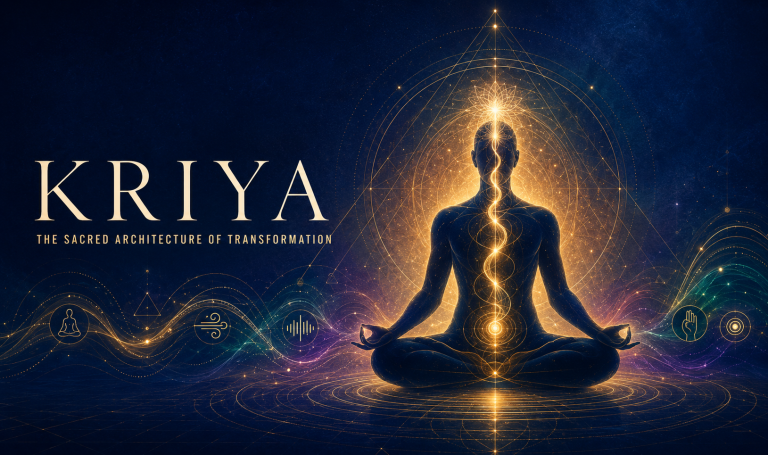
This is why a kriya should not be viewed as a random collection of interesting exercises. It is a complete energetic architecture.
Kriya as Sacred Action
The deeper meaning of kriya is conscious or sacred action.
Most human action is not completely conscious. We react from memories, fears, desires, expectations, unresolved emotions, and inherited conditioning. We may believe that we are freely choosing, while much of our behavior is being directed by patterns beneath the surface of awareness.
A kriya interrupts this unconscious momentum.
During practice, the body may become uncomfortable. The mind may begin negotiating:
“This is too difficult.”
“I have done enough.”
“This is not working.”
“I will practice properly tomorrow.”
In that moment, the kriya reveals more than the strength of the arms or the flexibility of the spine. It shows us how the mind behaves when it meets intensity, uncertainty, repetition, or resistance.
Do we immediately withdraw?
Do we become irritated?
Do we compare ourselves with others?
Do we abandon our awareness and force the body?
Or can we remain present, listen deeply, modify responsibly when necessary, and continue with dignity?
The kriya becomes a laboratory of consciousness. It gives us a safe and contained space in which to meet our habits without being controlled by them.
Over time, the practitioner learns that discomfort is not always danger, that intensity does not have to become panic, and that resistance does not automatically mean we must abandon our direction.
This is where physical practice begins becoming spiritual practice.
The Sacred Sequence
A Kundalini Yoga kriya is traditionally practiced in the order in which it was taught. The sequence matters because each component may prepare the body and energy for what follows.
One exercise may open circulation.
Another may stimulate the navel center.
Another may strengthen the nervous system.
Another may direct the accumulated energy toward the higher centers.
The relaxation at the end allows the entire experience to integrate.
If we casually remove one exercise, rearrange the order, or greatly extend the part we enjoy while shortening the parts we resist, we may alter the intended balance of the kriya.
Think of it as preparing a medicinal formula. Each ingredient may be beneficial by itself, but the relationship between the ingredients determines the final effect.
Or consider a musical composition. Individual notes may be beautiful, but it is their order, rhythm, spacing, and relationship that create the music.
In the same way, the intelligence of a kriya lives within its sequence.
This does not mean the practitioner should ignore physical limitations or force the body into pain. Responsible modifications are sometimes necessary. But there is a difference between modifying a posture to practice safely and redesigning the kriya according to personal preference.
When the total practice time must be shortened, the traditional guidance is to reduce the duration of the exercises proportionately, preserving the internal relationship of the sequence as much as possible. The integrity of the kriya remains more important than performing one favored exercise for the full time.
The Elements That Create a Kriya
Asana: The Posture
Asana establishes the physical geometry of the practice.
The position of the spine, arms, legs, hands, and head influences muscular engagement, circulation, balance, breathing capacity, and attention. A posture also creates a particular psychological experience.
Some postures make us feel grounded.
Some expose weakness or instability.
Some open the chest and challenge our willingness to be seen.
Some strengthen the navel and develop the capacity to act.
In Kundalini Yoga, posture is not only about achieving an external shape. It becomes a container through which energy and awareness can move.
Pranayama: The Direction of Life Force
The breath is one of the most direct bridges between the voluntary and involuntary systems of the body.
When the breath changes, the inner state changes.
A rapid breath creates a different experience from a slow breath. A segmented breath affects us differently from long, deep breathing. Breath retention, when used appropriately, produces another quality of concentration and energetic pressure.
Pranayama is often translated as breath control, but it can be understood more deeply as the expansion and conscious direction of prana—the life force moving through us.
In a kriya, breath is not merely delivering oxygen. It is carrying rhythm, attention, vitality, and intention through the practice.
Mantra: The Organizing Power of Sound
The mind is always producing sound, whether through spoken words or silent inner dialogue.
Mantra gives the mind a conscious vibration to inhabit.
Instead of allowing thought to wander through fear, memory, planning, or self-judgment, the practitioner places awareness within a deliberate sound current. The rhythm of the mantra coordinates breath, movement, and attention.
Mantra can also change the emotional atmosphere of a difficult exercise. The body may be experiencing intensity, but the mind is being trained to remain connected to meaning.
We are no longer simply enduring the posture. We are moving through it with consciousness.
Mudra: The Gesture of Consciousness
Mudras are intentional hand positions used to influence the energetic and mental quality of the practice.
The hands possess an extraordinary degree of sensory and motor representation in the brain. When the fingers are placed together in a particular arrangement, the mudra provides a stable physical pattern for attention.
A mudra can create a feeling of receptivity, grounding, prayer, focus, protection, balance, or projection. It gives consciousness a gesture through which to express itself.
Bandha: Containing and Directing Energy
Bandhas are body locks used to contain, consolidate, and direct pranic energy.
Rather than allowing the energy generated through movement, breath, and mantra to scatter, the locks help gather and redirect it. They bring internal structure to the practice.
Bandhas should be learned carefully and practiced with sensitivity. They are not created through brute muscular force. Their power comes from coordination, awareness, and precision.
Drishti: The Direction of Attention
The eyes are closely connected to the movement of the mind.
When the eyes move constantly, attention often moves with them. A specific eye focus, or drishti, helps gather mental energy and reduce distraction.
The eyes may be closed and directed toward the brow point, the tip of the nose, the crown, or another prescribed point. Although the movement may be subtle, maintaining the eye focus can become one of the most mentally demanding aspects of a practice.
Drishti teaches us that attention itself is energy.
Where attention goes, energy follows.
The Geometry of the Human Body
Kundalini Yoga frequently uses precise angles in postures and movements. Raising the legs or arms to 30, 45, 60, or 90 degrees is traditionally understood to create different patterns of muscular engagement, circulation, pressure, and energetic stimulation.
The Ancient sages describes kriya as a science of angles, rhythms, and vibrations. From this perspective, the body is not treated as a machine that simply needs exercise. It is approached as a living network of muscles, nerves, glands, breath, attention, and subtle energy.
An angle is therefore not merely a visual measurement. It changes the effort required, the muscles recruited, the way the breath moves, and the practitioner’s internal experience.
This helps explain why precision matters.
Moving the body “approximately” through a practice may provide some benefit, but conscious alignment gives the kriya a clearer pathway through which to work.
At the same time, precision should never become violence toward the body. The purpose is not to imitate an idealized posture at the cost of safety. The practitioner works with the body that is present today while maintaining the intention and essential direction of the exercise.
Sat Kriya: A Complete Practice Within a Single Action
Among the many practices within Kundalini Yoga, Sat Kriya holds a special place.
Most kriyas contain a series of exercises. Sat Kriya is unusual because it is one primary action that functions as a complete practice.
The practitioner traditionally sits in Rock Pose, extends the arms overhead, interlaces the fingers while pointing the index fingers upward, and chants Sat Naam rhythmically.
On Sat, the navel is drawn inward and upward.
On Naam, it is released.
The movement is created from the navel center rather than through exaggerated breathing or uncontrolled movement of the whole body. The mantra, muscular action, posture, and rhythm become one unified experience.
Sat Kriya is traditionally used to strengthen the nervous system, cultivate vitality, work with the navel center, support energetic balance, and awaken the practitioner’s awareness of the movement of Kundalini.
But its deepest teaching may be found in its simplicity.
The action is repeated.
The mind becomes bored.
The body meets effort.
Resistance rises and falls.
The mantra continues.
Eventually, something inside begins to coordinate. Breath, sound, movement, and awareness stop feeling like separate tasks. They become a single current.
This is the essence of kriya: many dimensions of the self beginning to act as one.
Sat Kriya is a powerful practice and should be learned with proper guidance, particularly when someone is new, pregnant, recovering from illness or surgery, or managing a medical condition.
Why Kriya Prepares Us for Meditation
Many people attempt to meditate while the body is restless, the breath is shallow, the nervous system is overstimulated, and the mind is filled with unfinished emotional momentum.
They sit down and immediately encounter noise.
Then they conclude that they are “bad at meditation.”
But the difficulty may not be a lack of spiritual capacity. The system may simply need preparation.
Kriya creates that preparation.
Movement gives restlessness somewhere conscious to move.
Breath begins regulating the inner rhythm.
Mantra gathers scattered thought.
Posture strengthens the ability to remain present.
Sustained attention exhausts some of the mind’s habitual resistance.
Relaxation allows accumulated tension to release.
After a well-practiced kriya, meditation often becomes more natural. The body is ready to be still because it has already moved. The mind is quieter because it has been given a point of focus. The breath is subtler because the larger energetic disturbances have begun to settle.
Kriya is therefore a bridge between action and stillness.
We do not force the mind to become silent. We create the inner conditions in which silence can reveal itself.
Relaxation Is Part of the Kriya
One of the most frequently underestimated parts of Kundalini Yoga is the relaxation that follows a kriya.
Some practitioners treat relaxation as optional. They complete the final exercise, look at the clock, and immediately move into the next activity.
But relaxation is not an empty space after the “real work.”
It is part of the work.
During a kriya, the system is stimulated and reorganized. Breath patterns change. Muscles contract and release. Attention is concentrated. Emotions or subconscious impressions may arise. Energy is generated and redirected.
Relaxation gives the body and mind time to integrate these changes.
It is the silence after the mantra.
The pause after the exhalation.
The stillness in which the system learns that it no longer has to keep doing.
This is particularly important in a culture that knows how to stimulate itself but has forgotten how to receive. We are accustomed to effort, productivity, intensity, and achievement. Relaxation teaches another kind of intelligence: the capacity to let transformation settle into us.
Without integration, practice can become another form of spiritual striving.
With integration, the experience is absorbed.
The Benefits of a Consistent Kriya Practice
The effects of kriya are cumulative.
A single practice may produce a noticeable shift. We may feel lighter, calmer, clearer, or more energized. But the deeper transformation comes through consistency.
Over time, practice may support:
- Greater awareness of the breath
- Improved physical strength and mobility
- A more resilient nervous system
- Increased capacity to remain steady under pressure
- Greater emotional self-awareness
- Improved concentration
- A stronger relationship with the navel center and personal will
- Recognition of subconscious habits
- A greater capacity for stillness
- A more direct experience of inner guidance
These changes may not always arrive dramatically.
Sometimes transformation appears as a profound meditation or emotional release. At other times it appears quietly: we pause before reacting, communicate more clearly, recover from stress more quickly, or recognize a familiar pattern before entering it.
The kriya is working not only when we feel something spectacular.
It is working when our way of living begins to change.
The Difference Between Intensity and Effectiveness
A powerful kriya is not necessarily the kriya that makes us sweat the most, shake the most, or feel the most dramatic sensation.
Intensity can be meaningful, but intensity alone is not transformation.
The ego can become attached to difficulty. We may begin measuring our spiritual progress by how long we can hold our arms up, how intensely we can breathe, or how much discomfort we can tolerate.
But kriya is not self-punishment.
The purpose is conscious participation.
There are moments when continuing through resistance develops discipline. There are also moments when reducing the intensity, modifying a posture, or resting is the more conscious action.
The essential question is not simply, “Can I force myself to continue?”
The deeper question is, “Can I remain in a truthful relationship with my body, breath, and awareness?”
This distinction matters.
Pushing from fear, pride, comparison, or self-rejection reinforces unconsciousness. Meeting a genuine edge with steadiness, intelligence, and compassion strengthens consciousness.
The same external posture can therefore produce very different inner results.
How to Approach a Kriya Practice
Before beginning, create a space in which you can practice without interruption. Traditionally, Kundalini Yoga is practiced on an empty stomach or after allowing sufficient time following a light meal.
Sit on a natural-fiber mat, blanket, or other supportive surface. Wear clothing that allows the body to move and breathe comfortably.
Tune in with the Adi Mantra:
Ong Namo Guru Dev Namo
This is not simply a ceremonial introduction. It is a way of shifting from ordinary momentum into conscious practice. It invites the practitioner to listen to the wisdom within and to connect with the stream of teaching that supports the practice.
Follow the kriya in its prescribed order.
Honor the breath pattern and eye focus.
Modify responsibly when needed without casually redesigning the practice.
Remain aware of the difference between productive challenge and pain.
Complete the prescribed relaxation.
Then sit quietly and observe.
What has changed?
How does the breath feel?
What is the quality of the mind?
Where is energy moving?
What emotion or insight has become visible?
The observation after the kriya is as valuable as the performance of the exercises. This is where experience becomes awareness.
Kriya and the Subconscious Mind
The subconscious mind stores impressions that the conscious mind cannot continuously process.
Every unfinished emotional experience, repeated reaction, internalized message, and survival strategy leaves a trace. These impressions influence how we perceive the present, even when we do not recognize their origin.
Kriya can bring us into contact with this deeper material.
During practice, an unexpected emotion may arise. A memory may surface. Irritation may appear without an obvious external cause. We may suddenly feel sadness, fear, vulnerability, or joy.
The purpose is not to dramatize every sensation or assign mystical meaning to every thought.
The invitation is to witness.
Can the emotion move through the body without immediately becoming a story?
Can we remain present without suppressing it or identifying with it?
Can the breath hold enough space for an old pattern to be experienced differently?
Kriya does not necessarily transform us by explaining every subconscious impression. Sometimes it works by giving the body a new experience in the presence of that impression.
Where we once contracted, we breathe.
Where we once escaped, we remain.
Where we once reacted automatically, we observe.
This is how new pathways are cultivated.
From Doing Kriya to Living in Kriya
Eventually, the real practice begins when we leave the yoga mat.
If kriya means conscious action, then every aspect of life can become kriya.
Preparing food can become kriya when it is done with presence and love.
Speaking can become kriya when words are aligned with truth.
Listening can become kriya when we are not preparing our reply while another person is speaking.
Rest can become kriya when it is chosen consciously rather than reached through complete exhaustion.
Work can become kriya when our energy serves a meaningful purpose.
A boundary can become kriya when it protects truth without becoming punishment.
A relationship can become kriya when two people are willing to meet one another beyond habit, projection, and performance.
Living in kriya does not mean living in constant activity. It means allowing our actions to arise from alignment.
Before acting, we pause.
Before speaking, we listen.
Before committing, we feel whether the body, heart, mind, and spirit are moving in the same direction.
Kriya teaches us to reduce the distance between intention and action.
The Inner Alchemy of Repetition
The mind often seeks novelty. It wants a new meditation, a new teaching, a new kriya, and a new experience.
But transformation frequently comes through repetition.
When we practice the same kriya consistently, the outer sequence remains familiar while the inner experience changes.
On one day, the practice feels effortless.
On another, it feels unbearable.
One day brings clarity.
Another reveals anger.
Another brings nothing dramatic at all.
The kriya becomes a mirror showing us the changing weather of the inner world. Because the practice remains relatively constant, we begin to recognize that it is we who are changing.
Repetition also takes us beyond the excitement of beginning. It invites us into relationship, discipline, intimacy, and depth.
We stop asking, “What new experience can this practice give me?”
We begin asking, “What is this practice revealing that I have not yet been willing to see?”
Kriya Is Not an Escape from Life
A true spiritual practice does not remove us from humanity. It makes us more available to it.
The purpose of kriya is not to create a permanently elevated state in which ordinary life feels inconvenient. It is not to bypass grief, responsibility, conflict, or the practical realities of being human.
The purpose is to increase our capacity to meet life consciously.
If the practice makes us more rigid, judgmental, spiritually superior, or disconnected from the needs of the body, something essential has been missed.
A mature kriya practice should gradually make us more present, more compassionate, more discerning, and more capable of effective action.
The quality of our practice is revealed through the quality of our presence.
How do we speak when we are disappointed?
How do we behave when we do not get what we want?
Can we remain centered when circumstances change?
Can we protect our energy without closing the heart?
Can we act decisively without abandoning compassion?
These are the living expressions of kriya.
The Grace of Sacred Action
Kriya begins with action, but it does not end there.
Through conscious action, the body becomes more available to breath. Breath becomes more available to awareness. Awareness becomes less entangled in unconscious reaction. Eventually, action and stillness no longer feel like opposites.
The body moves, yet something within remains still.
The mantra vibrates, yet something within is silent.
The breath becomes powerful, yet the center remains peaceful.
This is the grace of kriya.
We act without becoming lost in action.
We experience without becoming imprisoned by experience.
We direct energy without attempting to control all of life.
Kriya reminds us that transformation does not require rejecting the body or escaping the world. The body itself becomes the instrument. Breath becomes the carrier. Sound becomes the guide. Awareness becomes the space in which a new possibility can emerge.
A kriya may begin as a sequence of exercises.
With devotion, it becomes a conversation with the Self.
With consistency, it becomes a method of transformation.
And when its wisdom enters daily life, kriya becomes sacred action—the capacity to move through the world with awareness, alignment, purpose, and grace.
The ultimate kriya is not simply what we practice on the mat.
It is the life we create when every action begins to carry the vibration of consciousness.