
For generations, medicine taught that cerebrospinal fluid (CSF) existed primarily to cushion and nourish the brain and spinal cord.
It was viewed as a protective bath surrounding the central nervous system—a beautiful but relatively isolated system.
But science is beginning to reveal something far more fascinating.
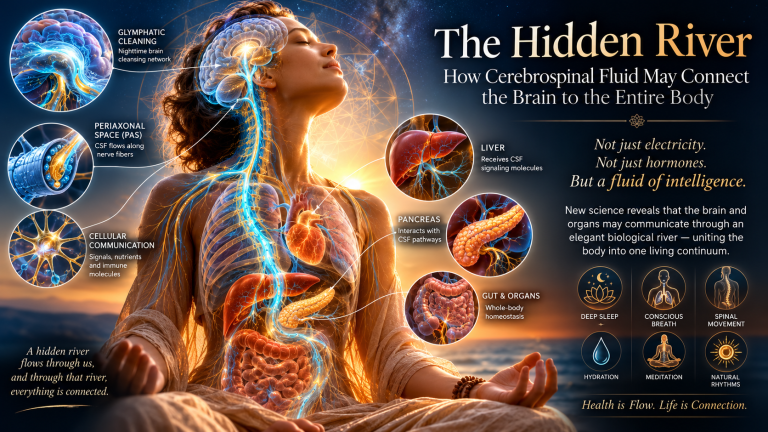
Recent research published in the Proceedings of the National Academy of Sciences (PNAS) suggests that cerebrospinal fluid may travel much farther than previously imagined. Instead of ending at the spinal cord, CSF appears capable of moving along peripheral nerves through what researchers call the periaxonal space, reaching organs such as the liver and pancreas.
This discovery hints at something many traditional healing systems have suggested for thousands of years:
The brain and body may communicate through far more intimate pathways than we once understood.
The River Within
Cerebrospinal fluid is one of the most remarkable substances in the body.
Every day, the brain produces approximately 500 milliliters of this crystal-clear liquid.
Its functions include:
- Cushioning the brain.
- Removing metabolic waste.
- Delivering nutrients.
- Maintaining pressure balance.
- Supporting immune surveillance.
- Facilitating communication between cells.
Modern neuroscience has already transformed our understanding of CSF through the discovery of the glymphatic system—the brain’s nighttime cleansing network.
Now, another piece of the puzzle appears to be emerging.
The Newly Discovered Pathway
Researchers identified a route called the Periaxonal Space (PAS).
This microscopic space surrounds individual nerve fibers (axons).
Their findings suggest that CSF may travel:
Brain → Spinal cord → Peripheral nerves → Organs
Rather than existing only inside the skull and spine, cerebrospinal fluid may extend its influence throughout the body.
The study demonstrated connections to organs including:
Liver
Hepatic stellate cells appear capable of receiving substances carried by CSF.
Pancreas
Pancreatic stellate cells also seem to interact with cerebrospinal fluid.
This suggests the possibility that CSF transports:
- Signaling molecules
- Nutrients
- Immune mediators
- Regulatory compounds
which may help coordinate whole-body homeostasis.
Why This Is Such a Big Deal
For decades, scientists viewed the nervous system mainly through electrical impulses.
Neurons fired.
Signals traveled.
Muscles contracted.
Organs responded.
But perhaps there is another layer.
Not only electrical communication.
Not only hormones.
But fluid communication.
An elegant biological river carrying information throughout the organism.
This possibility opens entirely new questions:
- Could disturbances in CSF flow affect organ health?
- Could inflammation travel through these pathways?
- Might neurodegenerative diseases involve systemic components?
- Could enhancing fluid movement improve healing?
These questions remain largely unanswered, but they represent an exciting frontier.
The Body as One Continuum
One of the limitations of modern medicine has been compartmentalization.
Neurology studies the brain.
Gastroenterology studies digestion.
Cardiology studies the heart.
Endocrinology studies hormones.
Yet living organisms do not experience themselves as separate departments.
Your body functions as one integrated field.
This new research supports the idea that:
Nothing in the body truly exists in isolation.
The liver talks to the brain.
The pancreas talks to the nervous system.
The immune system communicates with both.
Everything participates in one great symphony.
Ancient Systems Have Long Emphasized Fluid Intelligence
Long before MRI scanners and electron microscopes existed, many traditions recognized the importance of subtle flows.
Ayurveda speaks of:
Rasa
The nourishing essence that circulates life.
Ojas
The refined vitality supporting immunity and consciousness.
Majja Dhatu
The tissue associated with marrow and the nervous system.
Traditional Chinese Medicine speaks of:
- Jing
- Essence
- Meridians
Yogic traditions describe:
- Nadis
- Prana
- Amrita
Of course, these concepts are not identical to cerebrospinal fluid.
They belong to different frameworks.
But it is fascinating that many ancient systems emphasized:
Health is flow.
Disease is stagnation.
The Craniosacral Connection
Practitioners of Craniosacral Therapy (CST) have long proposed that subtle movements of cerebrospinal fluid influence the entire organism.
Although some aspects of craniosacral theory remain controversial and difficult to measure scientifically, this new research provides intriguing support for the idea that CSF may extend beyond the confines of the central nervous system.
Advocates suggest that improving mobility around the skull, spine, and connective tissues may:
- Reduce tension.
- Support nervous system regulation.
- Enhance relaxation.
- Promote whole-body balance.
More research will be necessary to understand precisely how these effects occur.
Why Sleep May Be the Ultimate CSF Therapy
One of the most powerful stimulators of cerebrospinal fluid flow is not a supplement.
Not a biohack.
Not a machine.
It is deep sleep.
During slow-wave sleep:
- Brain cells shrink.
- Interstitial spaces expand.
- Glymphatic clearance increases.
- Metabolic waste is removed.
- Cerebrospinal fluid pulses more vigorously.
This is why sleep deprivation affects far more than energy levels.
Poor sleep disrupts one of the body’s most fundamental cleansing mechanisms.
Breathing and Fluid Motion
CSF movement appears strongly influenced by:
Respiration
Deep diaphragmatic breathing generates pressure changes that help propel fluid.
Heartbeat
Arterial pulsations drive rhythmic CSF oscillations.
Movement
Walking, spinal mobility, and gentle exercise influence fluid dynamics.
Posture
Spinal alignment affects mechanical forces throughout the nervous system.
In a sense, every breath creates waves within the ocean inside you.
Kundalini Yoga and the Sacred Flow
Yogic traditions have always emphasized the importance of spinal vitality.
Many Kundalini Yoga practices involve:
- Spinal flexes.
- Breath retention.
- Rhythmic movement.
- Long deep breathing.
- Sat Kriya.
- Cat-Cow.
- Cobra Pose.
- Meditation.
Traditionally, these practices were said to awaken prana and support the ascent of consciousness.
Modern physiology offers another perspective:
Perhaps these practices also enhance:
- Pressure gradients.
- Vagal tone.
- Lymphatic circulation.
- Venous return.
- Cerebrospinal fluid dynamics.
While more research is needed, it is remarkable that many ancient exercises naturally emphasize the spine, breath, and rhythm—the very forces known to influence fluid movement.
A New View of Healing
Perhaps healing is not merely chemistry.
Perhaps it is not merely electricity.
Perhaps life is also a matter of flow.
Blood flows.
Lymph flows.
Breath flows.
Emotions flow.
Thoughts flow.
And now we are beginning to appreciate that cerebrospinal fluid—the hidden river surrounding the brain—may also flow throughout the body in ways we are only starting to understand.
The more we study the human organism, the less it resembles a machine made of separate parts.
And the more it resembles what yogis and sages have long described:
A living continuum of intelligence.
Practical Ways to Support Healthy Cerebrospinal Fluid Dynamics
Prioritize Deep Sleep
The glymphatic system performs much of its work during slow-wave sleep.
Breathe Through the Diaphragm
Long, slow breathing creates pressure waves that influence CSF movement.
Move Your Spine Daily
Gentle spinal flexion and extension maintain mobility and fluid dynamics.
Walk
Walking provides rhythmic stimulation to the entire nervous system.
Hydrate
CSF is approximately 99% water.
Practice Meditation
Reducing stress improves autonomic balance and vascular function.
Spend Time in Silence
The nervous system restores itself most effectively when overstimulation decreases.
Final Thoughts
Science is still in the early chapters of this story.
Much remains unknown.
But discoveries like these remind us to remain humble.
The body is not simply a collection of organs.
It is a network.
A continuum.
A river of intelligence.
And perhaps, beneath every thought, every breath, and every heartbeat, there exists a silent current carrying information, nourishment, and life itself.
A hidden river flowing from the brain to the body.
And through that river, everything may be connected.