
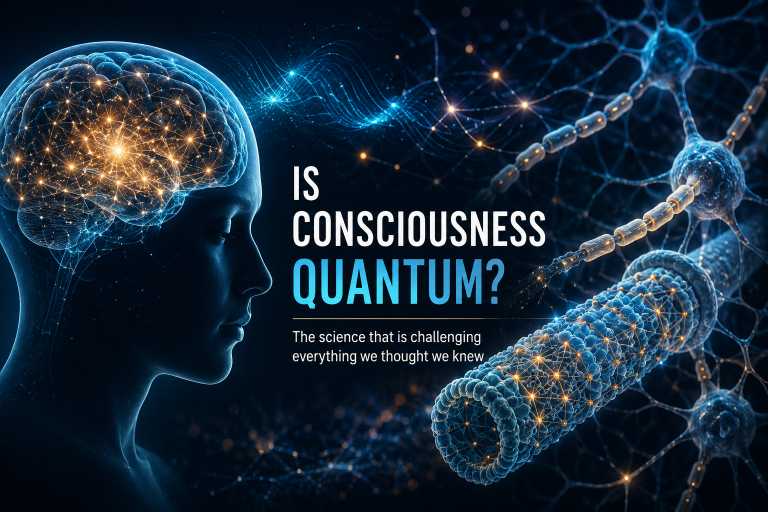
For more than a century, neuroscience has searched for one of the greatest mysteries in existence:
How does consciousness arise?
How does a collection of neurons, electrical impulses, and chemical reactions produce something as intimate as the experience of seeing a sunset, remembering your childhood, falling in love, or simply knowing that you exist?
Despite extraordinary advances in brain imaging, molecular biology, and computational neuroscience, no widely accepted theory has fully explained why physical matter gives rise to subjective experience. Scientists can identify which regions of the brain become active during different mental states, but identifying correlations is not the same as explaining consciousness itself.
Increasingly, a small but influential group of researchers has suggested that perhaps neuroscience has been asking the right question with incomplete physics.
Perhaps consciousness cannot be fully understood without quantum mechanics.
The Brain as More Than a Biological Computer
Traditional neuroscience generally views the brain as an immensely sophisticated biological computer.
Neurons communicate through electrical signals and neurotransmitters. Networks process information. Memories emerge from changing synaptic connections. Consciousness is often assumed to be an emergent property of sufficiently complex computation.
This framework has been enormously successful in explaining many aspects of perception, learning, movement, and cognition.
Yet one profound mystery remains.
Why should information processing produce subjective awareness at all?
A computer can process enormous quantities of data without experiencing anything.
What transforms information into experience?
This question—sometimes called the “hard problem of consciousness”—continues to challenge philosophers, physicists, and neuroscientists alike.
The Penrose-Hameroff Proposal
One of the most unconventional attempts to answer this question comes from Roger Penrose and Stuart Hameroff.
Together they developed what is known as the Orchestrated Objective Reduction (Orch-OR) theory.
Rather than locating consciousness solely in the firing of neurons, Orch-OR proposes that conscious moments arise through quantum processes occurring inside microscopic structures known as microtubules.
Microtubules are tiny cylindrical protein structures found inside nearly every cell of the body. In neurons, they help maintain cellular architecture, transport molecules, and organize internal structure.
According to Orch-OR, however, microtubules may do far more.
They may function as quantum processors capable of supporting delicate quantum states that contribute directly to conscious experience.
If true, this would fundamentally change our understanding of the brain.
Instead of functioning only through classical electrical activity, the brain would also operate partly through quantum information processing.
Why Quantum Physics Is Different
Quantum mechanics describes nature at its smallest scales.
Unlike classical objects, quantum systems can exist in multiple possible states simultaneously through superposition.
They can also become linked through quantum entanglement, where measurements performed on one system remain statistically correlated with another, even when separated by large distances. Importantly, entanglement does not allow information to travel faster than light, but it does reveal correlations that have no classical explanation.
These properties are radically different from everyday physics.
If similar quantum behavior plays a meaningful role inside living brains, then the mechanisms underlying consciousness could be very different from those described by conventional neuroscience alone.
Experimental Evidence Begins to Appear
For many years, Orch-OR remained largely theoretical.
Critics argued that the brain’s warm, wet, and noisy environment would destroy quantum coherence almost instantly, making sustained quantum effects biologically impossible.
Recently, however, researchers have begun testing some of these ideas experimentally.
A study published in eNeuro investigated whether stabilizing microtubules would influence consciousness during anesthesia.
Researchers administered a drug that stabilizes microtubules in rats and compared them with untreated animals.
The stabilized animals remained conscious significantly longer under anesthesia than controls.
The experiment does not prove Orch-OR or establish that consciousness is generated by quantum effects. However, it provides evidence that microtubules themselves may play a more direct role in maintaining conscious states than previously appreciated.
That represents an intriguing piece of data in a field that has long relied largely on theoretical arguments.
The Possible Role of Myelin
Another intriguing proposal comes from theoretical work published in Physical Review E.
Researchers suggested that myelin, the fatty insulating sheath surrounding many nerve fibers, could provide physical conditions favorable for maintaining quantum coherence and entanglement over biologically relevant distances.
Traditionally, myelin is understood as electrical insulation that speeds nerve conduction.
The new hypothesis suggests an additional possibility.
Its unique physical properties might help protect fragile quantum states inside neural tissue.
At present, this idea remains speculative and has not been experimentally demonstrated in living brains. Nevertheless, it illustrates how researchers are beginning to explore whether known brain structures could, in principle, support quantum phenomena.
What Would It Mean If Consciousness Were Quantum?
If quantum processes genuinely contribute to consciousness, the implications would be profound.
Our understanding of the brain would require significant revision.
Mental activity might involve both classical neural computation and quantum dynamics.
Consciousness could become a subject not only for neuroscience but also for quantum information science.
Such findings would likely reshape multiple disciplines, including neuroscience, cognitive science, physics, artificial intelligence, and philosophy of mind.
However, it is important to distinguish between established quantum phenomena and broader philosophical interpretations. Current quantum theory does not demonstrate that consciousness is non-local, immortal, universal, or capable of influencing reality in extraordinary ways. Those claims go beyond the available evidence.
Why Many Scientists Remain Skeptical
Despite growing interest, the majority of neuroscientists remain unconvinced.
Their skepticism is based on substantial scientific concerns.
Quantum coherence is notoriously fragile.
Interactions with the surrounding environment typically destroy coherent quantum states extremely rapidly—a process known as decoherence.
Because the brain operates at body temperature in a chemically active environment, many researchers argue that maintaining biologically meaningful quantum states long enough to influence cognition would be extraordinarily difficult.
Others point out that conventional neuroscience continues to explain many aspects of brain function without requiring quantum mechanisms.
From this perspective, quantum consciousness may introduce unnecessary complexity unless it provides unique predictions that can be experimentally verified.
These are legitimate scientific objections, and they continue to drive active debate.
Science Advances Through Testing
One encouraging aspect of this discussion is that it is increasingly moving beyond philosophy.
Researchers are designing experiments.
They are measuring.
They are testing predictions.
Whether Orch-OR ultimately proves correct or incorrect, the process itself advances scientific understanding.
Every rigorous experiment refines our models of how the brain works.
That is how science progresses—not through certainty, but through careful investigation.
A Mystery Still Unfolding
Consciousness remains one of the deepest unanswered questions in science.
We know that brain activity and conscious experience are intimately related.
What we still do not fully understand is why physical processes become subjective experience.
Quantum theories such as Orch-OR offer one possible avenue for exploration.
They are neither established fact nor mere philosophical speculation. They are scientific hypotheses that continue to be examined through increasingly sophisticated experiments.
Perhaps future research will reveal that consciousness emerges entirely from classical neural computation.
Perhaps it will reveal that quantum physics contributes in ways we are only beginning to understand.
Or perhaps the answer will combine elements of both.
For now, humility remains appropriate.
The human brain is the most complex known structure in the observable universe, and the phenomenon it generates—or participates in—continues to surprise us.
The most exciting part is not that science has solved the mystery.
It is that we have finally reached the point where we can begin asking these questions with experiments instead of speculation.
And that may be the beginning of an entirely new chapter in understanding what it means to be conscious.