
Most people think of the tongue as a tool for speech, taste, or swallowing.
In reality, the tongue is one of the most influential regulators of the human nervous system.
Its position quietly affects how we breathe, how we hold ourselves, how safe we feel in our bodies—and whether our system is oriented toward rest or survival.
Long before we consciously “do” breathwork, posture, or relaxation, the tongue is already speaking to the brain.
The Tongue: A Neurological Bridge, Not Just a Muscle
Anatomically, the tongue is extraordinary.
It is directly connected to:
-
The hyoid bone, which anchors the tongue to the throat and neck
-
The jaw and cervical spine
-
The diaphragm, through fascial and neurological chains
-
The vagus nerve, which governs parasympathetic regulation
Because of these connections, the tongue acts like a control dial between breathing, posture, and autonomic tone.
Small shifts in tongue position can create large systemic effects.
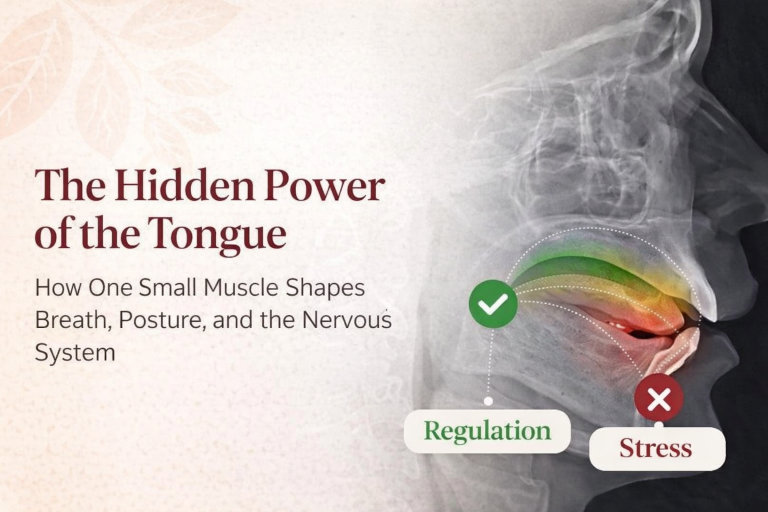
Two Tongue Positions, Two Nervous System States
Although the tongue is capable of complex movement, from a nervous system perspective there are two dominant resting patterns—each associated with a very different internal state.
1. Tongue Resting Gently on the Hard Palate
(The Regulation Pattern)
When the tongue rests softly against the hard palate, just behind the upper teeth (without force or tension), several things happen simultaneously:
Breathing
-
Encourages nasal breathing
-
Supports slower, deeper, more efficient respiration
-
Allows the diaphragm to move freely
Nervous System
-
Signals safety to the brainstem
-
Activates the parasympathetic (rest-and-digest) response
-
Improves vagal tone and heart rate variability
Posture
-
Supports natural cervical alignment
-
Reduces jaw, neck, and shoulder tension
-
Encourages a subtle lift through the midline
Energy & Awareness
-
Conserves energy rather than leaking it through tension
-
Enhances mental clarity and emotional steadiness
-
Creates internal containment rather than collapse or bracing
In simple terms, this position tells the body:
“I am safe. I can breathe. I don’t need to brace.”
In yogic language, this supports pranic containment and upward flow without strain or force.
2. Tongue Pulled Back or Down Toward the Throat
(The Stress Pattern)
When the tongue retracts toward the soft palate or throat, a very different cascade occurs.
This pattern is extremely common in modern life and is often unconscious.
Breathing
-
Narrows the airway
-
Encourages mouth breathing
-
Leads to shallow, upper-chest respiration
Nervous System
-
Activates sympathetic (fight-or-flight) tone
-
Increases baseline alertness and hypervigilance
-
Reduces vagal influence
Posture
-
Tightens the jaw and throat
-
Pulls the head forward
-
Creates chronic neck and shoulder tension
Emotional State
-
Often present in anxiety, stress, overwhelm, and trauma
-
Associated with holding, clenching, or bracing
-
Makes it harder for the system to truly rest
This position communicates something very different:
“I need to be ready. I might be under threat.”
Even if the mind feels calm, the body remains on alert.
Why the Tongue Matters More Than You Think
The tongue is one of the fastest ways to influence the autonomic nervous system.
Faster than posture correction.
Often faster than breath techniques alone.
Because it sits at the crossroads of:
-
airway
-
vagal pathways
-
cervical alignment
-
diaphragmatic coordination
…changing tongue tone can immediately alter:
-
muscle tension throughout the spine
-
breathing rhythm
-
heart rate variability
-
emotional regulation
This is why tongue awareness appears—sometimes subtly, sometimes explicitly—in:
-
ancient yogic practices
-
somatic therapy
-
speech and myofunctional therapy
-
trauma-informed breathwork
-
modern nervous system regulation work
The body has always known this. We are simply remembering.
A Common Mistake: Forcing the Tongue
Many people hear “tongue to the roof of the mouth” and immediately create effort.
This misses the point.
The goal is not placement.
The goal is rest.
Forcing the tongue can increase jaw tension and sympathetic tone—the opposite of what we want.
A Better Cue (Gentle and Nervous-System Friendly)
Instead of “put your tongue somewhere,” try this:
Let the tongue soften, widen, and rest naturally behind the upper teeth, touching the roof of the mouth like it belongs there.
No pushing.
No holding.
No doing.
Just allowing.
If the tongue doesn’t want to stay there at first, that’s information—not failure.
Tongue Position as a Trauma-Informed Entry Point
For many people, especially those with a history of chronic stress or trauma, the tongue has learned to stay braced.
Inviting it to soften can feel unfamiliar—or even vulnerable.
That’s okay.
Tongue awareness should always be:
-
invitational
-
slow
-
non-corrective
-
paired with safety cues
Regulation happens through permission, not discipline.
A Quiet Practice You Can Try Anywhere
-
Sit or stand comfortably.
-
Notice where your tongue is resting—without changing it.
-
Notice your breath.
-
Gently allow the tongue to soften and rest against the hard palate.
-
Let the jaw unclench.
-
Observe what shifts.
You may notice:
-
breath slowing
-
shoulders dropping
-
a sense of internal quiet
-
emotional settling
Or you may notice resistance.
Both are valid signals from the system.
The Bigger Picture
Healing doesn’t always require complex techniques.
Sometimes it begins with listening to the smallest signals the body is already sending.
The tongue—quiet, overlooked, and constantly active—is one of those signals.
When it learns that it no longer has to brace, the rest of the body often follows.