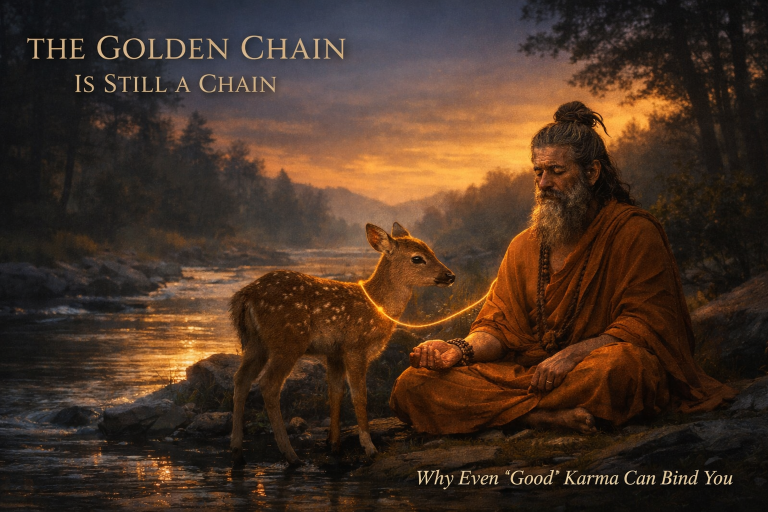
Why Even “Good” Karma Can Bind You
There is a brutal elegance to this truth:
The universe does not care if your chain is made of gold or iron.
If you are holding it, you will be pulled where it goes.
We are taught to avoid bad karma.
We are rarely warned about good karma.
But spiritual maturity begins when we understand something subtle:
attachment to goodness can bind just as deeply as attachment to sin.
To illustrate this, the sages preserved one of the most profound psychological and metaphysical stories in the yogic tradition — the story of King Bharata.
The King Who Walked Away from Everything
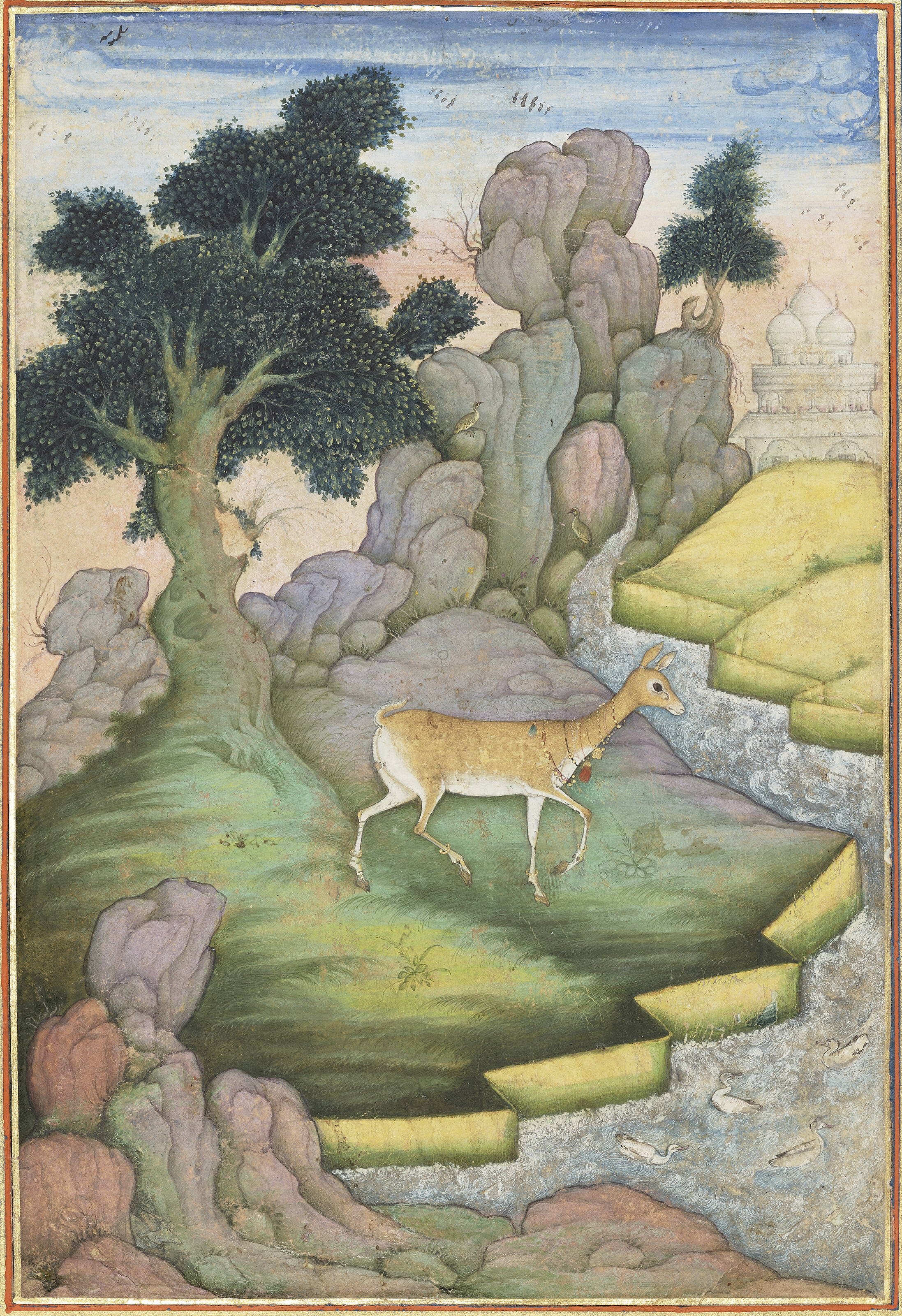
Bharata was no ordinary ruler.
He was a monarch so righteous, so spiritually evolved, that he renounced his vast kingdom in the prime of his life. He had tasted power. He had tasted wealth. He had tasted honor.
And he found them insufficient.
So he walked away.
He entered the forest to pursue liberation — moksha — the final freedom beyond birth and death. His meditation was deep. His awareness steady. He was nearing the threshold of transcendence.
Then something happened.
Compassion — or Subtle Attachment?
One day, while meditating by a river, Bharata witnessed a pregnant deer leap across the water in terror from a lion’s roar. The shock caused her to miscarry mid-air. The mother died from exhaustion. The tiny fawn fell helplessly into the rapids.
Without hesitation, Bharata saved it.
On the surface, this was pure compassion. Noble. Beautiful. Holy.
He fed the fawn. Protected it. Raised it.
But something shifted.
Slowly, meditation time shortened.
Worry time increased.
“Has it eaten?”
“Where is it wandering?”
“What if wolves attack?”
“What if it falls into the river again?”
His mind, once dissolved in the infinite, became tethered to the finite.
And this is where the gold chain formed.
The Subtle Shift: From Awareness to Identity
The act of saving the deer was not the problem.
The identification was.
A new identity crystallized:
“I am the protector.”
“I am responsible.”
“I must ensure its survival.”
The seeker became a savior.
The meditator became a father.
The awareness that once rested in the source of existence now revolved around an object of attachment.
This is the binding thread.
Not the action.
The ownership.
Not compassion.
The “I” behind compassion.
The Final Thought That Determines Destiny
In yogic psychology, the last thought at the moment of death carries immense weight. It reveals what your consciousness is anchored to.
When Bharata’s body began to fail, he did not meditate on the absolute.
He did not dissolve into the infinite.
His last thought was:
“Who will care for my deer?”
And according to the law of karma, consciousness flows toward what it clings to.
He was reborn… as a deer.
Not because he committed sin.
But because he committed identification.
He had to live out the momentum of that attachment — finishing the energetic transaction of that single golden thread.
Iron Chains vs. Golden Chains
Bad karma is obvious.
It feels heavy. It disturbs. It corrodes.
Good karma feels refined. Noble. Justified.
But if both are performed with the sense of:
“I am the doer.”
Then both create bondage.
Iron shackles hurt immediately.
Golden chains feel prestigious.
But both still bind.
And the universe is impartial.
It does not reward moral aesthetics.
It responds to energetic attachment.
The Psychology Behind the Story
This teaching is not anti-compassion.
It is anti-identification.
In modern language:
-
You can help someone without becoming their rescuer.
-
You can love without becoming possessed by the role of lover.
-
You can serve without building a personality around being indispensable.
The ego is sophisticated.
It prefers moral superiority over moral failure.
The “sinner” identity is crude.
The “savior” identity is elegant.
But both reinforce the central illusion:
“I am the separate doer.”
As long as that identity persists, the cycle continues.
The Real Teaching: Act Without Ownership
The Bhagavad wisdom distilled this principle clearly:
Act fully.
Love deeply.
Serve compassionately.
But release the identity of the doer.
Compassion without ownership liberates.
Compassion with ownership binds.
Bharata’s story is not a condemnation. It is a warning of how subtle the ego becomes at advanced stages of spiritual development.
Even at the threshold of enlightenment, attachment can whisper:
“This is noble. This is good. This is necessary.”
And slowly, meditation becomes management.
Silence becomes supervision.
Infinity becomes anxiety.
The Silk Thread Is Still a Thread
Most people are not bound by hatred.
They are bound by responsibility.
By roles.
By identities built around goodness.
“I am the healer.”
“I am the teacher.”
“I am the strong one.”
“I am the one who saves others.”
These are golden threads.
But they still pull.
The question is not whether you act.
The question is:
Are you holding the chain, or is action flowing through you?
Beyond the Doer
Freedom does not require withdrawing from the world.
It requires dissolving the internal narrator who claims ownership.
When compassion arises naturally — without identity, without anxiety, without possession — it becomes pure.
It leaves no residue.
It creates no karmic echo.
It does not pull you into another cycle.
The universe does not weigh your morality.
It mirrors your attachment.
Gold or iron — it makes no difference.
If you grip it, you go where it goes.
If you release it, you are free.
And that is the razor’s edge of spiritual maturity.
Act.
Love.
Serve.
But remain unattached.
Because even a silk thread can tether a soul to lifetimes.