
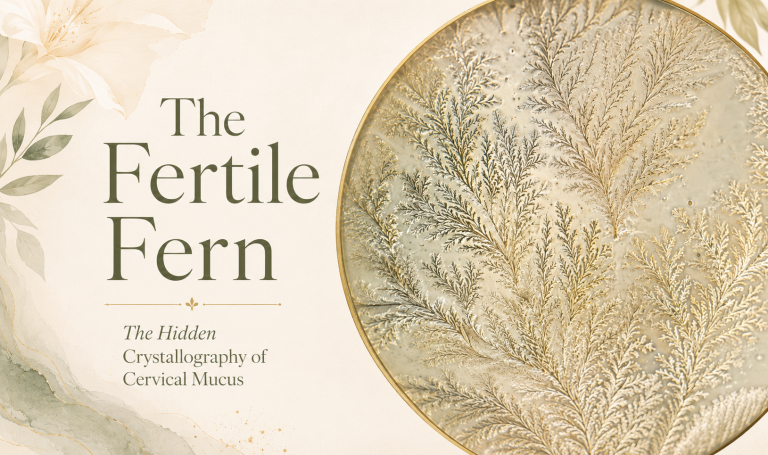
What looks like frost on a winter window, a botanical illustration, or a delicate fern pressed into glass is actually one of the most remarkable biological signals produced by the human body: cervical mucus photographed under a microscope at peak fertility.
At first glance, the image seems almost too beautiful to be biological. Branching lines extend outward like leaves. Crystal arms form elegant patterns. The structure looks less like a bodily fluid and more like a secret geometry of nature — something between snowflake, plant, river delta, and sacred mandala.
But this is not random beauty.
This is the body speaking in chemistry.
This microscopic pattern is known as arborization, or more commonly, the ferning pattern. It appears when cervical mucus is placed on a glass slide, allowed to dry, and observed under magnification. Around ovulation, under the influence of rising estrogen, the salts and proteins within the mucus crystallize into this characteristic fern-like structure. In medical literature, this palm-leaf or fern-like appearance has long been recognized as a sign of estrogen-dominant cervical mucus near ovulation.
The visual poetry is stunning, but the biology behind it is even more profound.
The Cervix Is Not Passive
Modern people often think of the cervix as simply a physical doorway between the vagina and uterus. But the cervix is far more intelligent than that. It is a dynamic gatekeeper, a biochemical filter, a fertility sensor, and a living interface between protection and possibility.
Throughout the menstrual cycle, the cervix produces mucus that changes in texture, quantity, stretch, moisture, and chemical composition. These changes are not accidental. They are directed by the shifting hormonal conversation between the brain, ovaries, uterus, and cervix. Estrogen and progesterone do not merely “affect” cervical mucus; they transform its structure and function.
For much of the cycle, cervical mucus is thick, sticky, and relatively difficult for sperm to penetrate. This is not a flaw. It is protection. The mucus acts as a barrier, helping guard the upper reproductive tract and preventing sperm from easily entering when conception is not biologically favored.
But as ovulation approaches, everything changes.
Estrogen rises during the late follicular phase, and the cervix begins producing mucus that is clearer, wetter, more abundant, more elastic, and more slippery. This is the classic “egg-white” cervical mucus many fertility awareness methods describe. It is not just a visual sign. It is a functional transformation. Thin, wet, fertile-quality mucus helps sperm move toward the egg at the very moment when conception becomes possible.
The body does not simply open the door.
It changes the architecture of the doorway.
The Science of the Fern
The ferning pattern appears because the composition of cervical mucus changes under the influence of estrogen. When estrogen is high, the mucus contains a different balance of water, salts, proteins, and mucins. As a sample dries on glass, sodium chloride and other components crystallize along the mucus fibers, creating the branching fern-like formations seen under a microscope. (ScienceDirect)
This is why the image looks botanical. The body is not drawing a fern intentionally, of course, but crystallization often follows repeating structural laws. The same mathematical tendencies that create frost, mineral formations, river branches, and plant veins can also appear in dried biological fluids when the chemical conditions are right.
This is where the image becomes so fascinating.
The ferning pattern is not decoration.
It is evidence of a hormonal state.
When estrogen rises before ovulation, cervical mucus becomes more fertile, more conductive to sperm movement, and more likely to form this crystalline pattern. After ovulation, progesterone rises, mucus becomes thicker and more opaque again, and the ferning pattern typically disappears.
The microscope reveals what the body already knew.
Fertility Is a Narrow Window
The human fertile window is much narrower than many people imagine. Conception is generally possible in the days leading up to ovulation because sperm can survive for several days in fertile cervical mucus, while the egg itself is viable for a much shorter time after release. Large studies of menstrual cycles have shown that the fertile window is usually concentrated around the days before ovulation and the day of ovulation, although the exact timing varies significantly from cycle to cycle.
This is why cervical mucus matters so much.
It is not merely a symptom of fertility.
It is part of fertility.
Without fertile-quality mucus, sperm survival and transport become much more difficult. With fertile-quality mucus, the reproductive tract becomes more hospitable. The cervix shifts from defense to selective invitation. The mucus becomes less like a wall and more like a pathway.
Studies on cervical mucus patterns show that estrogen supports the secretion of more fertile-quality mucus before ovulation, while progesterone after ovulation causes a sharp reduction in mucus secretion. Research also shows that cervical mucus observations correlate with the probability of pregnancy on specific cycle days.
That is extraordinary.
A woman’s body is not waiting passively for conception to happen. It is actively preparing the terrain.
The Body Builds a Pathway for Sperm
During non-fertile phases of the cycle, cervical mucus can be dense, viscous, and difficult to pass through. Around ovulation, the mucus becomes more hydrated and structurally permissive. At the molecular level, its organization changes in ways that can support sperm migration rather than block it.
This is one of the great misunderstandings of fertility. People often think conception depends only on sperm meeting egg, as though fertilization were simply a matter of timing and chance. But the reproductive system is far more elegant than that. The body must create the correct environment. The cervix must soften its barrier. The mucus must become receptive. The sperm must survive, move, and be guided. The egg must be released. The hormonal cascade must be synchronized.
Fertility is not one event.
It is an orchestration.
And cervical mucus is one of the clearest external signs of that orchestration.
When fertile mucus appears, the body is announcing: the gate is open, the river is flowing, the pathway is prepared.
The Ferning Test: Useful, But Not Absolute
Clinicians have known about this phenomenon for decades. The ferning phenomenon in cervical mucus was described in gynecology in the mid-20th century, and it became one of the ways clinicians could observe the effects of estrogen and infer proximity to ovulation.
But it is important to hold this with nuance.
The presence of ferning can suggest that estrogen is high and that the body is producing fertile-quality mucus. Its absence, especially when expected, may invite further inquiry into hormonal patterns, ovulation, mucus quality, or other reproductive factors. However, ferning alone should not be treated as a perfect ovulation detector or a standalone fertility diagnosis.
More precise clinical tools, such as urinary luteinizing hormone testing and ultrasound monitoring, can be more accurate for confirming ovulation timing. One study comparing ovulation detection methods found urinary LH testing correlated strongly with ultrasound-confirmed ovulation, while mucus observations and salivary ferning were less precise when used alone.
So the ferning pattern is meaningful, but not magical in the simplistic sense.
It is a signal.
Not the whole story.
It is one piece of a larger fertility intelligence that includes cycle regularity, cervical mucus sensation, basal body temperature, luteinizing hormone, progesterone, ovarian function, uterine health, thyroid status, stress physiology, metabolic health, age, and the health of both partners.
The body is wise, but wisdom must be read carefully.
Why This Image Feels So Sacred
There is something deeply moving about seeing fertility crystallized.
Most people are taught to think of the body mechanically. Hormones are reduced to numbers. Cycles are reduced to charts. Fertility is reduced to probability. The womb is discussed in clinical language, often stripped of mystery, reverence, and awe.
But then you look at cervical mucus under a microscope, and suddenly the body becomes cosmic again.
A fluid becomes a fern.
A hormone becomes a pattern.
A cycle becomes a crystal.
A hidden inner process becomes visible architecture.
This is the meeting point between biology and wonder.
The human body has been encoding fertility information in mucus, salts, proteins, pH, hydration, viscosity, and crystallography for the entire history of our species. Long before microscopes, long before hormone panels, long before fertility apps, the body already carried this intelligence. The microscope did not create the wisdom. It simply allowed us to witness it.
The body was speaking all along.
Science gave us another way to listen.
Fertility Awareness Is Body Literacy
Learning to observe cervical mucus is not only useful for conception. It can also become a form of body literacy.
When someone begins noticing the rhythm of cervical mucus — dry days, sticky days, creamy days, slippery days, stretchy days, and the return to thicker mucus after ovulation — they begin to understand the cycle as a living process rather than a monthly inconvenience. Fertility awareness methods often use these changes to help identify fertile days, though they are most effective when learned carefully and often combined with other signs such as basal body temperature.
This matters because the menstrual cycle is not just about menstruation.
It is a monthly report from the endocrine system.
Cervical mucus can reflect estrogenic activity. Ovulation can reflect deeper hormonal coordination. Cycle regularity can reflect stress, nourishment, metabolic health, thyroid function, sleep, and nervous system balance. The cycle is not separate from the rest of life. It is one of the body’s ways of revealing whether life force is flowing freely or under strain.
Of course, not every variation means something is wrong. Cervical mucus can be influenced by age, hydration, medications, hormonal contraception, infections, sexual activity, and individual variation. Any abnormal discharge, strong odor, irritation, pain, or sudden change should be assessed by a qualified healthcare provider.
But when observed over time, the pattern becomes a language.
And every language becomes clearer with relationship.
The Feminine Body as Living Intelligence
The ferning pattern is a reminder that the feminine body is not chaotic.
It is cyclical.
It is not irrational.
It is rhythmic.
It is not merely emotional.
It is exquisitely responsive to inner and outer conditions.
Every month, the body prepares. It thickens, softens, opens, secretes, protects, releases, receives, and renews. It builds a possibility and then lets it go. It carries the wisdom of timing not as an idea, but as tissue. Not as philosophy, but as fluid. Not as metaphor, but as measurable chemistry.
This is why ancient traditions often honored the menstrual cycle as sacred time. They may not have had microscopes, but they understood something modern culture often forgets: the reproductive body is not simply biological machinery. It is an intelligence system.
The cervix knows when to protect.
It knows when to open.
It knows when to become a wall.
It knows when to become a river.
And at peak fertility, that river leaves behind a crystalline signature that looks like a fern.
The Hidden Geometry of Becoming
There is a deep symbolism in the fact that fertile mucus forms a pattern resembling plant life.
The fern is one of Earth’s ancient forms. It is associated with unfolding, moisture, resilience, and hidden reproduction. Ferns grow in shaded forests. They unfurl from spirals. They belong to an older botanical memory of the planet.
And here, inside the human body, at the edge of ovulation, a fern-like geometry appears.
Not because the body is trying to imitate a plant.
But because life repeats its patterns.
Branching is one of life’s favorite designs. We see it in trees, lungs, rivers, neurons, blood vessels, lightning, mycelium, and now cervical mucus. Wherever life needs movement, exchange, distribution, nourishment, or communication, branching appears.
The fertile fern is the signature of readiness.
The body has changed phase.
The gate has opened.
The inner landscape has become receptive.
Reading the Body With Reverence
The lesson here is not that every person needs to examine cervical mucus under a microscope. The deeper lesson is that the body is always revealing itself.
Sometimes it speaks through temperature.
Sometimes through sensation.
Sometimes through mood.
Sometimes through appetite.
Sometimes through bleeding.
Sometimes through cervical mucus.
Sometimes through a crystalline fern appearing on glass.
The more we learn to read these signs, the less alienated we become from our own biology. We stop treating the body as a machine that malfunctions and start relating to it as a living intelligence that communicates.
This does not mean rejecting medicine. Quite the opposite. The microscope is medicine. Hormone testing is medicine. Ultrasound is medicine. Fertility science is medicine. But medicine becomes more powerful when it is joined with reverence.
Science tells us what is happening.
Reverence helps us understand why it matters.
The Crystal Code of Fertility
Cervical mucus ferning is one of those rare biological phenomena that feels both scientific and mystical. It is measurable, observable, and hormonally driven. Yet it is also beautiful enough to awaken awe.
At peak fertility, the body produces a fluid that not only supports the possibility of conception, but also dries into a crystalline botanical pattern.
That is astonishing.
The reproductive body does not merely function.
It composes.
It patterns.
It signals.
It protects.
It invites.
It encodes.
For thousands of generations, this wisdom unfolded silently in the cervix, hidden from ordinary sight. Every cycle, the chemistry changed. Every cycle, the gate opened and closed. Every cycle, the body wrote its fertility in fluid.
Then the microscope arrived.
And suddenly, we could see the handwriting.
The fern was there all along.
The body had always known.
We finally learned how to read the glass.