
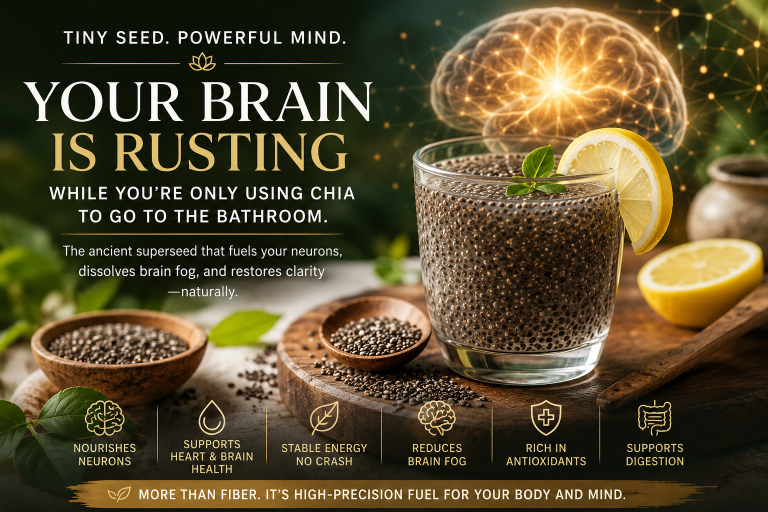
Most people think chia seeds are little more than nature’s laxative.
A spoonful for constipation. A trendy topping for yogurt. A source of fiber and little else.
But the story of chia seeds runs much deeper than bowel regularity.
These tiny black seeds are among the richest plant sources of alpha-linolenic acid (ALA), a form of omega-3 fatty acid that plays an important role in maintaining cell membrane integrity, supporting cardiovascular health, and contributing to the complex biochemical environment upon which the brain depends. Their benefits extend far beyond digestion, although some of the more dramatic claims circulating online deserve a closer look. Salvia hispanica
Your Brain Is Built From Fat
Despite making up only about 2% of body weight, the human brain contains nearly 60% fat by dry weight.
These fats are not passive storage molecules.
They form the membranes surrounding every neuron, influence how cells communicate, and help maintain the fluidity necessary for neurotransmission.
Omega-3 fatty acids are especially important because they become incorporated into cell membranes throughout the body. Low omega-3 status has been associated with inflammation, cardiovascular disease, and certain aspects of cognitive decline. However, the relationship is complex, and no single food can “repair” the brain overnight.
Chia seeds provide:
- Alpha-linolenic acid (ALA)
- Soluble and insoluble fiber
- Protein
- Magnesium
- Calcium
- Potassium
- Polyphenols and antioxidants
- Lignans
These compounds work together to support metabolic and vascular health, both of which indirectly influence brain function.
Brain Fog Is Often a Circulation and Energy Problem
Many people experience afternoon brain fog and immediately reach for caffeine.
But concentration depends upon multiple systems:
- Stable blood sugar
- Healthy circulation
- Adequate hydration
- Mitochondrial energy production
- Sleep quality
- Stress regulation
- Nutrient status
Chia seeds may contribute to several of these areas.
Their soluble fiber slows glucose absorption, helping reduce dramatic blood sugar swings. Their omega-3 content contributes to cardiovascular health. Their magnesium content supports hundreds of enzymatic reactions involved in energy metabolism.
Rather than acting like a stimulant, they provide nutritional building blocks that support long-term physiological resilience.
The Remarkable Gel
One of chia’s most fascinating properties is its ability to absorb many times its weight in water.
When soaked, the seed coat forms a mucilaginous gel composed primarily of soluble fiber.
This gel:
- Promotes satiety.
- Supports bowel regularity.
- Slows gastric emptying.
- Helps maintain hydration.
- Moderates glucose absorption.
Traditional cultures valued these qualities long before modern nutritional science understood the underlying mechanisms.
The ancient peoples of Central America considered chia a source of endurance and sustained energy.
Fresh Grinding Makes Sense
Omega-3 fats are vulnerable to oxidation.
For this reason, freshly grinding chia seeds shortly before consumption is reasonable. Whole seeds are naturally protected by their outer shell, while grinding exposes the oils to air and light.
Grinding immediately before use may preserve freshness.
A practical preparation might include:
- Two tablespoons freshly ground chia seeds.
- Warm (not boiling) water.
- A squeeze of fresh lemon juice.
- Allowing the mixture to hydrate for 10–15 minutes.
There is no evidence that using a wooden spoon or drinking in exactly three sips changes absorption, but chewing thoroughly and mixing with fluids can improve digestibility and hydration.
Does ALA Cross the Blood-Brain Barrier?
This is where many exaggerated claims begin.
Alpha-linolenic acid does participate in brain metabolism, and some ALA can enter brain tissues.
However, the body must convert ALA into EPA and DHA—the longer-chain omega-3 fatty acids more directly involved in neural function.
Unfortunately, this conversion is relatively inefficient.
Most estimates suggest:
- Less than 10% converts to EPA.
- Often less than 1–5% converts to DHA.
This means chia seeds are an excellent plant omega-3 source, but they are not equivalent to direct DHA sources.
The idea that one serving creates noticeable mental clarity within twenty minutes or “repairs neurons” immediately is not supported by current evidence.
Nutrition builds slowly.
Cells remodel over weeks, months, and years.
Biology is architecture, not magic.
Kefir and Chia: An Interesting Combination
Combining freshly ground chia with kefir creates a nutrient-dense meal.
The pairing provides:
- Probiotics
- Protein
- Calcium
- Omega-3 fats
- Fiber
- Polyphenols
Fermented foods may influence the gut microbiome, and growing evidence suggests that gut health communicates extensively with the nervous system through what researchers call the gut-brain axis.
Whether using goat kefir or another fermented dairy product, the combination can provide a balanced and satisfying mid-morning meal.
What About Chia Oil on the Temples?
Applying chia oil to the skin can certainly serve as a relaxing self-care ritual.
Massage around the temples and neck may:
- Reduce muscle tension.
- Promote relaxation.
- Improve local blood flow.
- Encourage parasympathetic activity.
However, there is no convincing evidence that omega-3 fatty acids are absorbed through the skin in amounts sufficient to nourish neurons or directly influence cognitive performance.
The benefit likely comes more from the massage itself than from transdermal delivery of fatty acids.
Coconut Water and Omega-3 “Shots”
Coconut water provides potassium and hydration.
Omega-3 oils provide fatty acids.
Both are healthy, but there is no evidence that potassium acts as a special carrier transporting fatty acids into neuronal mitochondria.
Human physiology is rarely that simple.
Still, beginning the day hydrated and consuming healthy fats may support overall metabolic function.
Chia’s Greatest Gift May Be Systemic
The brain does not exist in isolation.
Cognition depends upon:
- Healthy blood vessels.
- Stable glucose regulation.
- Reduced inflammation.
- Efficient mitochondria.
- Hormonal balance.
- Adequate sleep.
- Good digestion.
Chia seeds influence several of these systems simultaneously.
Not because they are miraculous.
But because biology itself is interconnected.
The bowel, blood vessels, immune system, microbiome, and nervous system speak to one another continuously.
Perhaps this is why so many people notice that when digestion improves, mental clarity often improves too.
Not because a magical molecule suddenly switches the brain on.
But because the body functions as a single integrated network.
The Bigger Lesson
Modern nutrition often searches for pharmaceutical precision.
One molecule.
One target.
One miracle.
Nature usually works differently.
Chia seeds will not instantly dissolve brain fog, reverse aging, or transform your neurons in twenty minutes.
But over months and years, consistently consuming nutrient-dense foods, maintaining metabolic health, sleeping well, exercising regularly, and managing stress can profoundly influence how clearly we think and how gracefully we age.
Sometimes the most powerful medicines are not dramatic.
They are small.
Quiet.
And taken every day.
Scientific Reference
Marcinek K, Krejpcio Z.
“Chia seeds (Salvia hispanica): health promoting properties and therapeutic applications – a review.”
Annals of the National Institute of Hygiene (2017).
PMID: 28646829.
Informational content only. This article is intended for educational purposes and should not replace professional medical advice.