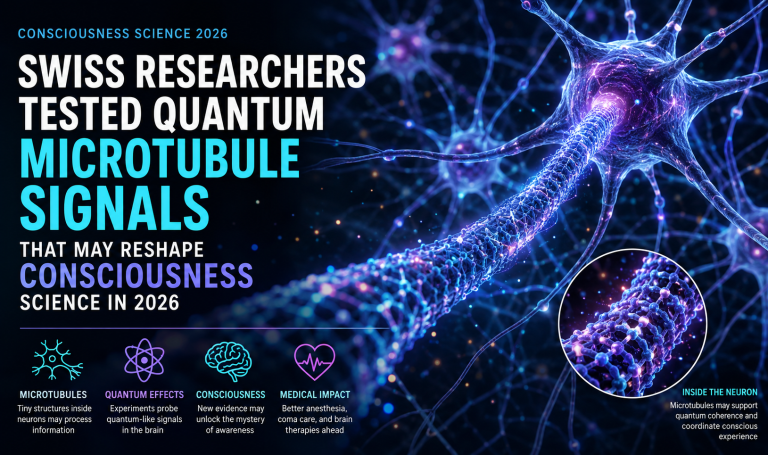
What if consciousness is not created only by electrical impulses firing between neurons — but also by ultra-small physical processes happening deep inside the microscopic architecture of the brain itself?
For decades, neuroscience has largely treated consciousness as an emergent property of large-scale neural networks:
billions of neurons,
trillions of synapses,
electrochemical signaling,
pattern recognition,
memory integration,
and dynamic information processing.
But a growing number of researchers are revisiting a more controversial possibility:
What if awareness also depends on hidden processes occurring inside the neuron itself?
In 2026, renewed investigations into quantum-like activity within microtubules are once again drawing attention to one of the most debated theories in modern consciousness science.
The idea sounds almost unbelievable.
Yet the question refuses to disappear.
And now, advances in sensing technology, computational neuroscience, quantum biology, and anesthesia research are forcing science to look again.
What Are Microtubules?
Inside every neuron exists an internal structural network called the cytoskeleton.
One of its key components is the microtubule.
Microtubules are tiny cylindrical protein structures built primarily from tubulin proteins.
They serve several essential biological functions:
- Maintaining cellular shape
- Transporting nutrients and molecules
- Organizing internal cellular architecture
- Assisting cell division
- Supporting neuronal connectivity
They are extraordinarily small.
A human hair is roughly 80,000–100,000 nanometers wide.
A microtubule is only about 25 nanometers in diameter.
Yet despite their tiny size, they form vast interconnected scaffolding systems throughout neurons.
For years, scientists assumed microtubules were mostly structural — biological “support beams.”
But some researchers began asking a radical question:
What if they also process information?
The Quantum Consciousness Hypothesis
One of the most famous — and controversial — theories involving microtubules is the Orch-OR Theory (Orchestrated Objective Reduction), proposed by:
- Sir Roger Penrose, mathematical physicist
- Dr. Stuart Hameroff, anesthesiologist and consciousness researcher
The theory suggests that consciousness may emerge partly from quantum processes occurring inside neuronal microtubules.
In simplified terms, the hypothesis proposes:
- Quantum states may form within microtubules
- These states may coordinate across neurons
- Conscious moments may emerge from orchestrated collapses of these quantum states
The proposal challenged mainstream neuroscience because the brain appears far too warm, wet, and noisy for delicate quantum effects to survive.
Traditional physics argued quantum coherence should collapse almost instantly in biological tissue.
And for years, many scientists dismissed the theory outright.
Why Scientists Are Looking Again
The landscape began changing when researchers discovered that biology may already use quantum effects in surprising ways.
Examples include:
- Photosynthesis efficiency in plants
- Bird navigation and magnetoreception
- Enzyme tunneling effects
- Quantum behavior in olfactory systems
Quantum biology slowly became a legitimate scientific field rather than pure speculation.
That shift reopened an uncomfortable possibility:
Could the brain also exploit quantum-scale phenomena?
In 2026, newer experiments are focusing less on philosophical claims and more on measurable biological signatures.
Researchers are investigating whether microtubules exhibit unusual signal dynamics during different states of consciousness, including:
- Wakefulness
- Deep sleep
- General anesthesia
- Meditation
- Psychedelic states
- Disorders of consciousness
Why Anesthesia Became So Important
One of the strongest reasons scientists became interested in microtubules again is anesthesia.
General anesthesia remains one of the greatest mysteries in medicine.
Doctors can reliably “turn off” consciousness.
But science still does not fully understand exactly how subjective awareness disappears.
Some anesthetic agents interact strongly with neuronal proteins associated with microtubules.
That observation raised intriguing questions:
- Are microtubules involved in integrating awareness?
- Could consciousness depend partly on intracellular coordination?
- Are certain anesthetics disrupting deeper cellular signaling mechanisms?
Modern neuroimaging combined with ultra-sensitive electromagnetic measurements now allows researchers to examine brain-state transitions with much greater precision than even a decade ago.
The result is not proof —
but it is enough evidence to justify continued investigation.
The Brain May Be More Than Electrical Wiring
Traditional neuroscience often compares the brain to a computer.
Neurons fire.
Signals travel.
Networks process information.
But consciousness itself remains unexplained.
Scientists can identify correlations between brain activity and conscious states, yet the “hard problem” persists:
Why does subjective experience exist at all?
Why do electrical patterns become:
- color,
- emotion,
- memory,
- pain,
- love,
- awareness,
- identity?
Microtubule researchers argue the answer may involve deeper layers of organization beneath synaptic signaling.
Not replacing neural networks —
but complementing them.
In this model, neurons are not just wires.
They are internally dynamic quantum-sensitive systems.
Important Clarification: This Does NOT Prove a “Quantum Soul”
This is where social media often becomes misleading.
Claims such as:
“Scientists proved consciousness comes from quantum tunneling”
or
“Researchers discovered the soul in microtubules”
are massive exaggerations.
No serious scientist has proven:
- the existence of a soul,
- life after death,
- supernatural consciousness,
- or mystical quantum immortality.
What researchers are investigating is far more precise:
Whether ultra-small physical processes inside neurons contribute meaningfully to conscious experience.
That distinction matters enormously.
Science is not proving spirituality.
Science is exploring whether current brain models are incomplete.
Why This Research Could Change Medicine
Even if the theory turns out only partially correct, the implications could be profound.
1. Better Anesthesia Monitoring
If consciousness correlates with measurable microtubule dynamics, anesthesiologists could monitor awareness more accurately during surgery.
That could reduce:
- accidental awareness under anesthesia,
- over-sedation,
- neurological complications.
2. Improved Coma Assessment
Patients in vegetative or minimally conscious states may retain hidden forms of awareness that current tools miss.
Deeper cellular measurements could potentially help:
- detect residual consciousness,
- improve prognosis,
- guide treatment decisions.
3. Brain-Computer Interfaces
Understanding intracellular information processing may eventually improve:
- neural decoding,
- prosthetics,
- communication systems,
- cognitive restoration technologies.
4. Neurodegenerative Disease Research
Microtubules are already deeply implicated in diseases such as:
- Alzheimer’s disease
- Parkinson’s disease
- traumatic brain injury
Understanding their signaling behavior could reshape future therapeutic approaches.
Consciousness May Be Layered
One of the most fascinating implications of this research is that consciousness may not emerge from a single mechanism.
Instead, awareness may involve multiple interacting layers:
- Electrical signaling
- Chemical modulation
- Electromagnetic synchrony
- Neural network integration
- Cellular architecture
- Quantum-scale effects
The brain may operate more like an orchestra than a machine.
And microtubules may be part of the hidden rhythm section scientists previously ignored.
Ancient Traditions Asked Similar Questions
Long before neuroscience existed, contemplative traditions explored consciousness through direct experience.
Yogic sciences,
Buddhist meditation systems,
mystical traditions,
and contemplative practices across cultures all proposed that awareness has subtler dimensions than ordinary sensory perception.
Modern science is not validating every spiritual claim.
But it is increasingly discovering that reality is stranger, more interconnected, and more layered than classical models assumed.
In many ways, the frontier of consciousness science is becoming a meeting point between:
- neuroscience,
- physics,
- biology,
- philosophy,
- and contemplative inquiry.
The Real Story Is Intellectual Humility
Perhaps the most important lesson of 2026 is not that quantum consciousness has been proven.
It has not.
The real breakthrough is that science is becoming willing to revisit difficult questions without immediate dismissal.
For years, many researchers avoided consciousness studies entirely because the subject felt too philosophical, too speculative, or too strange.
Now that is changing.
Advances in:
- quantum sensing,
- computational modeling,
- neuroimaging,
- and systems biology
are allowing researchers to ask deeper questions with greater rigor.
And history repeatedly shows:
The questions once considered absurd sometimes become the foundations of future science.
Final Thoughts
Consciousness remains the greatest unsolved mystery in human existence.
You are experiencing reality right now —
colors,
thoughts,
memories,
identity,
emotion,
awareness itself.
Yet science still cannot fully explain how matter becomes experience.
Microtubule research may ultimately revolutionize neuroscience.
Or it may reveal only a small missing piece of a much larger puzzle.
Either way, the search itself matters.
Because every time humanity dares to investigate the unknown with sincerity, humility, and courage, we expand the boundaries of what it means to understand ourselves.
And perhaps the strangest truth of all is this:
The deepest mysteries of consciousness may not exist somewhere far away in the cosmos.
They may already be unfolding silently inside every neuron of your brain.