For more than a century, quantum physics has challenged one of our deepest assumptions about reality:
That particles simply move from point A to point B like tiny billiard balls.
But a remarkable development in quantum measurement theory is revealing something far stranger.
Quantum particles may retain a hidden “memory” of everywhere they have been — a subtle imprint of their entire trajectory history woven into the fabric of the wave function itself.
And now, physicists have experimentally demonstrated evidence of this hidden history using one of the most delicate tools in modern science:
Weak quantum measurements.
The implications are profound.
Not only does this challenge classical ideas of motion and observation, but it may fundamentally reshape how we understand memory, causality, information, and even consciousness itself.
The Strange Nature of Quantum Motion
In classical physics, the path of an object is simple.
A baseball travels through the air along a predictable trajectory.
A car drives down a road.
A planet orbits a star.
At every moment, the object has a definite position and velocity.
Quantum particles do not behave this way.
An electron, photon, or atom exists as a wave function — a probabilistic spread of possible locations and paths.
Until measurement occurs, the particle does not appear to occupy one definite trajectory.
Instead, quantum theory suggests the particle explores many possible paths simultaneously.
This is the essence of wave-particle duality.
And nowhere is this mystery more beautifully demonstrated than in the famous:
Mach–Zehnder Interferometer


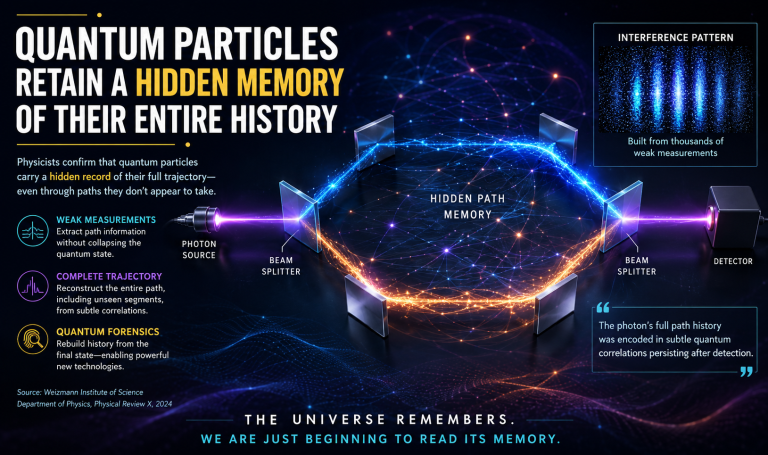
This elegant optical setup splits a photon into multiple possible paths using beam splitters and mirrors.
When recombined, the photon produces interference patterns that reveal its wave-like behavior.
But here is the paradox:
If you strongly measure which path the photon took, the interference disappears.
Observation collapses the wave function.
The photon “chooses” a path.
For decades, physicists assumed that any attempt to determine the particle’s trajectory would necessarily destroy the quantum behavior itself.
But weak measurement changed everything.
What Is a Weak Quantum Measurement?
Traditional measurements in quantum mechanics are invasive.
They force the system into a definite state.
Weak measurements are different.
Instead of violently collapsing the wave function, they interact with the particle extremely gently — so gently that the quantum coherence largely survives.
A single weak measurement gives only tiny fragments of information.
Almost meaningless on its own.
But when physicists correlate thousands or millions of weak measurements statistically, hidden patterns emerge.
It becomes possible to reconstruct aspects of the particle’s behavior without fully destroying the quantum state.
This is exactly what researchers at the Weizmann Institute of Science explored.
The Discovery: Hidden Trajectory Memory
In their experiments, physicists used weak measurements on photons moving through a Mach–Zehnder interferometer.
The astonishing result:
The photons carried subtle quantum correlations encoding information about their complete trajectory history — including paths they did not appear to traverse under ordinary strong measurements.
In other words:
The particle’s history was not erased.
It remained embedded in the quantum structure of the system.
The final detected photon still contained hidden information about where it had been.
This suggests something extraordinary:
Quantum systems may preserve a distributed memory of their evolution across spacetime.
The wave function is not merely a temporary probability cloud.
It behaves more like an informational field retaining traces of its past interactions.
The Wave Function Does Not Simply Vanish
One of the biggest misconceptions in popular quantum physics is the idea that wave functions simply “collapse and disappear.”
Modern quantum theory paints a more nuanced picture.
When measurement occurs, coherence is redistributed into the environment and measuring apparatus through a process called:
Quantum Decoherence


The information is not necessarily destroyed.
Instead, it becomes dispersed into correlations.
Weak measurements allow physicists to access tiny remnants of those correlations without completely overwhelming the system.
This is why the particle’s hidden path history can still be reconstructed.
The quantum past leaves echoes.
Quantum Memory vs Classical Memory
Classical memory is localized.
A hard drive stores bits in a physical medium.
A neuron stores patterns through synaptic changes.
DNA stores genetic information chemically.
Quantum memory is radically different.
It is:
- Distributed
- Nonlocal
- Correlation-based
- Probabilistic
- Context-dependent
The memory exists not necessarily in a single place, but in the relationships between quantum states.
This is one reason quantum computers are so powerful.
Quantum systems can encode vast amounts of relational information simultaneously.
And this new research suggests those relational histories may persist longer and more richly than previously understood.
The Birth of Quantum Forensics
One of the most exciting implications of this work is something researchers are calling:
Quantum Forensics
The ability to reconstruct the history of a quantum particle from its final measured state.
This could revolutionize multiple technologies.
Quantum Computing
Quantum computers are incredibly sensitive to noise and decoherence.
Weak measurement techniques could help:
- Track where computational errors originated
- Reconstruct fault histories
- Improve quantum error correction
- Stabilize qubits more efficiently
Quantum Communication
Quantum encryption depends on detecting disturbances.
Trajectory reconstruction could:
- Authenticate communication channels
- Detect interception attempts
- Improve quantum network security
- Enhance entanglement verification
Fundamental Physics
These techniques may also deepen our understanding of:
- Time symmetry
- Retrocausality
- Information conservation
- Quantum gravity
- The measurement problem itself
Did the Particle “Really” Travel Those Paths?
This is where philosophy and physics begin to overlap.
According to standard Copenhagen interpretations:
The particle does not have a definite trajectory until measurement.
But alternative interpretations — including:
- Many Worlds
- Bohmian Mechanics
- Two-State Vector Formalism
- Relational Quantum Mechanics
suggest that hidden trajectory structures may genuinely exist.
Weak measurements do not fully settle the debate.
But they strongly imply that quantum systems preserve far more information about their evolution than classical intuition expects.
Reality may be less about isolated events…
…and more about persistent informational relationships unfolding across time.
The Deeper Implication: The Universe Remembers
Perhaps the most awe-inspiring implication is this:
Nature may never fully forget.
Every interaction leaves subtle traces.
Every event imprints correlations into the fabric of reality.
At the quantum level, the universe behaves less like a machine of disconnected objects and more like a living web of informational continuity.
This echoes ideas emerging across multiple disciplines:
- Quantum information theory
- Holographic physics
- Complexity science
- Systems biology
- Neuroscience
- Consciousness studies
Increasingly, reality appears fundamentally relational.
Not separate things…
but evolving patterns of connected information.
Ancient Wisdom and Quantum Echoes
Interestingly, many ancient philosophical traditions proposed that actions leave subtle imprints long before modern physics existed.
In yogic philosophy, this is reflected in concepts like:
- Samskaras (impressions)
- Akashic memory
- Karmic residues
- Subtle energetic traces
While these ideas arise from entirely different frameworks than quantum mechanics, the symbolic parallels are striking.
Modern physics is not “proving spirituality.”
But it is revealing a universe that is vastly more interconnected, information-rich, and memory-bearing than classical materialism once imagined.
Final Thoughts
Weak quantum measurements are opening a doorway into one of the deepest mysteries in physics:
How information persists through the quantum world.
The emerging picture suggests that particles do not simply appear, move, and vanish.
They carry echoes of their journey.
The past remains encoded in hidden correlations woven into reality itself.
And perhaps this is one of the great revelations of modern science:
The universe is not merely made of matter.
It is made of memory.