
What if intuition isn’t just a gut feeling or subconscious pattern recognition—but a form of memory that reaches forward in time?
This idea, once dismissed as mystical, is now being explored at the edges of neuroscience, psychophysiology, and consciousness research. A growing body of experimental work suggests that the human nervous system may register information before it arrives through the senses, hinting that awareness itself might not be bound to linear time.
When the Body Knows Before the Mind
Researchers associated with institutions such as the HeartMath Institute and the Institute of Noetic Sciences have conducted controlled experiments examining how the body responds to unpredictable stimuli.
In these studies, participants were shown randomly selected emotional images or exposed to sudden sounds—events designed to be impossible to anticipate. Yet something remarkable appeared:
-
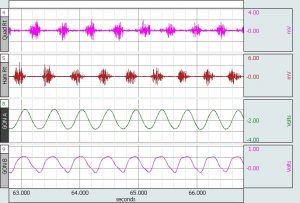
Heart rhythm patterns shifted seconds before the stimulus
-
Brain wave activity changed prior to conscious awareness
-
Physiological markers of attention and arousal activated early
Importantly, these responses occurred before the random event was revealed—before the brain could logically process or predict anything.
This phenomenon is sometimes referred to as presentiment: the body’s subtle anticipation of a future event.
Beyond Instinct: A Different Kind of Knowing
Traditional science explains intuition as rapid subconscious processing—your brain recognizing patterns faster than conscious thought. That explanation accounts for many intuitive experiences, but it doesn’t fully explain pre-event physiological changes.
If the stimulus is genuinely random, what is the body responding to?
Some researchers propose a radical possibility:
intuition may not be prediction—it may be perception across time.
In this view, intuition functions less like guesswork and more like memory retrieval, except the memory hasn’t happened yet.
Consciousness and Non-Linear Time
This idea aligns with emerging theories in physics and consciousness studies suggesting that time may not be strictly linear.
In quantum physics, phenomena such as entanglement show that information can be correlated across distance instantly, without regard for space. Some interpretations extend this logic to time, proposing that information may also be linked across past, present, and future.
If consciousness is not confined to the brain—but instead participates in a broader informational field—then intuitive flashes may arise when awareness briefly accesses that field.
In this framework:
-
The brain becomes a receiver, not the source
-
The heart–brain system acts as a tuning mechanism
-
Intuition is the signal breaking through before thought catches up
The Heart’s Role in Temporal Sensitivity
One of the most intriguing findings from heart–brain research is that the heart often responds before the brain.
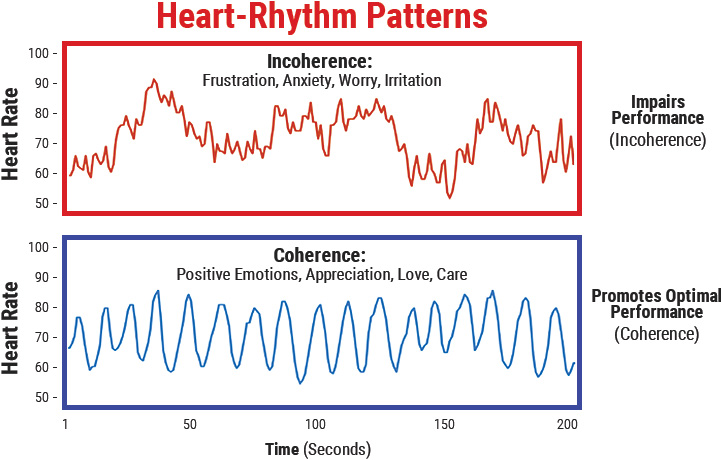
The heart generates a powerful electromagnetic field, measurable several feet outside the body, and sends more signals to the brain than the brain sends back. When heart rhythms become coherent—smooth, ordered, and harmonious—people show increased emotional stability, clarity, and intuitive accuracy.
This suggests that intuition may not arise from thinking harder, but from regulating the nervous system so subtle information can be perceived.
Calm, coherence, and emotional regulation appear to be prerequisites for intuitive sensitivity.
Intuition as an Evolutionary Sense
If intuition can access information beyond the present moment, it reframes its role in human survival and evolution.
Rather than a vague or unreliable feeling, intuition may be:
-
An early warning system
-
A guidance mechanism
-
A form of non-sensory perception refined through regulation and awareness
This could explain why intuitive signals are often quiet, subtle, and easy to override—modern life trains us to privilege analysis over sensation.
Living With a Time-Expanded Awareness
If intuition truly operates across time, the implication is profound:
we are not merely reacting to life—we are in subtle dialogue with what is coming.
Cultivating intuition, then, isn’t about becoming psychic. It’s about:
-
Slowing the nervous system
-
Developing heart–brain coherence
-
Learning to trust subtle internal signals
-
Reducing noise so information can be felt
In a world obsessed with control and certainty, intuition reminds us that intelligence exists beyond logic—and that awareness may be far more expansive than we’ve been taught.
Perhaps intuition is not imagination at all.
Perhaps it is memory… remembering forward.