
We often assume that scientific breakthroughs arrive with clarity.
They don’t.
More often, they arrive quietly… misunderstood, partially seen, waiting for the right era to reveal their true meaning.
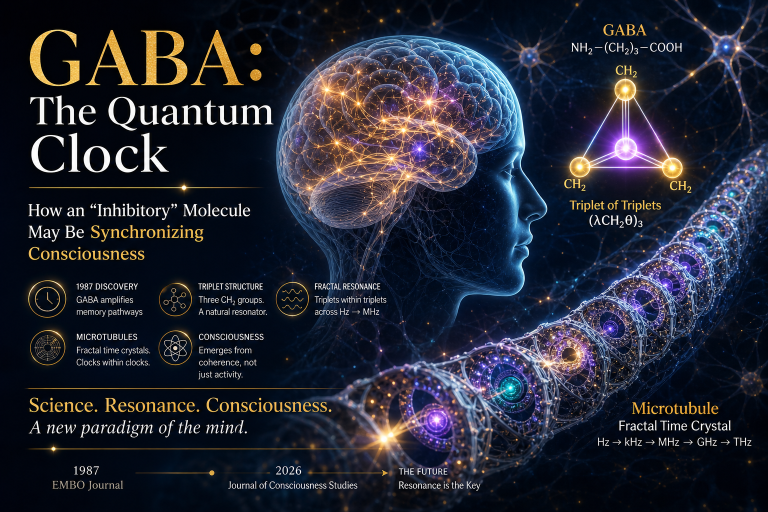
In 1987, a paper published in the EMBO Journal documented something unusual about one of the brain’s most familiar molecules: GABA.
At the time, it was categorized as a biochemical interaction.
Today, it may be pointing toward something far more profound:
A molecular role in the timing architecture of consciousness itself.
The Original Observation: Not Just Inhibition
GABA—gamma-aminobutyric acid—has long been defined as the brain’s primary inhibitory neurotransmitter.
Its job seemed simple:
- Reduce neuronal firing
- Calm the nervous system
- Maintain balance
But the 1987 study revealed something that didn’t fit this model.
In hippocampal slices, GABA receptor activation significantly amplified noradrenaline-induced phospholipase C activity, increasing polyphosphoinositide turnover.
This cascade is not trivial—it is directly tied to:
- Long-Term Potentiation (LTP)
- Synaptic plasticity
- Learning and memory formation
So instead of merely suppressing activity, GABA was enhancing the very processes that encode experience.
At the time, the language to interpret this was limited.
Today, we can revisit this finding with a more sophisticated question:
What if GABA is not simply regulating intensity—but coordinating timing?
The Hidden Intelligence of Structure
To understand this possibility, we have to move beyond chemistry into structure and resonance.
GABA’s molecular form is deceptively simple:
NH₂–(CH₂)₃–COOH
But embedded within this structure is something quietly elegant:
Three methylene groups (–CH₂–)
A triplet.
In conventional biochemistry, this is just a chain.
In resonance-based frameworks, this is geometry with functional consequence.
The work of Anirban Bandyopadhyay introduces the idea that biological systems operate through fractal resonance hierarchies—patterns that repeat across multiple scales of frequency:
- Brain waves (Hz)
- Cellular oscillations (kHz)
- Molecular vibrations (MHz)
- Quantum domains (GHz → THz)
These systems often organize into “triplets within triplets”—nested oscillatory structures that maintain coherence across levels.
Now consider:
- GABA contains a structural triplet
- The brain exhibits fractal triplet oscillations
- Resonance depends on both structure and frequency
This leads to a powerful hypothesis:
GABA may act as a molecular resonator—helping phase-lock neural activity into coherent timing patterns.
Microtubules: The Fractal Timekeepers Inside the Cell
While synapses handle communication between neurons, a deeper layer of organization exists within the cell itself.
Microtubules—cylindrical protein structures—have traditionally been viewed as scaffolding.
But emerging research suggests something far more radical.
In a recent publication in the Journal of Consciousness Studies, researchers including Stuart Hameroff and Anirban Bandyopadhyay propose that:
Microtubules may function as fractal time crystals.
This means:
- They sustain oscillations across multiple frequency bands
- These oscillations are self-similar and nested
- They operate as “clocks within clocks”
This aligns with the Orch OR (Orchestrated Objective Reduction) theory, which suggests that consciousness emerges from coordinated quantum processes within microtubules.
If true—even partially—this reframes the brain completely.
The brain is not just electrical.
It is temporal, resonant, and deeply synchronized.
The Missing Link: GABA as a Phase Synchronizer
Now we bring the threads together.
What we observed in 1987:
GABA enhances signaling pathways tied to learning and memory.
What we understand today:
Microtubules may function as multi-scale oscillatory systems tied to consciousness.
The emerging insight:
Biology is not just chemical—it is timing-based.
So where does GABA fit?
A compelling model begins to form:
- GABA modulates phase relationships between neurons
- It influences intracellular signaling rhythms
- It may help align synaptic activity with deeper microtubule oscillations
In this view:
GABA is not just inhibitory.
It is a synchronizer of biological time.
Beyond the Metaphor: Is GABA a “Biological Qubit”?
The idea that GABA could function as a “biological qubit” is provocative—and must be approached carefully.
A qubit:
- Encodes information through coherence and phase
- Exists in multiple potential states
- Requires synchronization to function
GABA is not a qubit in the strict quantum computing sense.
But the analogy highlights something essential:
Biological systems may process information not only through signals—but through coherence.
If GABA influences:
- Oscillatory alignment
- Timing precision
- Phase synchronization
Then it participates in a deeper layer of information processing—one that sits between chemistry and consciousness.
A New Model of the Brain
We are standing at the edge of a paradigm shift.
The old model:
- Neurons fire
- Signals transmit
- Consciousness emerges
The emerging model:
- Oscillations synchronize
- Structures resonate
- Consciousness arises from coherence across scales
In this framework:
- The brain is not just computing
- It is tuning itself continuously
And molecules like GABA act not as brakes—but as timing regulators within a complex symphony.
Bridging Science and Practice
This is where the implications move beyond theory.
If consciousness is tied to coherence, then:
- Breath regulates oscillatory rhythms
- Mantra entrains neural timing
- Meditation stabilizes phase relationships
- Emotional states reflect degrees of coherence
Practices like:
- Kundalini Yoga
- Pranayama
- Sound and mantra repetition
may not just “calm the mind.”
They may tune the underlying timing architecture of the nervous system.
The Deeper Realization
Forty years ago, we observed a signal.
We documented it.
We categorized it.
We moved on.
But now, with advances in quantum biology, resonance theory, and microtubule research, we are beginning to see what that signal may have been pointing toward.
Not just neurotransmission.
Not just plasticity.
But synchronization across scales of reality.
Final Reflection
GABA is still what we thought it was.
But it may also be much more.
Not just an inhibitor.
Not just a modulator.
But a keeper of timing within a system that depends on coherence to function.
And if that is true, then consciousness itself may not be defined by activity alone…
But by how precisely that activity is aligned in time.