
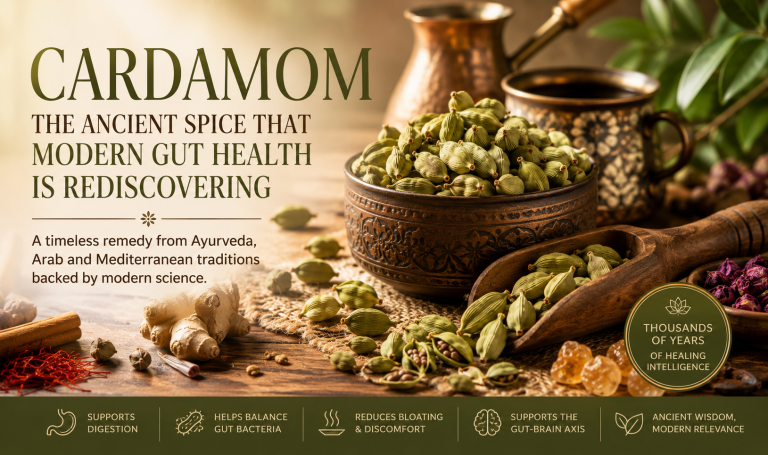
For most people, cardamom is just a flavor.
A fragrant note in chai.
A spice sprinkled into desserts.
An aromatic addition to coffee.
But across Ayurvedic, Arab, Persian, and Mediterranean traditions, cardamom was never viewed as merely culinary.
It was medicine.
For thousands of years, physicians, healers, and traditional food systems used cardamom to support digestion, reduce intestinal discomfort, improve breath, calm bloating, and restore balance to the gastrointestinal tract long before the words “microbiome,” “gut-brain axis,” or “digestive inflammation” existed.
Modern science is now beginning to explore what ancient systems already understood intuitively:
certain spices do far more than flavor food — they actively shape physiology.
And cardamom may be one of the most underestimated among them.
The Forgotten Intelligence of Ancient Food Medicine
One of the great mistakes of modern nutrition is separating food from function.
Traditional systems never made that distinction.
In Ayurveda, food was energetic medicine.
In Arab medicine, digestion was central to vitality and longevity.
In Mediterranean cultures, herbs and spices were integrated into daily life not merely for taste, but for resilience, circulation, warmth, digestion, and microbial balance.
Cardamom sat at the center of many of these traditions.
Not because it was exotic.
Because it worked.
Ancient physicians repeatedly prescribed cardamom for:
- Bloating
- Gut spasm
- Heavy digestion
- Fermentation
- Acidic stomach conditions
- Foul breath
- Sluggish digestion
- Mucus accumulation
- Nervous stomach conditions
Today we might describe these through the lens of:
- microbiome imbalance
- dyspepsia
- altered gastric motility
- inflammation
- stress-related digestive dysfunction
Different language.
Same human body.
Why Cardamom Was Added to Coffee for Centuries
One of the most fascinating traditional uses of cardamom appears in Arabic coffee culture.
Traditional Bedouin and Middle Eastern coffee preparations often combine coffee with freshly cracked green cardamom pods.
At first glance, this seems purely cultural.
But there is deeper physiological intelligence behind it.
Coffee stimulates gastric acid secretion and can irritate sensitive digestive systems in some individuals. Cardamom appears to help buffer part of that effect through its volatile oils and digestive-supportive compounds.
Traditional systems recognized this experientially centuries ago.
The pairing was not random.
It was functional.
Ancient cultures often developed culinary traditions through long-term biological observation rather than laboratory analysis. They noticed which combinations created vitality and which created imbalance.
This is one reason traditional food systems deserve more scientific respect than they often receive.
The Active Compounds Inside Cardamom
Cardamom contains numerous bioactive compounds, including:
- Cineole
- Terpinene
- Limonene
- Linalool
- Flavonoids
- Polyphenols
- Essential oils
These compounds are being studied for their potential roles in:
- Digestive support
- Gastric motility
- Antioxidant activity
- Antimicrobial effects
- Anti-inflammatory effects
- Breath improvement
- Nervous system regulation
Some preliminary studies suggest cardamom may exhibit inhibitory effects against certain harmful bacterial strains, including H. pylori in laboratory settings. However, this does not mean cardamom alone “eliminates” H. pylori infections clinically, and it should not replace medical treatment when necessary.
This distinction matters.
Ancient wisdom can coexist with scientific integrity.
We do not need exaggeration to appreciate the power of traditional medicine.
The Gut-Brain Connection
One reason cardamom has remained valued across cultures may be because digestion is not merely mechanical.
The gut and nervous system are deeply interconnected.
Modern neuroscience now recognizes the bidirectional communication network between the gastrointestinal tract and the brain — often called the gut-brain axis.
Stress changes digestion.
Fear changes digestion.
Trauma changes digestion.
Chronic sympathetic activation alters motility, acid secretion, microbiome diversity, and inflammatory signaling.
Traditional systems observed this relationship long ago.
This is why aromatic spices were often considered both digestive and emotional medicines simultaneously.
Cardamom is warming without being overly aggressive.
Stimulating without being excessively heating.
Opening without overwhelming.
In Ayurvedic language, it helps kindle digestive fire while reducing stagnation.
Why Fresh Cardamom Matters
One important insight from traditional spice usage is that freshness dramatically changes potency.
The volatile aromatic compounds in spices degrade over time, especially once ground.
Whole green cardamom pods preserve essential oils far longer than pre-ground powder.
When freshly cracked, cardamom releases a distinctly floral, eucalyptus-like aroma. That fragrance reflects the volatile compounds still present within the pod.
Old cardamom often smells flat, dusty, or weak.
Traditional herbal systems paid enormous attention to freshness because potency was understood through direct sensory experience:
- smell
- color
- texture
- vitality
Modern industrial food systems often ignore these subtleties.
But ancient medicine rarely did.
Cardamom and Digestive Fire in Ayurveda
In Ayurveda, digestion is considered foundational to health.
Not merely calorie absorption.
Transformation.
The digestive system is viewed as the interface between the external world and internal consciousness.
When digestion weakens:
- toxins accumulate
- energy stagnates
- inflammation increases
- clarity decreases
Cardamom is traditionally used to support what Ayurveda calls Agni — the digestive fire.
Unlike intensely heating spices, cardamom is considered balancing and aromatic, making it useful even for individuals sensitive to stronger stimulants.
It is frequently combined with:
- ginger
- cinnamon
- fennel
- saffron
- clove
- coriander
Not simply for flavor harmony, but for synergistic digestive effects.
Ancient Systems Understood Synergy
Modern culture often searches for isolated “superfoods” or miracle compounds.
Ancient traditions thought differently.
They emphasized combinations.
Coffee with cardamom.
Kefir with warming spices.
Digestive teas after meals.
Warm water infusions.
Seasonal eating.
Herbal synergy.
The goal was not biohacking.
The goal was balance.
Many traditional systems recognized that digestion is influenced by:
- temperature
- timing
- emotional state
- preparation methods
- food combinations
- season
- stress
- rhythm
This systems-based understanding is now slowly re-emerging in integrative medicine.
The Modern Digestive Crisis
Modern digestive dysfunction is increasingly common:
- bloating
- reflux
- IBS
- constipation
- microbiome imbalance
- chronic inflammation
- stress-induced digestive disruption
Part of this may stem from the reality that modern life constantly activates survival physiology.
We eat quickly.
Under stress.
Distracted.
Overstimulated.
Disconnected from natural rhythms.
Ancient food systems evolved under entirely different nervous system conditions.
The value of traditional spices like cardamom may extend beyond chemistry alone.
Their ritual use slows the human being down.
Warm tea.
Slow brewing.
Aromatic preparation.
Mindful consumption.
The medicine may not only be molecular.
It may also be neurological.
Simple Traditional Ways to Use Cardamom
Traditional systems commonly used cardamom in ways that remain beautifully practical today:
Morning Digestive Infusion
Freshly crack 2–3 green pods into warm water and steep for several minutes.
Cardamom Coffee
Add freshly cracked cardamom to coffee grounds before brewing.
Digestive Spice Tea
Combine:
- cardamom
- ginger
- cinnamon
in warm water after meals.
Fermented Dairy Pairing
In some traditions, cardamom is stirred into cultured dairy or kefir alongside saffron and honey.
Breath & Digestion Support
Chewing whole cardamom pods after meals remains common in many cultures.
Ancient Wisdom and Modern Science Do Not Need to Compete
One of the most beautiful shifts happening today is the gradual reconciliation between traditional wisdom and scientific inquiry.
For too long, ancient medicine was dismissed because it lacked laboratory language.
But many traditional systems were built upon thousands of years of direct observation across generations.
Science helps explain mechanisms.
Tradition preserves patterns of lived experience.
The future of health may not belong entirely to ancient systems or modern systems alone.
It may emerge through integration.
And perhaps that is why something as small as cardamom matters.
Because sometimes the oldest remedies endure not through marketing…
but because humanity kept rediscovering their value generation after generation.
The kitchen was once humanity’s first pharmacy.
And in many ways, it still is.