
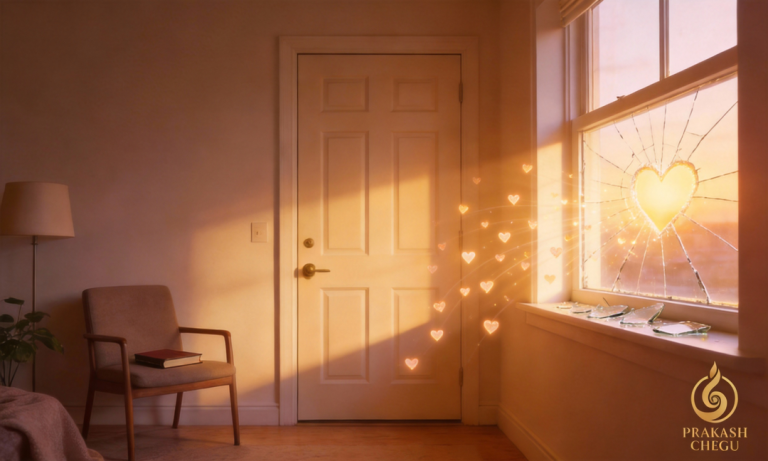
There is a particular kind of violence that love sometimes requires.
Not the kind that destroys for the sake of destruction—but the kind that refuses to let walls stand when connection matters more than preservation.
“If the front door of my heart is locked and you need to get in… break a window. We can clean it up later.”
I’ve been turning this idea over in my mind for weeks, like a stone smoothed by water. What does it mean to tell someone they’re worth the damage? To say that the defenses we’ve spent years constructing—those carefully painted doors with their deadbolts and chains—matter less than the person standing on the other side?
What does it mean to choose connection over containment?
The Architecture of Self-Protection
We spend so much of our lives building.
Careers. Reputations. Identities that feel acceptable, respectable, survivable. And somewhere along the way, we also build walls. We install doors with good locks. We design entryways with rules: knock first, wait to be invited, wipe your feet, present yourself properly.
These aren’t flaws. They’re adaptations.
Every locked door has a story. Someone knocked too hard. Someone entered without consent. Someone left the door swinging open when they walked away, letting the cold rush in.
So we learned to lock up. To regulate access. To become skilled architects of our own emotional security systems. There is wisdom in this. There is self-respect in it. There is maturity in knowing that not everyone deserves unrestricted access to your inner world.
Boundaries are not the problem.
But then something happens.
The Emergency That Changes Everything
Then someone shows up who needs in.
Not wants in—needs in.
And maybe you’re not ready. Maybe the door is locked not because you don’t care, but because you care too much. Maybe you’re in the middle of your own renovation—sorting through old patterns, discarded furniture from past relationships, emotional debris you haven’t yet hauled out.
Maybe there’s a sign on your heart that says Closed for Repairs, and you mean it.
They could walk away.
They probably should walk away.
Any reasonable person sees a locked door and thinks: This isn’t the time. I’ll come back later.
But what if later is too late?
What if the emergency is now?
This is where the metaphor sharpens. Because breaking a window is not subtle. It’s loud. Irreversible. It leaves evidence. You cannot break a window quietly or tentatively. You can’t half-do it and change your mind.
Breaking a window requires conviction.
It requires clarity.
It requires believing that what’s on the other side matters more than the glass itself.
The Permission to Be Needed
“Break a window” is not casual permission.
It’s a declaration of priority.
It says: If there is a real emergency in your life, and I’m unreachable through normal channels, I am giving you permission to disrupt my carefully maintained exterior.
In a culture that rewards being low-maintenance, emotionally contained, endlessly self-regulated—this is radical. We’re taught not to impose. Not to be “too much.” To respect boundaries at all costs.
And yes—boundaries matter.
But so does urgency.
Sometimes love demands disruption. Sometimes care requires refusing to let someone’s temporary unavailability become permanent distance.
When you tell someone they can break a window, you’re really saying:
I trust you to know the difference between an emergency and an inconvenience.
I trust your judgment.
I trust your restraint.
I trust that you would only do this when it truly matters.
That level of trust is rare. And it’s intimate.
The Mess We Postpone
“We can clean it up later.”
This line carries more wisdom than it first appears.
Because it names the truth: there will be a mess. Broken glass. Consequences. Repairs. Conversations that don’t wrap neatly.
And still—it’s worth it.
How much of life do we postpone because we’re waiting for conditions to be perfect? How many conversations do we delay, connections defer, reconciliations avoid because we want everything tidy before we let anyone in?
But crises don’t respect timing. Love doesn’t check your calendar.
Sometimes the choice is simple:
A clean house with no one in it.
Or a messy house with someone you love standing in the room, glass crunching underfoot, both of you shaken—but together.
The mess can be cleaned.
The window can be repaired.
The damage can be assessed and integrated.
But distance? Distance calcifies.
When Windows Should Stay Intact
This metaphor has a shadow side—and it matters to name it.
Not everyone who wants to break a window should.
Not every emotional spike is an emergency. Not every demand for access is love. Some people hear break a window and translate it into permission for chaos—disregard for boundaries, manufactured crises, emotional entitlement.
That is not what this is.
The difference is discernment.
Breaking a window because you’re bored or dysregulated is violation.
Breaking a window because you see smoke and the house is burning is care.
Love knows the difference.
The Practice of Being Reachable
This is not a call to be endlessly available.
It’s a call to be reachable.
To not be so fortified that no signal can get through. To not confuse emotional self-containment with emotional absence. To allow for the possibility that even while under construction, something—or someone—might matter enough to interrupt the process.
Reachability is courage.
It says: I am resilient enough to handle the disruption.
It says: I trust myself to repair what urgency damages.
It says: connection matters more than perfection.
What We’re Really Saying
When you tell someone they can break a window, you are saying:
You matter more than my comfort.
You matter more than my image.
You matter more than my temporary inconvenience.
You’re saying: I trust you.
And: I am not afraid of the aftermath.
You’re saying: I would rather deal with broken glass than live with the regret of an unopened door.
And maybe most importantly, you’re saying:
I am not so fragile that I cannot be disrupted.
And I am strong enough to rebuild afterward.
The Invitation
So here’s the real invitation.
Build your boundaries.
Lock your doors when you need to.
Take your time to heal, renovate, repair.
But leave a window.
Let the people who matter know that there is a way in when it truly counts. Let them know they are worth a little mess. Worth the noise. Worth the urgency.
Because what good is a perfectly maintained house if the people you love are standing outside in the rain, afraid to disturb you?
Break a window.
We can clean it up later.
The glass is replaceable.
The moment might not be.