There is a quiet wisdom woven into the natural world.
Not the kind that announces itself with headlines or demands your attention through urgency. Nature teaches differently. It whispers. It repeats. It demonstrates the same truths over and over again until one day, when your life has reached exactly the right moment, you finally understand what it has been saying all along.
Perhaps this is why so many spiritual traditions encourage us to spend time in forests, beside rivers, under open skies, or watching the sunrise. Nature is not simply beautiful scenery. It is a living scripture.
Every tree, every flower, every wave, every gust of wind carries a lesson about how life unfolds.
The problem is not that nature has stopped teaching.
The problem is that we have stopped listening.
Modern life has trained us to seek constant progress, endless productivity, and immediate results. We celebrate acceleration while forgetting that every meaningful process in existence follows cycles rather than straight lines.
When we return to nature, we remember something ancient.
We remember ourselves.
The Wind: Changing Direction Does Not Mean You Are Lost
One of the greatest fears people carry is the fear of changing course.
They stay in careers that no longer inspire them.
They remain in relationships that quietly diminish them.
They continue living identities they outgrew years ago because consistency feels safer than uncertainty.
Society often celebrates unwavering persistence, but nature offers a different perspective.
Watch the wind.
It never apologizes for changing direction.
It bends around mountains instead of crashing into them. It moves with changing temperatures, shifting seasons, and invisible currents. It is constantly adapting, yet it never loses its essence.
It is still the wind.
Human beings often mistake adaptation for failure.
Changing careers after twenty years.
Moving to another country.
Beginning a spiritual path later in life.
Leaving behind beliefs that no longer feel true.
Starting over after divorce.
Reinventing yourself after illness.
None of these mean you are lost.
They often mean you have finally started listening.
Ancient yogic philosophy describes life as a continual dance between stability and transformation. The Sanskrit concept of Pravṛtti refers to outward engagement with life, while Nivṛtti represents the inward return toward truth. Healthy living requires both movement and stillness.
The wind understands this naturally.
Perhaps we should too.
The Flowers: You Do Not Need to Bloom Every Season
Modern culture has quietly convinced us that our worth depends on visible achievement.
We should always be producing.
Always growing.
Always creating.
Always succeeding.
Always smiling.
Always “becoming the best version of ourselves.”
Nature completely disagrees.
Walk through a garden in winter.
Many flowers have disappeared.
Nothing appears to be happening.
Yet beneath the soil, roots continue their invisible work.
Energy is being conserved.
Life is reorganizing itself.
The next bloom is already being prepared.
The flower does not judge itself because it is not flowering today.
It does not compare itself to another species blooming in a different season.
It simply trusts its timing.
Human beings have forgotten this wisdom.
There are seasons for expansion.
There are seasons for learning.
There are seasons for healing.
There are seasons for grief.
There are seasons for stillness.
There are seasons when your greatest accomplishment is simply remaining open to life.
Rest is not the opposite of growth.
It is part of growth.
Even neuroscience reflects this principle.
Many of the brain’s most important processes occur during periods of rest rather than active effort. During sleep and quiet wakefulness, the brain consolidates memories, reorganizes neural pathways, clears metabolic waste through the glymphatic system, and strengthens the connections that support learning and creativity.
The same principle applies emotionally.
Healing often occurs when we stop forcing ourselves to heal.
Sometimes the most productive thing you can do is simply allow yourself to exist without demanding constant improvement.
The Ocean: You Can Be Both Calm and Chaos
The ocean contains contradictions.
Its surface may appear perfectly still while immense currents move below.
A peaceful shoreline can become a powerful storm within hours.
It nourishes life.
It shapes continents.
It destroys coastlines.
It inspires poets.
It humbles sailors.
The ocean is not confused by its contradictions.
Only humans are.
Many people believe they must choose between softness and strength.
Between compassion and boundaries.
Between peace and passion.
Between vulnerability and power.
Nature never makes these distinctions.
Water is perhaps the gentlest substance on Earth.
Yet over time it carves mountains.
It smooths stone.
It reshapes landscapes.
Gentleness is not weakness.
Power is not aggression.
The Bhagavad Gita describes the sthitaprajña—the person of steady wisdom—as one who remains inwardly anchored amid life’s inevitable waves. This is not emotional suppression; it is emotional mastery.
The ocean does not resist its tides.
It expresses them fully.
Likewise, emotional maturity does not mean never feeling anger, sadness, joy, fear, or excitement.
It means allowing emotions to move through us without allowing them to define us.
You can be peaceful without becoming passive.
You can be powerful without becoming forceful.
You can be deeply loving while maintaining clear boundaries.
The ocean never apologizes for its depth.
Neither should you.
The Trees: Growth Begins Long Before Anyone Notices
Perhaps no teacher is more patient than a tree.
Plant a seed today.
For weeks, nothing appears.
Months may pass with little visible change.
Yet beneath the soil an extraordinary process unfolds.
Tiny roots branch outward in every direction, searching for water, minerals, and stability. The future height of the tree depends almost entirely upon the invisible architecture developing underground.
Nature understands something modern culture often forgets:
What cannot be seen is usually more important than what can.
The strongest trees are not built from fast growth.
They are built from deep roots.
Human development follows the same pattern.
Long before people notice confidence, countless moments of quiet courage have already occurred.
Long before they admire wisdom, years of questioning and reflection have taken place.
Long before they celebrate success, thousands of unseen decisions have been made in solitude.
The world usually applauds the fruit.
Nature values the roots.
This mirrors a profound principle found in both biology and spirituality.
In biology, root systems stabilize, nourish, and communicate through vast underground fungal networks that scientists call the “wood wide web.” Trees even exchange nutrients and chemical signals, supporting one another through these hidden connections.
Spiritually, our inner roots are our values, disciplines, character, and relationship with the deeper Self.
Meditation.
Prayer.
Silence.
Integrity.
Service.
Compassion.
These practices rarely produce immediate applause.
But over time they create lives that cannot easily be shaken.
Living by Seasons Instead of Timelines
One of humanity’s greatest sources of suffering comes from measuring life against clocks instead of cycles.
We ask:
“Why haven’t I achieved this by thirty?”
“Why isn’t my business growing faster?”
“Why haven’t I found my partner?”
“Why am I not healed yet?”
Nature asks different questions.
“What season are you in?”
A tree does not produce fruit in winter.
A flower does not bloom during every month.
The ocean does not remain perfectly calm.
The wind does not blow from one direction forever.
Why do we expect ourselves to?
Living seasonally means recognizing that each chapter of life serves a purpose.
There will be seasons of building.
Seasons of letting go.
Seasons of uncertainty.
Seasons of abundance.
Seasons of solitude.
Seasons of profound connection.
None are mistakes.
Each prepares the next.
Returning to the Wisdom We Already Know
Perhaps the deepest lesson nature offers is not that we must become something new.
It reminds us of what we have always been.
We are not separate from the cycles around us.
The same intelligence that teaches a seed when to sprout, guides migrating birds across continents, times the tides with the Moon, and orchestrates the changing seasons also lives within us.
When we spend less time fighting life’s rhythms and more time cooperating with them, something remarkable happens.
Anxiety softens.
Comparison fades.
Patience grows.
Trust returns.
We stop demanding that life unfold according to our schedules and begin participating in something far older and wiser than our plans.
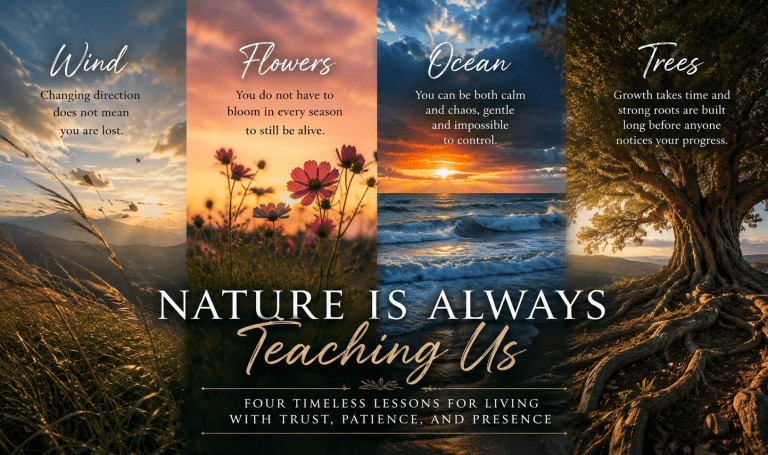
The wind reminds us that changing direction does not mean we are lost.
The flowers remind us that not every season is meant for blooming.
The ocean reminds us that we can hold both gentleness and immense power.
The trees remind us that the deepest growth happens underground, long before the world notices.
Nature has never been trying to impress us.
It has always been trying to teach us.
The invitation is beautifully simple.
Slow down.
Step outside.
Listen.
The next lesson may already be waiting in the rustle of leaves, the scent of a flower, the rhythm of the waves, or the whisper of the wind.
And perhaps, if you listen closely enough, you’ll realize that nature has been telling your own story all along.