For more than half a century, biology has rested upon one of its most fundamental principles:
DNA makes RNA.
RNA makes protein.
This framework, known as the Central Dogma of Molecular Biology, was proposed by Francis Crick in 1958 and became one of the foundational organizing principles of modern life science.
The logic appeared elegant and absolute.
DNA stored genetic information.
RNA carried the message.
Proteins performed the work of life.
Information flowed in one direction — from blueprint to execution.
Even when exceptions emerged, such as reverse transcription in retroviruses like HIV/AIDS, the deeper assumption still remained intact:
New DNA required an existing template.
Life copied itself from prior instructions.
Then, within a span of roughly thirty days, biology was shaken twice.
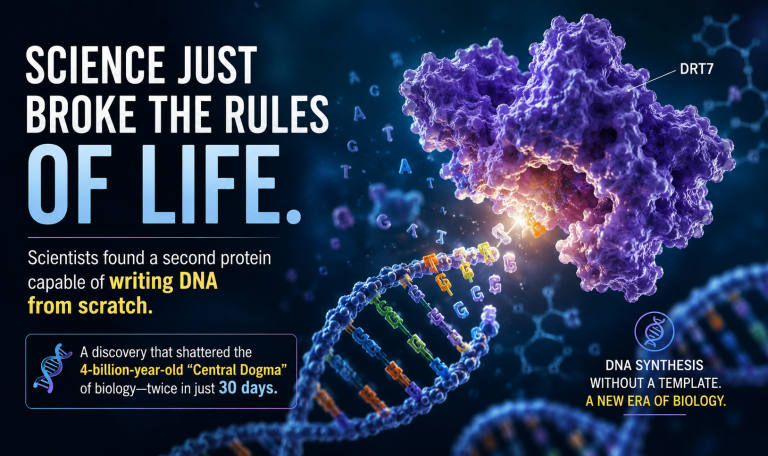
Scientists identified not one, but two proteins — DRT3 and now DRT7 — capable of synthesizing DNA de novo, meaning from scratch, without relying on a parental DNA template.
This is not merely a new biochemical curiosity.
It represents a profound challenge to one of the deepest assumptions in molecular biology:
That genetic information must always descend from prior genetic information.
The implications ripple far beyond genetics.
They touch the origins of life, evolution, synthetic biology, medicine, information theory, and perhaps even our philosophical understanding of creation itself.
What Exactly Was Discovered?
Researchers studying bacterial defense systems uncovered proteins called DRT3 and DRT7, part of a larger family associated with microbial immune responses.
At first glance, these proteins appeared unusual but not revolutionary.
Then scientists realized something astonishing:
These proteins could assemble DNA molecules without needing a DNA template to copy from.
Normally, enzymes called DNA polymerases require:
- a preexisting strand,
- a primer,
- and strict base-pair instructions.
DNA replication has always been understood as a highly constrained process.
Like copying a book, biology was believed to require an original manuscript.
But DRT7 appears capable of generating DNA sequences independently through an entirely different molecular strategy.
Even more remarkable:
DRT3 and DRT7 do not perform this feat the same way.
They use distinct biochemical mechanisms to achieve a similarly impossible outcome.
That detail matters enormously.
Because when nature evolves two separate solutions to the same problem, it often signals something fundamental rather than accidental.
Why This Shatters Old Assumptions
The original Central Dogma was never merely about chemistry.
It was about directionality.
Biology assumed information moved through a structured hierarchy:
DNA → RNA → Protein.
But discoveries over time already began softening the rigidity of that model:
- Reverse transcriptase showed RNA could rewrite DNA.
- Epigenetics revealed environmental influence could modify gene expression.
- CRISPR systems demonstrated programmable genomic editing.
- RNA editing exposed dynamic rewriting inside living cells.
Yet all these processes still depended upon existing informational templates.
The new discovery is different.
DRT7 suggests that biological systems may possess mechanisms for generating genetic information without inherited instruction sets.
That possibility changes the philosophical architecture of genetics itself.
Instead of life functioning purely as replication,
life may also contain intrinsic mechanisms of spontaneous molecular authorship.
What “De Novo DNA Writing” Actually Means
To appreciate the magnitude of this discovery, imagine language.
Traditional genetics operates like copying text:
every sentence comes from an earlier sentence.
Even mutations are modifications of inherited structure.
But de novo DNA synthesis is more like generating entirely new words without an original manuscript.
The cell is not merely copying information.
It is composing.
That distinction is revolutionary.
Because it suggests biology may be more creative, adaptive, and improvisational than previously believed.
Why Would Nature Need Such Proteins?
One leading theory involves microbial warfare.
Bacteria exist in an unimaginably competitive environment dominated by viruses called bacteriophages.
To survive, microbes evolved astonishing defensive systems:
- CRISPR
- restriction enzymes
- toxin-antitoxin systems
- programmable nucleases
- molecular decoys
DRT proteins may belong to this hidden arsenal.
If a virus invades a bacterium, the ability to rapidly generate new DNA structures without templates could create emergency defense responses:
- genetic traps,
- decoy sequences,
- antiviral barriers,
- or molecular sabotage systems.
In other words:
Nature may have evolved “genetic improvisation” as a survival strategy.
And if that is true, it suggests life possesses a deeper flexibility than classical genetics ever imagined.
The Origin-of-Life Implications
Perhaps the most profound question raised by DRT7 concerns the origin of life itself.
For decades, scientists have struggled with a paradox:
How did the first genetic systems emerge if DNA replication requires preexisting templates?
This has always created a chicken-and-egg problem.
You need genetic information to replicate genetic information.
But where did the original information come from?
Discoveries like DRT7 hint that primitive life may have possessed biochemical systems capable of generating nucleic acid structures before stable template-based inheritance fully evolved.
This could reshape theories about:
- abiogenesis,
- prebiotic chemistry,
- RNA-world hypotheses,
- and the emergence of early self-organizing systems.
It suggests that the earliest life forms may have been far more fluid, experimental, and dynamically generative than modern biology.
The Central Dogma Was Never Completely Wrong
It is important to understand something subtle.
The Central Dogma is not “dead.”
Most biology still operates through DNA → RNA → Protein.
What is changing is our understanding of how flexible biological information systems truly are.
Science advances this way repeatedly.
Newtonian physics was not destroyed by relativity.
It was expanded.
Classical genetics is not collapsing.
It is being revealed as part of a larger framework.
And this pattern appears throughout scientific history:
- quantum mechanics expanded classical physics,
- epigenetics expanded Mendelian inheritance,
- neuroplasticity expanded neuroscience,
- microbiome science expanded human physiology.
Now de novo DNA writing may expand molecular biology itself.
The Information Theory Perspective
From an information science viewpoint, this discovery is extraordinary.
Life has traditionally been modeled as:
- storage,
- transmission,
- replication,
- and error correction.
But DRT7 introduces another dimension:
Generative biological computation.
The cell may not merely preserve information.
It may actively create new informational architectures under certain conditions.
This moves biology closer to adaptive systems theory, where living organisms function less like rigid machines and more like dynamic, self-organizing intelligence networks.
That concept increasingly aligns with modern complexity science.
Potential Medical Applications
Although the science is still early, the implications could become enormous.
Possible future applications include:
Synthetic Biology
Scientists may eventually engineer programmable systems capable of generating entirely new DNA structures on demand.
Gene Therapy
De novo DNA synthesis could allow more flexible repair systems for damaged genomes.
Antiviral Defense
Understanding bacterial defense proteins often leads to revolutionary biotechnology tools — just as CRISPR emerged from microbial immunity research.
Regenerative Medicine
Adaptive DNA-writing systems could one day help tissues respond dynamically to injury or disease.
Evolutionary Engineering
Researchers may develop self-adaptive genetic systems capable of evolving novel biological functions rapidly.
At present, these remain speculative possibilities.
But CRISPR itself once sounded speculative too.
A Humbling Reminder About Science
Perhaps the deepest lesson here is epistemological.
Humanity often assumes we understand life because we can manipulate fragments of it.
But discoveries like DRT7 remind us that biology still contains entire layers of intelligence hidden beneath our current models.
The closer science looks, the stranger life becomes.
Proteins once thought impossible appear.
Cells behave in ways no textbook predicted.
Information flows through pathways previously unimaginable.
Nature continually exceeds the boundaries of our certainty.
And that may be one of the healthiest truths science can offer:
not rigidity,
but evolving humility.
Life May Be More Creative Than We Imagined
For centuries, biology has largely viewed life as a system of inheritance.
Genes passed forward.
Instructions copied themselves.
Organisms preserved continuity.
But discoveries like DRT3 and DRT7 hint at something more profound.
Life may not merely replicate.
Life may generate.
Under the right conditions, biology itself may possess intrinsic capacities for molecular creativity — mechanisms capable of producing novelty directly from dynamic biochemical intelligence rather than simple duplication.
If true, this discovery will not merely revise a chapter in biology textbooks.
It may eventually reshape how we understand evolution, adaptation, emergence, and the creative architecture of life itself.
And perhaps the most beautiful part is this:
The deeper science explores reality, the less mechanical life appears — and the more alive it becomes.