When devotion becomes a way of life — the sacred marriage of Tulsi and Vishnu, and what it teaches us about love, renewal, and the holiness of the everyday.
There is something deeply moving about a tradition that prepares a wedding for a plant.
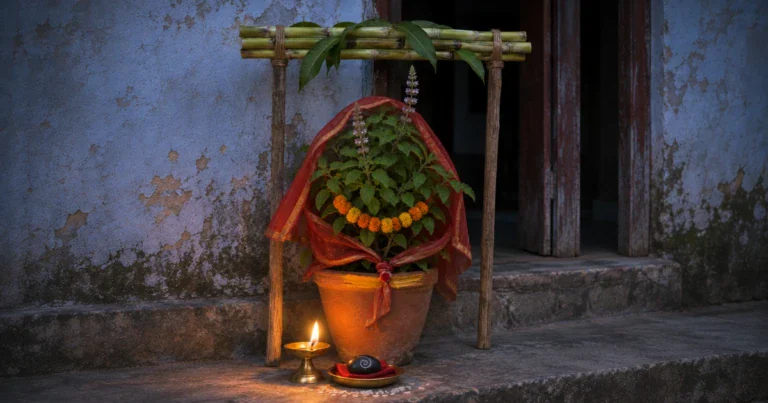
A courtyard is swept. A small earthen lamp is lit. Flowers are gathered. A Tulsi plant, familiar to the household through months of watering and care, is adorned like a bride. Beside her sits a form of Vishnu or Krishna. Family members gather, prayers are offered, and an ordinary corner of the home becomes a place of celebration.
The gestures are tender. The meaning reaches far beyond their simplicity.
Tulsi Vivah invites us to consider what happens when devotion becomes a relationship: something we return to, care for, and allow to shape our conduct.
We can speak eloquently about the sacred while neglecting the life immediately around us. We can seek extraordinary experiences while overlooking the small responsibilities through which love becomes visible.
A plant at the threshold asks for something concrete. Water. Light. Attention. Someone who remembers.
Through the ceremonial marriage of Tulsi and Vishnu, the household is invited to remember, too: that the divine can be encountered within the life we already have, and that reverence matures through care.
What is Tulsi Vivah?
Tulsi Vivah is the ceremonial wedding of the sacred Tulsi plant, revered as Tulsi Devi, with Lord Vishnu — often represented by a Shaligram — or with a form of Lord Krishna. In many devotional traditions, Tulsi is honored as Vishnu’s beloved and associated with Goddess Lakshmi. The festival takes place during the Hindu month of Kartika.
The ceremony brings together several dimensions of religious life: devotion to the deity, reverence for a living plant, the symbolism of marriage, and the participation of a household or community.
For a devotee, Tulsi is a presence to whom one offers respect. That relationship gives a different quality to the smallest actions. Watering becomes service. A lamp becomes an offering. A courtyard becomes a place where attention gathers.
This is one of the festival’s most accessible invitations. You do not have to travel far to begin living with reverence. You can begin by changing the quality of your relationship with what is already beside you.
When is Tulsi Vivah celebrated?
Tulsi Vivah is widely associated with Kartika Shukla Dwadashi, the twelfth lunar day of Kartika’s bright fortnight. Customs also place its observance within the period from Prabodhini Ekadashi to Kartika Purnima, with particular emphasis on Dwadashi.
For 2026, Tulsi Vivah falls on Saturday, November 21 for New Delhi and by India’s official tourism festival listing. A household observing elsewhere should follow its local panchang and family tradition for the appropriate tithi and ceremony time.
Its proximity to Devutthana (Prabodhini) Ekadashi is meaningful. In the traditional sacred calendar, Vishnu’s awakening marks the conclusion of the Chaturmas period. Tulsi Vivah also signals the reopening of the marriage season in many Hindu communities.
Read contemplatively, this is a beautiful movement: inwardness ripens into participation. What has been gathered through prayer and restraint is brought back into relationship, responsibility, and shared life.
There are seasons for withdrawing and listening. There are also seasons for making a commitment and allowing life to ask more of us.
The stories behind the sacred marriage
Tulsi’s mythology has several versions. Two important narrative strands deserve to be distinguished rather than folded into one supposedly uniform account.
Vrinda and Jalandhara
In the Skanda Purana (Vaishnava Khanda, Karttikamasa Mahatmya, Chapter 21), Vrinda is the wife of Jalandhara. Vishnu deceives her through an assumed appearance. When she recognizes the deception, she condemns him and pronounces a curse connected with his future experience of separation from his wife. Her grief is central to the episode.
This is a difficult story. Its emotional weight should remain visible when we tell it.
Tulsi and Shankhachuda
In the Devi Bhagavata Purana (Book 9, Chapter 24), the husband is Shankhachuda. Vishnu assumes his appearance and deceives Tulsi. Discovering what happened, she reproaches Vishnu and curses him to become stone. The narrative connects her with the Gandaki River and the Tulsi plant, and Vishnu with the sacred Shaligram. It also describes her divine union with him.
The stories overlap in theme, but their characters and details differ. Naming the text helps preserve the richness of the tradition.
These are Puranic theological narratives. They explore divine action, devotion, suffering, and sacred transformation through story. Reading them well requires more than extracting a simple moral from every event.
Making room for the difficult questions
A thoughtful reader may feel troubled by the deception in these accounts. That response deserves room within a serious spiritual conversation.
Tulsi’s protest belongs to the story. Her anguish has a voice. A devotional reading can attend to the eventual sacred union while also acknowledging the violation of trust that precedes it.
For contemporary life, an essential ethical distinction is clear: a myth involving divine deception gives no person permission to deceive a partner, override consent, or demand acceptance of harm in the name of destiny.
Spiritual language carries responsibility. When we describe suffering as a lesson, we must still care about the person who suffered. When we speak of transformation, we must allow grief its own time and dignity.
My contemplative reading of Tulsi Vivah begins here: devotion must be able to include truth. Reverence becomes deeper when it can remain present with a difficult question without silencing the person asking it.
The festival can then become an occasion to honor trust, to examine how we use power, and to ask whether our spiritual commitments make us more accountable in love.
Tulsi and Vishnu: the meeting of tenderness and steadiness
One way to meditate on the festival is through the qualities suggested by its sacred forms.
Tulsi is living, fragrant, responsive, and dependent on care. Vishnu, as the sustaining presence in Hindu theology, evokes preservation and continuity. In the Shaligram form, that sustaining presence is encountered through stone.
As a contemplative metaphor, the meeting of plant and stone invites reflection on tenderness and steadiness. This is an interpretation of the imagery, rather than a claim that the scriptures assign a single fixed meaning to it.
Tenderness makes relationship responsive. It allows us to notice a change in someone’s voice, an unspoken worry, a need that has not yet become a request.
Steadiness makes that responsiveness trustworthy. It helps us keep our word, return to a difficult conversation, and care for someone when affection is less effortless than it was yesterday.
Love needs both qualities. Warmth benefits from dependable action. Commitment benefits from a heart that continues to listen.
We might bring these questions to the ceremony: Where does my tenderness need greater consistency? Where has my discipline become rigid? What would it mean to be both reliable and kind?
These questions belong to everyone, regardless of gender or relationship status. The marriage imagery becomes especially fruitful when it helps us cultivate the qualities we ask to receive from another person.
From asking for blessings to offering ourselves
Many prayers begin with a need. We ask for relief, companionship, health, prosperity, or direction. There is something deeply human about bringing these needs into a sacred relationship.
Devotion can also grow toward another question: What am I willing to offer?
At Tulsi Vivah, this question may be approached through the language of commitment. We offer the part of ourselves that is able to show up. We bring our attention back when it wanders. We allow a cherished value to influence a difficult decision.
This is a practical way to contemplate surrender. We loosen our insistence that life must unfold according to one preferred script, while continuing to act with discernment and responsibility.
We can pray for a relationship and remain willing to recognize incompatibility. We can seek prosperity and remain faithful to ethical work. We can long for healing while accepting the support and time that healing may require.
The offering deepens as it includes our conduct. A flower is placed before the deity; patience is brought into a conversation. A lamp is lit; a truth we have avoided is finally spoken with care.
In this way, devotion begins to shape the person making the prayer.
Why a single leaf matters
Tulsi worship brings attention to a small offering. The Bhagavad Gita (9.26) expresses a related principle: Krishna accepts a leaf, flower, fruit, or water offered with devotion. The verse speaks broadly of a leaf; it does not specifically name Tulsi.
The spiritual implication is generous. Meaningful participation is available even when resources are modest.
A person may have little money for elaborate offerings. Another may lack the time or space for a large ceremony. Yet both can bring attention, gratitude, and a sincere willingness to serve.
There is freedom in remembering this. The wish to make an offering beautiful can coexist with simplicity. Beauty grows through care: a clean vessel, fresh water, a thoughtfully placed flower, a prayer spoken with understanding.
The leaf also offers a question for daily life. What small act have I dismissed because it seems too ordinary to matter?
Perhaps it is a call to a parent. Perhaps it is washing the dishes after a shared meal, paying someone promptly, or setting aside the phone when a loved one is speaking.
Such acts are small enough to repeat. Through repetition, they begin to reveal what we value.
Sacred marriage and the household path
Tulsi Vivah brings sacred attention into the household. Its wedding imagery can help us reflect on marriage as an ongoing practice of building a life together.
Attraction may bring two people close. Living together asks them to learn how to make decisions, handle money, care for relatives, face illness, repair misunderstandings, and remain curious about each other as they change.
The ceremonial wedding lasts an evening. The practice of care continues afterward.
This is where the symbolism becomes demanding in a useful way. A vow asks to be expressed through conduct. A blessing asks what kind of home we are preparing to sustain it.
Can someone speak honestly in this home? Can an apology be offered without immediately becoming an argument about blame? Are the daily responsibilities visible and fairly shared? Does spiritual practice make us easier to approach when something is wrong?
For couples, Tulsi Vivah can become an annual occasion to revisit these questions. Sit together after the ceremony and name one quality you appreciate in each other. Then identify one practical change that would make your shared life more caring.
For someone seeking partnership, the festival can offer a different reflection: What habits am I cultivating that would help love flourish when it arrives?
For someone living alone, it can be an occasion to strengthen friendship, hospitality, service, or devotion. A meaningful spiritual life has many forms of belonging.
The sacred feminine has a voice
In the Devi Bhagavata Purana (Book 9, Chapter 25), Tulsi is praised through names including Vrinda, Vrindavani, Vishvapujita, Vishvapavani, Pushpasara, Nandini, and Krishnajivani. The chapter presents her as worthy of worship and honor; it also depicts Hari seeking her and offering her reverence.
This gives us another point of contemplation. To honor the sacred feminine in a ceremony is to accept a responsibility toward the people whose care sustains our lives.
Consider the person who remembers everyone’s appointments, the elder who keeps the family connected, the partner who notices what the household needs, or the caregiver whose work becomes visible only when it stops.
Their contribution deserves recognition while it is being given. Appreciation can take practical forms: listening, sharing a burden, providing rest, respecting a decision, or asking what support would actually help.
If we place flowers before Tulsi, we can also ask how we respond when a woman beside us expresses exhaustion, disappointment, or a boundary.
Reverence grows credible through these encounters. The home becomes more sacred as the people within it become more able to speak and be heard.
A living plant teaches a living devotion
There is a quiet discipline in caring for Tulsi after the wedding decorations come down.
A plant continues to need attention on an ordinary morning. Its care draws us back from abstraction. We have to notice the soil, the light, the season, and the condition of the leaves.
This can become a practice of humility. The plant responds according to its own needs. Our enthusiasm does not make excess water helpful. Our affection does not replace observation.
The same lesson applies to human relationships. Care becomes more effective when we learn how it is received. We may intend kindness and still need to ask a better question or change our approach.
Seen this way, Tulsi worship offers an opening into ecological responsibility. The wider application is ours to make: use resources thoughtfully, protect living things, and leave the place of celebration cleaner than we found it.
It is possible to carry this spirit into an apartment, a shared house, or a home far from India. A small, well-tended space can hold a serious commitment.
How Tulsi Vivah is traditionally celebrated
Customs vary across regions and families. Traditional sources record an evening wedding of Tulsi with Krishna on Kartika’s twelfth lunar day, followed by the distribution of offerings such as puffed rice, sugarcane, and coconut, along with wedding elements including garlands, processions, the Maharashtrian use of an intervening cloth, and Mangalashtaka verses.
The shared center is the honoring of Tulsi as the bride and Vishnu or Krishna as the groom. Around that center, communities bring their own songs, foods, ceremonial details, and inherited ways of celebrating.
For a formal observance, the family’s own tradition or a knowledgeable priest can guide the wedding rites. A simple devotional celebration at home can also be meaningful. The following is a suggested adaptation, rather than a universal scriptural procedure.
1. Prepare the space with attention
Clean the area around the Tulsi plant. Arrange a stable place for the deity image, offerings, and lamp. Let the preparation be unhurried enough that everyone participating understands what is being celebrated. If children are present, give them something meaningful to do: gather flowers, arrange fruit, or learn the name of the festival.
2. Adorn Tulsi gently
Place flowers and a light decorative cloth around the pot or pedestal without weighing down the branches. Give the plant’s health priority throughout the celebration. Keep the lamp safely away from leaves and fabric.
3. Place the form of Vishnu or Krishna beside her
Use the deity form appropriate to your household practice. Many ceremonies use a Shaligram; an image or murti of Krishna or Vishnu is also used. The arrangement should help participants understand and attend to the sacred relationship being honored.
4. Make a clear intention
A simple sankalpa may be spoken in your own language:
May this observance deepen devotion, strengthen honesty, and bring care into our home. May our commitments become a source of wellbeing for others.
Speak it slowly enough to consider what living by it would require.
5. Offer light, flowers, food, and prayer
Offer what is appropriate to your practice and means — a lamp, flowers, sandalwood, and food. Read a short account of the festival, sing a familiar bhajan, or repeat a devotional mantra. If you are following formal wedding rites, use the sequence taught in your tradition.
6. Share the celebration
Conclude with arati if customary and distribute prasad. Make space for someone who might otherwise spend the evening alone. Hospitality gives the ceremony a life beyond the altar.
7. Carry one commitment into tomorrow
Before leaving, choose one action that expresses the intention you made — a conversation you have postponed, a household responsibility you will take on, or a regular act of service. Give it a clear beginning. A vow becomes easier to honor when it has a place in the next day’s life.
Simple mantras for the observance
For a simple salutation to Tulsi, one may use:
ॐ श्री तुलस्यै नमः॥
Om Shri Tulasyai Namah.
Salutations to revered Tulsi.
A familiar mantra for Vishnu is:
ॐ नमो भगवते वासुदेवाय॥
Om Namo Bhagavate Vasudevaya.
I bow to Bhagavan Vasudeva.
For a personal observance, repeat the mantra slowly for a few minutes, allowing its meaning to remain present. If you already follow a lineage practice, use its guidance for pronunciation, count, and sequence.
You may also end with a prayer in your own words:
May I become more faithful in the care I give. May my speech protect trust. May devotion bring patience to my actions and generosity to my home.
What blessings do devotees seek?
Tulsi worship is traditionally associated with household auspiciousness, wellbeing, prosperity, and family continuity — with prayers for happiness, good fortune, descendants, health, and abundance.
These are devotional aspirations. They express the hopes people bring before the sacred; they do not establish a guaranteed outcome from performing a ceremony.
There is room to pray wholeheartedly for companionship, a harmonious marriage, children, healing, or material stability. There is also room to examine how we participate in the conditions surrounding those hopes.
If we seek harmony, we can practice truthful and patient conversation. If we seek prosperity, we can become more responsible with what we receive. If we seek a loving home, we can begin with one act of care that makes the present home more welcoming.
Prayer allows us to acknowledge both desire and limitation. Action allows us to answer for the part that belongs to us.
A seven-day reflection after Tulsi Vivah
The following practice is a contemporary extension of the festival’s themes. It can be done alone, with a partner, or as a household.
Day 1 — Notice what sustains you. Write down three forms of care that make your life possible. Thank one person specifically.
Day 2 — Keep a small promise. Choose a commitment you can fulfill today. Give it your full attention.
Day 3 — Listen with patience. Offer someone a conversation in which you make room for their experience before giving advice.
Day 4 — Tend something living. Care for a plant, prepare nourishing food, or help someone with a practical need. Notice what the situation actually requires.
Day 5 — Repair what is yours to repair. Acknowledge one mistake plainly. Where appropriate, offer a concrete way to make amends.
Day 6 — Practice hospitality. Share a meal, invite someone into conversation, or contribute to a community effort.
Day 7 — Renew one vow. Choose a sustainable practice of devotion or service for the coming month. Make it small enough to keep and meaningful enough to matter.
Return to the intention you spoke during the ceremony. Observe where it has begun to take shape.
The wedding continues in the way we live
When Tulsi Vivah ends, the lamps are extinguished. The guests return home. Flowers begin to fade, and the household resumes its familiar rhythm.
Tulsi remains.
Her continued presence offers a gentle question: what will we remember after the celebration?
We might remember that devotion has a daily form. That a promise deserves attention. That tenderness becomes trustworthy through consistency. That the people who care for us also need care.
We might begin to approach the home as a place of practice: somewhere to become more honest in speech, more patient in disagreement, more generous with time, and more attentive to life.
This gives the festival a lasting invitation. Each morning offers another opportunity to tend what we have called sacred.
We water the plant. We keep the promise. We listen to the person beside us.
And slowly, devotion becomes a way of life.
If this reflection speaks to you, my book Tulsi: The Plant at the Threshold explores this sacred plant as a bio-spiritual medicine for the modern household — its care, its chemistry, and its quiet place in a life of devotion.
Sources & further reading
- Skanda Purāṇa — Vaiṣṇava Khaṇḍa, Kārttikamāsa Māhātmya, Chapter 21 (Vrinda & Jalandhara)
- Devī Bhāgavata Purāṇa — Book 9, Chapters 24 & 25 (Tulsi & Shankhachuda; the names and praise of Tulsi)
- Bhagavad Gītā 9.26 (the leaf, flower, fruit, and water offered with devotion)
- Drik Panchang — Tulsi Vivah 2026 date and tithi
- Incredible India — official festival listing
- Marathi Vishwakosh — observance window and traditional prayers
- Ratnagiri Gazetteer — regional wedding customs and offerings