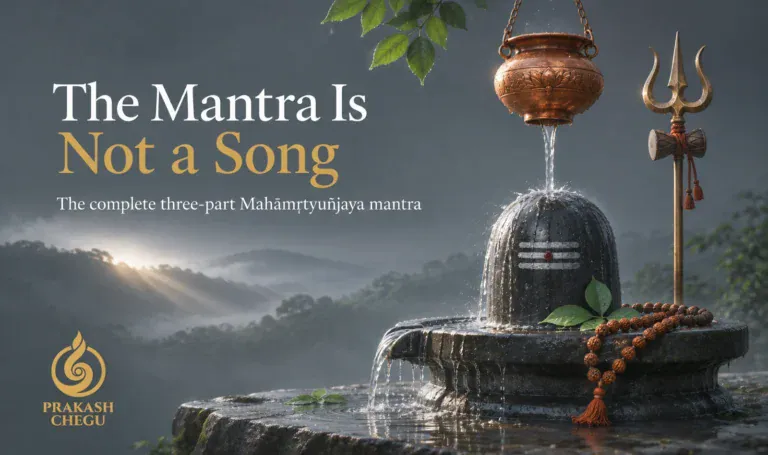
There are mantras we recite for prosperity, mantras we invoke for clarity, and mantras we turn towards when life brings us to a threshold.
The Mahāmṛtyuñjaya Mantra belongs to the threshold.
It is remembered during illness, surgery, danger, uncertainty, grief and profound transformation. It is chanted for protection, healing and longevity. It accompanies prayers for those struggling to remain in the body, as well as those preparing to leave it.
Yet its deepest purpose is not simply to prevent physical death.
The mantra is a prayer for liberation from everything within us that is already dying—and from everything we continue to hold long after its life has ended.
It does not promise that the physical body will never perish. It asks for something subtler and greater: that we may be released from the bondage of mortality without losing our connection to the immortal.
To understand this mantra, however, we must first remember what a Vedic mantra actually is.
A Mantra Is More Than Its Meaning
Modern spiritual culture often approaches mantra through translation. We read its meaning, appreciate its poetry and then sing the words according to a melody that feels beautiful.
There is nothing inherently wrong with devotional singing. A musical rendition can soften the heart, settle the mind and awaken profound bhakti. Contemporary versions of the Mahāmṛtyuñjaya Mantra have carried comfort to millions of people.
However, a devotional song and a Vedic recitation are not the same practice.
A Vedic mantra is not merely a sentence containing a spiritual idea. Its power is carried through several inseparable dimensions:
-
the Sanskrit syllables
-
the duration of each vowel
-
the joining of sounds through sandhi
-
the poetic metre or chandas
-
the placement of the breath
-
the Vedic accents or svaras
-
the consciousness and intention of the chanter
Meaning is important, but the mantra does not live through meaning alone.
Its architecture is sonic.
When the syllables, rhythm and tonal movements are altered, the words may remain a sincere prayer, but they are no longer being recited in precisely the form preserved by the Vedic oral tradition.
This is why Vedic chanting traditionally requires listening, repetition and correction under someone who has received the chant properly. A printed transliteration can help us remember the words, but it cannot fully transmit the living movement of the sound.
The Origins of the Mahāmṛtyuñjaya Mantra
The celebrated verse beginning with tryambakaṃ yajāmahe appears in the Ṛgveda, Maṇḍala 7, Sūkta 59, Mantra 12. It is addressed to Tryambaka, an epithet of Rudra, who is later widely identified with Śiva.
The verse also appears in Yajurvedic recensions, including the Taittirīya Saṃhitā and the Vājasaneyi Saṃhitā.
This familiar verse is ancient, sacred and complete in its own metrical form. Yet the traditional Mṛtyuñjaya-japa sequence presented here does not end with that verse.
It unfolds through three connected movements:
-
We invoke Tryambaka and pray for liberation from death.
-
We ask that the countless bonds or nooses of death be withdrawn.
-
We make the final offering to Mṛtyu itself.
When all three are chanted together, the mantra reveals its complete ritual architecture.
It moves from invocation, to liberation, to offering.
The Complete Three-Part Mṛtyuñjaya Mantra
In Sanskrit
ॐ त्र्यम्बकं यजामहे
सुगन्धिं पुष्टिवर्धनम् ।
उर्वारुकमिव बन्धनान्
मृत्योर्मुक्षीय माऽमृतात् ॥१॥
ये ते सहस्रमयुतं पाशा
मृत्यो मर्त्याय हन्तवे ।
तान् यज्ञस्य मायया
सर्वानवयजामहे ॥२॥
मृत्यवे स्वाहा ।
मृत्यवे स्वाहा ॥३॥
Transliteration
Oṃ tryambakaṃ yajāmahe
sugandhiṃ puṣṭivardhanam |
urvārukam iva bandhanān
mṛtyor mukṣīya mā’mṛtāt ||
Ye te sahasram ayutaṃ pāśā
mṛtyo martyāya hantave |
tān yajñasya māyayā
sarvān avayajāmahe ||
Mṛtyave svāhā |
Mṛtyave svāhā ||
First Stanza: The Prayer for Liberation
ॐ त्र्यम्बकं यजामहे
सुगन्धिं पुष्टिवर्धनम् ।
उर्वारुकमिव बन्धनान्
मृत्योर्मुक्षीय माऽमृतात् ॥१॥
We worship the Three-Eyed One,
the fragrant One who nourishes and strengthens life.
As a ripened fruit is released naturally from its stem,
may I be liberated from the bonds of death—
but never separated from immortality.
This first stanza invokes Tryambaka—Rudra-Śiva as the Three-Eyed One.
The two physical eyes perceive the world of opposites: life and death, pleasure and pain, gain and loss, self and other.
The third eye perceives the reality beneath the opposites.
To invoke Tryambaka is to invoke the intelligence that can see beyond appearances and recognise the eternal within the changing.
Tryambakam
Tryambakam means “the Three-Eyed One.”
The third eye is not merely an occult symbol. It represents the capacity to perceive what the ordinary senses cannot reveal.
It sees beyond the immediate circumstance.
It sees beyond personal fear.
It sees beyond the beginning and ending of forms.
Yajāmahe
Yajāmahe means “we worship,” “we honour,” or “we make a sacred offering to.”
It arises from the verbal root yaj, from which we also receive the word yajña.
We are not merely asking Śiva to do something for us. We are placing ourselves into the sacred process of transformation.
True prayer is not a negotiation in which we ask the Divine to preserve everything exactly as it is. It is a willingness to be changed by that which we invoke.
Sugandhim
Sugandhim means “the fragrant one.”
Fragrance spreads invisibly. It cannot be held in the hand, yet its presence fills an entire space.
In the same way, awakened consciousness is recognised through the subtle influence it creates. Someone established in truth may not need to announce their spirituality. Their presence carries its own fragrance.
Here, fragrance also suggests virtue, auspiciousness and the subtle essence of a life aligned with dharma.
Puṣṭivardhanam
Puṣṭivardhanam means “the one who increases nourishment, fullness, strength and flourishing.”
Puṣṭi is more than physical nutrition. It is the deep nourishment through which life becomes steady, whole and capable of ripening.
The mantra invokes a power that strengthens life—not so that we may cling to life indefinitely, but so that we may mature completely.
Urvārukam Iva
Urvārukam iva means “like a ripe cucumber, gourd or fruit.”
This is one of the mantra’s most profound images.
A ripe fruit does not need to be torn violently from its vine. When its maturation is complete, it separates naturally. There is no struggle and no premature cutting. The connection releases at the appropriate time.
This is how the mantra asks us to meet death and transformation: not through violence, panic or resistance, but through ripeness.
Bandhanān
Bandhanān means “from the bonds,” “from bondage,” or “from that which binds.”
Death is not the only bondage.
Fear is bondage.
Attachment is bondage.
Identification is bondage.
Unresolved grief is bondage.
The compulsion to control life is bondage.
The belief that we are only the body is bondage.
The mantra asks not merely for a longer life, but for freedom from the structures that prevent us from living fully.
Mṛtyor Mukṣīya
Mṛtyor mukṣīya means “may I be liberated from death.”
It does not necessarily mean, “May my body never die.”
Everything embodied passes through change. Vedic wisdom does not deny this. The prayer asks that we be freed from the domination of death—from untimely death in its protective sense, and ultimately from the fear, ignorance and karmic bondage that make us experience death as annihilation.
Mā’mṛtāt
Mā’mṛtāt means “not from immortality.”
This final phrase changes the meaning of the entire stanza.
The prayer does not say only:
“Release me from death.”
It adds:
“Do not separate me from immortality.”
The prayer is not for endless bodily existence. It is for unbroken awareness of that which death cannot touch.
The Fruit Must Ripen Before It Is Released
The image of the ripe fruit offers one of the most refined teachings on healing.
We often imagine healing as the restoration of an earlier condition. We want the pain to disappear, the body to return to what it was, the relationship to become what it once seemed to be, or life to resume its previous shape.
But some healing does not take us backwards.
Some healing ripens us beyond the form we have known.
The old identity may have to fall away. A relationship may complete its purpose. A belief may no longer be able to hold us. A role that once gave life meaning may become too small for the consciousness growing inside it.
At such moments, the Mahāmṛtyuñjaya Mantra does not simply say, “Preserve everything.”
It says:
Let what must ripen, ripen.
Let what must be released, release.
Let me pass through transformation without losing the immortal thread.
This is why the mantra is equally relevant in healing, bereavement, meditation and spiritual initiation.
Second Stanza: Loosening the Bonds of Death
ये ते सहस्रमयुतं पाशा
मृत्यो मर्त्याय हन्तवे ।
तान् यज्ञस्य मायया
सर्वानवयजामहे ॥२॥
O Death, those thousands and tens of thousands
of bonds and nooses that are yours,
laid around mortal beings and capable of striking them—
through the sacred power of yajña,
may we loosen, remove and render them powerless,
every one of them.
This is the essential second movement that is so often omitted.
The first stanza asks for liberation. The second directly addresses the forces that bind the mortal being.
The Thousands of Nooses
The word pāśa means a noose, cord, bond or fetter.
The stanza speaks of the thousands and tens of thousands of nooses belonging to Mṛtyu—the force of death and mortality.
Death does not approach the human being through a single doorway. Life can be diminished in countless ways long before the body itself dies.
We can lose vitality through fear.
We can lose purpose through despair.
We can lose integrity through compromise.
We can lose consciousness through unconscious repetition.
We can lose years of life to resentment, avoidance and attachment.
The nooses of Mṛtyu can therefore be understood both ritually and inwardly.
They include:
-
fear and anxiety
-
illness and physical vulnerability
-
attachment and possessiveness
-
addiction and compulsion
-
unresolved grief
-
destructive habits
-
karmic entanglement
-
anger, greed and jealousy
-
identification with the physical body
-
the belief that the temporary is permanent
This is why the second stanza matters.
The first gives us the vision of liberation. The second confronts the actual bonds that prevent that liberation.
Without this second movement, we may pray for freedom without acknowledging what binds us.
What Does “Through the Māyā of Yajña” Mean?
The phrase yajñasya māyayā requires careful understanding.
Here, māyā should not automatically be reduced to the later, popular meaning of illusion. In the Vedic context, it can indicate power, wisdom, extraordinary capacity, sacred means or transforming intelligence.
Yajñasya māyayā can therefore be understood as:
through the transformative power, sacred intelligence or spiritual means of yajña.
Yajña is more than an external fire ceremony. It is the principle of conscious offering.
When we offer fear into awareness, that is yajña.
When we surrender attachment into wisdom, that is yajña.
When we give the breath, voice and mind to mantra, that is yajña.
When the limited identity is placed into the fire of consciousness, that is yajña.
The stanza does not ask us merely to escape the nooses of death. It teaches that they are loosened through sacred offering.
Something must be offered.
Perhaps it is our fear.
Perhaps it is our resistance.
Perhaps it is our insistence that life unfold according to our plans.
Perhaps it is an identity we have already outgrown.
Perhaps it is the suffering we continue to preserve because it has become familiar.
The bonds are not always broken through force.
Sometimes they are dissolved through surrender.
Avayajāmahe: The Sacred Removal
The expression avayajāmahe carries the sense of causing something to be removed, warded off, appeased or ritually set aside through yajña.
The second stanza is therefore not simply praising Death. It is performing a sacred action:
May all the bonds of death be removed through the transforming power of this offering.
This makes the second stanza the necessary bridge between the prayer of the first and the surrender of the third.
First, we recognise immortality.
Then, we identify and loosen the bonds that obscure it.
Only then are we prepared to make the final offering.
Third Stanza: The Offering to Mṛtyu
मृत्यवे स्वाहा ।
मृत्यवे स्वाहा ॥३॥
To Mṛtyu—to Death and the divine power governing mortality—this offering is made. Svāhā.
To Mṛtyu, this offering is made. Svāhā.
This final stanza can initially sound paradoxical.
Why would we make an offering to Death while praying to be liberated from death?
Because the Vedic vision does not overcome a cosmic force by denying it.
Death is not treated as an accidental corruption of creation. Mṛtyu belongs to the sacred order of existence. Birth, growth, maturity, dissolution and renewal all participate in that order.
The problem is not that death exists.
The problem is our bondage to death—our terror of it, our unconsciousness of it and the countless invisible ways in which its nooses constrict life.
By saying Mṛtyave svāhā, we place Death itself into the field of yajña.
We acknowledge its power.
We cease pretending that we can control it.
We offer our fear of it.
We ask that it remain within its rightful place in the cosmic order.
The mantra does not attack Death.
It transforms our relationship with Death.
What Does Svāhā Mean?
Svāhā is commonly used while making an offering into sacred fire. Yet it is more than a ritual instruction.
It signals complete offering.
What is offered with svāhā is no longer held privately. It has been surrendered into a greater transforming intelligence.
When we say Mṛtyave svāhā, we are not inviting death carelessly. We are offering our fear, resistance and false sense of control into the sacred fire.
We are saying:
“Even this belongs to the Divine.”
This is the final freedom.
Not the fantasy that death can be permanently defeated by the ego, but the recognition that neither life nor death exists outside the sacred.
The Inner Architecture of the Three Stanzas
The complete sequence forms a precise spiritual progression.
The first stanza invokes
We turn towards Tryambaka, the Three-Eyed Consciousness, and ask to ripen beyond the bondage of mortality.
The second stanza releases
We address the thousands and tens of thousands of nooses that bind mortal life and ask that all of them be loosened through the transforming power of yajña.
The third stanza offers
We return Death to the sacred order through svāhā. Instead of denying it, fighting it or remaining unconsciously ruled by it, we place it within the fire of consciousness.
Thus, the mantra moves through three sacred actions:
Invocation. Liberation. Offering.
Or, more inwardly:
See the immortal.
Release the bonds.
Offer the fear.
This is what gives the three-part recitation its wholeness.
It is not merely a prayer to survive. It is a ritual passage from fear into freedom, from bondage into ripeness, and from resistance into sacred surrender.
The First Word Is Already a Teaching
One of the most common pronunciation difficulties appears in the first word:
tryambakam
The word is written:
त्र्यम्बकम् — tryambakam
It is formed from tri, meaning “three,” and ambaka, commonly understood here as “eyed” or “having eyes.” Tryambaka is therefore “the Three-Eyed One.”
But the joining of the sounds matters.
The beginning is not pronounced as several loose syllables—tri-ya-mba-kam. The consonants combine through sandhi to form trya.
It should be approached as:
tryam-ba-kam
rather than:
tri-yam-ba-kam
This may seem like a small distinction, but Vedic recitation is built upon precisely such distinctions.
Sanskrit is not merely written philosophy. Its sound structure carries the teaching.
Even the word Tryambaka asks us to bring together what the ordinary mind keeps separate.
Why Vedic Svara Matters
Classical Vedic recitation uses a tonal system commonly explained through three principal accents:
-
udātta — the raised or prominent tone
-
anudātta — the unraised or lower tone
-
svarita — the sounded, elevated or combined tonal movement
The precise realisation and notation can differ according to Vedic recension and chanting tradition.
The marks visible in a properly notated Vedic text are therefore not decorative punctuation. They guide the movement of the voice and protect the mantra’s inherited sonic form.
Changing the svara can change the vibrational and grammatical integrity of the recitation.
This is one reason a Vedic mantra should not simply be converted into an attractive melody and then presented as though that melody were the original chant.
Musical chanting can be devotional and spiritually moving.
But it should honestly be called a musical or bhakti rendition.
Vedic chanting is a different discipline.
One serves through melody.
The other preserves revelation through sound.
Both may have a place, but clarity protects the integrity of each.
The Mantra Should Not Become Entertainment
When a Vedic mantra is sung like a popular song, the mind naturally begins to follow melody, emotional build-up and musical resolution.
That can create a beautiful experience, but the experience may arise primarily from the music rather than from the mantra’s original sonic structure.
Vedic recitation asks for another kind of listening.
It is not about performing the mantra beautifully.
It is about surrendering the personal voice to the form of the mantra.
The chanter does not decorate the mantra.
The mantra refines the chanter.
This does not mean the voice must become cold or mechanical. Precision without presence is lifeless. But emotion should not overwhelm the metre, pronunciation or svara.
The deepest reverence is neither careless enthusiasm nor rigid perfectionism.
It is attentive devotion.
Should We Stop Chanting If Our Pronunciation Is Imperfect?
No.
Reverence should make us attentive, not afraid.
Many sincere practitioners were never given access to formal Sanskrit or Vedic chanting instruction. If the demand for perfection produces anxiety, silence or spiritual elitism, we have misunderstood the purpose of preservation.
Begin where you are.
Listen to a reliable teacher.
Learn one line at a time.
Slow the mantra down.
Notice long and short vowels.
Pay attention to the joining of sounds.
Do not force an artificial accent.
Do not rush towards 108 repetitions.
Allow yourself to be corrected.
It is better to chant eleven attentive repetitions than 108 hurried and unconscious ones.
Precision and devotion are not enemies.
Precision can itself become devotion.
To pronounce carefully is to say:
“These sounds did not begin with me. I will not treat them casually.”
How to Practice the Complete Three-Part Mantra
Sit in a clean, quiet place with the spine naturally upright.
If appropriate to your tradition, light a lamp. If you are conducting a homa under proper guidance, the offerings may be made into the sacred fire at svāhā. For personal japa without fire, the mantra may be offered inwardly into the fire of awareness.
Take several slow breaths and allow the body to settle.
Bring into awareness the person, condition or transition for which you are praying. Hold the intention gently. Do not try to force a particular outcome.
Chant all three stanzas as one complete cycle:
ॐ त्र्यम्बकं यजामहे
सुगन्धिं पुष्टिवर्धनम् ।
उर्वारुकमिव बन्धनान्
मृत्योर्मुक्षीय माऽमृतात् ॥
ये ते सहस्रमयुतं पाशा
मृत्यो मर्त्याय हन्तवे ।
तान् यज्ञस्य मायया
सर्वानवयजामहे ॥
मृत्यवे स्वाहा ।
मृत्यवे स्वाहा ॥
The recitation should not stop after mā’mṛtāt when undertaking this complete three-part Mṛtyuñjaya-japa practice.
The second stanza follows, addressing and loosening the countless bonds of Mṛtyu. The cycle then concludes with the two offerings of Mṛtyave svāhā.
One complete recitation includes all three movements.
According to your capacity and the instructions of your lineage, the complete sequence may be recited 3, 11, 27, 54 or 108 times.
If you have learned the Vedic svaras properly, preserve them. If you have not, chant slowly and respectfully while continuing to learn from a qualified teacher.
After the final repetition, sit in silence.
The silence after the mantra is not empty.
It is where the mantra completes its movement.
A Closing Prayer
You may conclude with a simple prayer:
May all beings be released from fear.
May those who are ill receive strength and grace.
May the thousands of visible and invisible bonds be loosened.
May those who are departing be carried in peace.
May those who remain be held in wisdom.
May we be liberated from death—but never separated from immortality.
The Victory Beyond Death
Mahāmṛtyuñjaya means “the great victory over death.”
But the greatest victory over death is not the indefinite preservation of the physical body.
It is the end of our enslavement to fear.
It is the recognition that life and death are not two unrelated events. They are movements within a reality larger than either. Forms appear, ripen, release and return—but consciousness itself is not exhausted by the changing form.
The complete mantra does not ask us to run away from mortality.
It teaches us how to stand before it:
With strength, but not rigidity.
With reverence, but not superstition.
With precision, but not spiritual pride.
With surrender, but not helplessness.
The first stanza teaches us to recognise the immortal.
The second teaches us to loosen the thousands of bonds that constrict mortal life.
The third teaches us to place even Death within the sacred fire.
Like a fruit that has received the sun, rain, darkness and nourishment required for its maturation, may we become complete.
And when the moment of release arrives—whether it is the death of a body, an identity, a relationship, a fear or an entire chapter of life—may we separate from bondage without being separated from the immortal.
Oṃ tryambakaṃ yajāmahe
sugandhiṃ puṣṭivardhanam |
urvārukam iva bandhanān
mṛtyor mukṣīya mā’mṛtāt ||
Ye te sahasram ayutaṃ pāśā
mṛtyo martyāya hantave |
tān yajñasya māyayā
sarvān avayajāmahe ||
Mṛtyave svāhā |
Mṛtyave svāhā ||
May the immortal be recognised.
May every bond be loosened.
May even our fear of death become an offering.
Frequently Asked Questions
What is the Mahāmṛtyuñjaya mantra used for?
It is a prayer turned to at life’s thresholds — illness, danger, grief, deep change — for healing, protection and longevity. Its deeper purpose is not only to postpone physical death but to free us from the bondage of mortality: from everything within us that is already dying yet still clung to.
Should I stop chanting if my Sanskrit pronunciation is imperfect?
No. Sincerity and steadiness matter more than perfection. Learn the svara and sounds as carefully as you can, chant with attention and devotion, and let accuracy grow over time. A mantra offered with a humble, present heart is not diminished by an imperfect tongue.
What is the difference between the short and the complete three-part mantra?
The familiar Tryambakam verse is the heart of the practice and complete in itself. The three-part form adds the preceding invocations, giving the fuller traditional sequence. Both are valid; the complete version simply offers more context and depth for sustained practice.