The Seven Living Faculties of Śukra
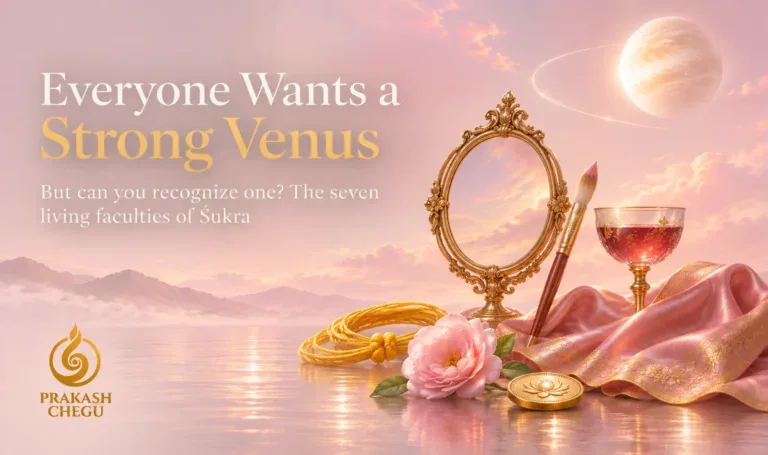
Everyone wants a “strong Venus.”
They want beauty, romance, comfort, attraction, artistic talent, a harmonious marriage and perhaps a life that appears to move with a little more grace.
But almost nobody asks what a strong Venus actually looks like.
We have reduced Śukra to luxury brands, physical attractiveness, sexual appeal and relationship status. If someone is beautiful, wealthy, fashionable or surrounded by admirers, we quickly declare that they must have an exceptional Venus.
But luxury is not Venus.
Luxury is merely one possible object through which Venus may express itself.
Śukra is the faculty that recognizes beauty, generates harmony, receives pleasure, creates relationship and restores vitality. It is not the expensive fabric. It is the intelligence that knows whether the fabric is beautiful. It is not the music playing in the room. It is the sensitivity that hears when one note is out of place.
Śukra governs the mysterious movement through which existence becomes desirable.
It transforms function into elegance.
It turns survival into enjoyment.
It changes attraction into relationship.
It refines raw experience into rasa—the essence that can actually be tasted.
A truly strong Venus cannot be measured by what a person owns. It must be recognized through what happens around them.
Does beauty increase in their presence?
Do people soften?
Do spaces become more harmonious?
Does affection deepen into intimacy?
Does pleasure nourish life—or slowly destroy it?
This is the real examination of Śukra.
The classical tradition gives us a far richer understanding of Venus than modern astrological shorthand suggests. When its different indications are gathered together, seven great faculties begin to emerge:
रूप, कला, कलत्र, भोग, रस, नीति, ओजस्
Rūpa. Kalā. Kalatra. Bhoga. Rasa. Nīti. Ojas.
Beauty. Art. Partnership. Enjoyment. Taste. Diplomacy. Vitality.
Seven faculties. One graha.
Why Is Venus Called Śukra?
The Sanskrit word Śukra carries meanings such as bright, clear, radiant, pure and brilliant. It also refers to reproductive essence or generative potency.
This already tells us that Venus is not simply concerned with decoration.
Śukra is that which makes life luminous and fertile.
Its radiance may manifest physically as beauty, emotionally as affection, artistically as creativity, socially as grace, relationally as intimacy or physiologically as reproductive vitality.
The Bṛhat Parāśara Horā Śāstra describes Śukra as having a beautiful form, lovely eyes and curling hair, and calls him a poet who enjoys the good life. The same chapter associates Śukra with vīrya, generative power, and places both Jupiter and Venus in the role of counsellors—Jupiter advising through wisdom and law, Venus through culture, refinement and the arts. See BPHS, Chapter 3.
The description is not merely of a physically attractive planet. It reveals an entire principle:
Śukra makes life worth entering, experiencing and continuing.
Let us look at its seven expressions.
1. The Glow — रूप
When beauty becomes presence
सुखि कान्तवपु श्रेष्ठः सुलोचनो भृगोः सुतः।
काव्यकर्ता कफाधिक्योऽनिलात्मा वक्रमूर्धजः॥
The son of Bhṛgu is described as possessing an attractive form, beautiful eyes, curling hair, poetic ability and an enjoyment of life.
But the glow of Venus is not simply conventional beauty.
Some people have perfectly proportioned features yet leave no impression. Others may not fit society’s current definition of beauty, yet the room changes when they enter it.
Their skin appears alive.
Their eyes receive you.
Their voice carries warmth.
Their movements contain rhythm.
Nothing about them is necessarily loud, but something about them remains in the memory.
This is kānti—radiance.
Kānti is not cosmetic perfection. It is the visible consequence of inner coherence. The senses, emotions, body and presence are not fighting one another. Because there is less internal conflict, something luminous can come through.
A strong Venus often creates an instinctive awareness of presentation. Such a person understands how to dress without appearing disguised, how to use fragrance without overwhelming a room and how to make the body an expression rather than an advertisement.
Even their voice may carry Venus.
The words need not be extraordinary. The tone itself does half the work.
This is why true Venusian beauty cannot be manufactured entirely from the outside. Cosmetics can alter the surface. Fashion can arrange the appearance. But neither can manufacture warmth, ease, receptivity or embodied presence.
A strong Venus does not merely make someone pleasant to look at.
It makes them pleasant to experience.
The shadow of the glow
An afflicted Venus may become preoccupied with being desired rather than becoming radiant. It may chase validation, alter the body repeatedly or confuse visibility with value.
Strong Śukra enjoys adornment.
Weak Śukra may require adornment in order to feel real.
2. The Maker — कला
A strong Venus does not merely consume beauty. It produces it.
Music, dance, poetry, fragrance, ornamentation, theatre, design, decoration and the pleasures of the senses belong to the wider Venusian field. Phaladīpikā associates Venus with sensual enjoyment, affection for the arts, music, dance, perfume and flowers. It also connects Venus with marriage, pleasure, wealth, homes, vehicles, clothing and jewellery. See the Chapter 2 overview.
But there is an important distinction:
A weak Venus may love beautiful things.
A strong Venus knows how to make something beautiful.
It edits.
It arranges.
It combines.
It notices that the flowers are too tall for the table, that the colour temperature of the light is wrong, that the music does not belong to the mood or that the sentence needs one fewer word.
This is not superficial fussiness. It is an instinct for proportion.
The strong Venusian person often possesses an internal tuning fork. They sense when something has fallen out of harmony and quietly begin correcting it.
Sometimes this becomes formal art: music, painting, dance, poetry, fashion, photography or architecture.
Sometimes it appears in ordinary life:
- Preparing food beautifully
- Arranging a room so people feel welcome
- Selecting exactly the right gift
- Creating a ritual with atmosphere and meaning
- Combining colours without needing to consult a chart
- Bringing grace to speech, movement or hospitality
This is kalā—the art by which consciousness gives itself an exquisite form.
The creation need not be commercially successful. The person may never call themselves an artist. Yet their hands keep arranging life until it feels right.
Venus requires more than talent
Artistic greatness is rarely produced by Venus alone.
Mercury may provide technique, coordination and linguistic or technical skill. The Moon may provide feeling and imagination. The fifth house may reveal creative intelligence; the third, the hands and expressive courage.
But Venus brings the power of aesthetic selection.
Mercury may know how to play every note.
Venus knows which note will make the heart open.
3. The Partner — कलत्र
Attraction is only the entrance. Relationship is the real Venusian art.
Venus is traditionally associated with kalatra—the spouse, partnership, sexuality, affection and the enjoyment arising through union.
Yet this has been badly simplified.
A prominent Venus may bring charm, admirers or romantic opportunity. But attention is not the same as partnership. Sexual availability is not the same as intimacy. Being wanted is not the same as knowing how to love.
The higher function of Venus is relational intelligence.
It knows how to remain oneself while receiving another.
It understands reciprocity.
It recognizes that affection must be expressed in a form the other person can actually feel.
It knows how to listen without immediately defending, how to disagree without humiliating, how to repair after conflict and how to maintain tenderness after novelty has disappeared.
Charm gets attention.
Venus knows what to do after the attention arrives.
A strong Venus does not necessarily mean that partnership falls into someone’s life without effort. Nor does it guarantee a flawless marriage. The seventh house, its lord, the Navāṁśa and the condition of other relationship factors must all be studied.
But strong Śukra often provides the capacity required for partnership:
- Receptivity without passivity
- Desire without possession
- Closeness without suffocation
- Pleasure without exploitation
- Compromise without self-betrayal
- Devotion without dependency
This person does not merely ask, “Does this person love me?”
They also ask, “Do I know how to love this person well?”
The shadow of partnership
When Venus is troubled, attraction can become bargaining.
Beauty is used to obtain power. Sex is used to secure affection. Affection is withdrawn to punish. Peace is maintained by avoiding truth.
A weak Venus may know how to seduce but not how to stay.
A mature Venus understands that harmony is not the absence of uncomfortable conversations. It is the ability to move through them without destroying the dignity of the relationship.
4. The Comfort — भोग
The ability to receive earthly life
Venus signifies clothes, ornaments, fragrance, flowers, vehicles, beds, homes, pleasurable surroundings and sensual enjoyment.
This is bhoga—experience, enjoyment and participation in the gifts of embodied life.
But Venusian comfort is not necessarily extravagance.
A modest room can be deeply Venusian if it is clean, fragrant, harmonious and welcoming. An expensive house can be hostile to Venus if it is cold, performative or emotionally lifeless.
Comfort is not the price of an object.
It is the quality of the experience produced by it.
A strong Venus knows how to receive pleasure without immediately feeling guilt, fear or the need to justify it. This sounds simple, but many people cannot rest without becoming anxious. They cannot receive a compliment without deflecting it. They cannot be cared for without feeling indebted.
Śukra governs the capacity to say:
“This is beautiful. I receive it. I allow it to nourish me.”
This capacity frequently creates a natural relationship with quality—good food, restful sleep, comfortable clothing, pleasing scents, graceful transportation and spaces that support the body.
Yet mature Venus never confuses comfort with excess.
The highest Venus understands enoughness.
It knows the moment pleasure has completed its work.
Bhoga must produce nourishment
Pleasure can either restore energy or consume it.
A meal may satisfy the body or become compulsive indulgence. Sexuality may deepen intimacy or fragment attention. Luxury may create ease or become a prison requiring endless income and maintenance.
The test of healthy Venus is not whether pleasure occurred.
The test is what remained afterward.
Did the experience leave you more peaceful, more connected and more alive?
Or did it leave you depleted, dependent and searching for the next sensation?
Strong Venus enjoys pleasure.
Afflicted Venus may be controlled by it.
5. The Taste — रस
Money buys the object. Śukra decides whether it was worth it.
Rasa is one of the deepest words in the Venusian vocabulary.
It may mean juice, essence, flavour, taste, feeling, aesthetic mood or the subtle experience extracted from something.
To possess rasa is not merely to want beautiful things. It is to recognize what has beauty and why.
This is rasajñatā—the capacity to know rasa.
A person with developed Venus can distinguish expensive from exquisite. They know that price and beauty frequently meet, but they are not the same thing.
They can recognize:
- Fine fabric from merely branded fabric
- Intimacy from emotional intensity
- Art from decoration
- Confidence from performance
- Sensuality from vulgar display
- Simplicity from emptiness
- Luxury from waste
- Sweetness from manipulation
This is why Venus is not merely desire.
Desire says, “I want it.”
Taste asks, “Is it worthy of being wanted?”
Strong Venus does not simply accumulate options. It develops discernment among them.
This discernment may become so precise that the person can explain in one sentence why an outfit, melody, design, relationship or atmosphere does not work.
They do not always need a theory.
They can taste the dish and identify what is missing.
The higher meaning of rasa
In Indian aesthetics, rasa is not simply personal preference. It is the distilled emotional essence through which art becomes experience.
The artist provides the form, but rasa arises inside the receiver.
Venus therefore governs both ends of beauty:
The ability to create a beautiful form—and the sensitivity required to be moved by it.
A person whose Venus is alive does not pass mechanically through the world. They are touched by colour, sound, fragrance, tenderness, poetry and proportion.
They allow life to reach them.
That receptivity is not weakness.
It is refinement.
6. The Diplomat — नीति
Charm was never merely decoration. It was strategy.
Śukra is not only the planet of lovers and artists. Śukra is also Śukrācārya, the guru and counsellor of the Asuras.
This changes the entire meaning of Venus.
Śukrācārya had to guide powerful beings driven by ambition, appetite and conflict. This required more than softness. It required intelligence, strategy, negotiation and the ability to preserve strength under difficult conditions.
Venus therefore rules a form of influence that does not depend on intimidation.
It persuades without cornering.
It negotiates without unnecessarily insulting.
It understands desire well enough to know what each person is actually seeking.
Mars wins by force.
Mercury wins through argument.
Jupiter wins through principle.
Venus often wins by making agreement more attractive than resistance.
This is nīti—practical wisdom, policy, counsel, strategy and intelligent conduct.
A strong Venus reads the room before speaking. It understands timing, tone and presentation. It knows that a correct idea delivered without grace may still fail.
This does not make Venus deceptive.
Diplomacy becomes manipulation only when harmony is used to hide self-interest.
At its best, Venus creates a path through which competing needs can coexist. It protects dignity while moving the conversation forward.
The true diplomat does not merely make everyone like them.
They make cooperation possible.
The shadow of diplomacy
Afflicted Venus may become excessively agreeable, flattering or politically seductive. It may say what each person wants to hear and call this harmony.
But real Venusian diplomacy does not abandon truth.
It gives truth a form that can be received.
Soft speech is not weak speech.
Sometimes it is the only speech powerful enough to enter a closed heart.
7. The Charge — ओजस्
Venus does not merely decorate life. It helps restore it.
Among the most profound Venusian associations is the connection between Śukra and generative vitality.
In the Bṛhat Parāśara Horā Śāstra, Venus is associated with vīrya—generative or reproductive potency. In Ayurveda, śukra dhātu is described as the final tissue in the sequence of seven dhātus and is associated with reproductive nourishment and creative vitality. These astrological and Ayurvedic uses are related symbolically, although they should not be treated as identical medical concepts. An Ayurvedic overview of śukra and artava dhātu.
Śukra is the body’s willingness to continue life.
This may manifest through fertility and reproductive health, but its symbolism extends further. The same current can become creative potency, enthusiasm, sensual vitality and the ability to bring an idea into form.
The person has “juice.”
They can generate.
They can recover.
They can return to affection after disappointment.
They can create again after failure.
This regenerative symbolism is beautifully embodied in the story of Śukrācārya and Mṛtasañjīvanī Vidyā, the knowledge by which the fallen could be restored to life.
Whether understood mythologically, spiritually or psychologically, the teaching is unmistakable:
The highest power of Venus is restoration.
It revives what conflict has exhausted.
It brings moisture to what has become dry.
It returns tenderness to what has become defensive.
It helps the body, heart and imagination remember their fertility.
Śukra and ojas are not identical
It is tempting to use Śukra, vīrya and ojas as interchangeable words, but their classical meanings are more nuanced.
Śukra dhātu refers to reproductive tissue and generative capacity. Ojas is the sustaining essence associated with stability, immunity, endurance and the integrity of life.
They are deeply related, but not identical.
Healthy Śukra can support the preservation of vitality. Excessive sensual expenditure, chronic emotional agitation and compulsive pleasure-seeking may weaken the very radiance Venus is supposed to produce.
This is the paradox:
Venus governs enjoyment, but Venus must also know how to conserve essence.
The highest Śukra is not endlessly stimulated.
It is deeply nourished.
Strong Venus Is Not the Same as Excess Venus
A person surrounded by luxury may not have a healthy Venus.
A person with endless romantic attention may not understand intimacy.
A prolific artist may be creating from emotional pain rather than inner harmony.
A sexually magnetic person may possess attraction without relational maturity.
A skilled negotiator may use charm manipulatively.
The quantity of Venusian objects does not reveal the quality of Venusian consciousness.
This is why a strong Venus should never be judged from appearances alone.
The deeper questions are:
- Does beauty produce peace or insecurity?
- Does attraction become intimacy or addiction?
- Does pleasure produce nourishment or depletion?
- Does charm create cooperation or manipulation?
- Does sensitivity inspire creativity or avoidance?
- Does comfort support dharma or weaken discipline?
- Does relationship allow truth, or merely preserve appearances?
Venus is not strong simply because desire is powerful.
Venus is strong when desire has refinement.
What Makes Venus Astrologically Strong?
The seven indications above describe how mature Śukra may express itself, but technical astrological strength requires an examination of the full chart.
Venus may gain strength through factors such as:
- Occupying its own signs, Taurus or Libra
- Exaltation in Pisces
- Supportive house placement
- Adequate ṣaḍbala
- Benefic association or aspect
- Freedom from severe combustion, affliction or planetary war
- Strength in the Navāṁśa
- Constructive relationship with the seventh house and its lord
- Support from houses connected with wealth, art, pleasure, partnership and creativity
- Activation through daśā and transit
Yet even this requires nuance.
Venus in Pisces is not automatically perfect. Venus in Virgo is not automatically incapable of love or art. House ownership, conjunctions, aspects, divisional dignity and the larger promise of the chart can radically modify the result.
A technically powerful Venus can also amplify Venusian shadows if consciousness has not matured.
It may increase craving, sensual excess, vanity, relational entanglement or attachment to comfort.
Astrological strength tells us that a planet has power.
It does not automatically tell us how wisely that power will be used.
The Seven Tests of Living Śukra
If you want to know whether Venus is truly alive in someone, do not begin with their jewellery, wardrobe or relationship status.
Look for these seven things.
1. Rūpa — Does their presence carry radiance?
Not perfection. Not performance.
Do the eyes, voice and body feel inhabited?
2. Kalā — Do they create beauty?
Can they shape an atmosphere, an object, a sound or an experience into greater harmony?
3. Kalatra — Can they sustain partnership?
Can they receive another person without possessing, erasing or exploiting them?
4. Bhoga — Can they receive pleasure?
Can they enjoy comfort without guilt, dependency or excess?
5. Rasa — Can they distinguish quality?
Do they know what is truly beautiful—or merely expensive, popular or desirable?
6. Nīti — Can they create agreement?
Can they influence without force and speak difficult truths without destroying dignity?
7. Ojas — Does their way of living preserve vitality?
Do beauty, love, art and pleasure make them more alive—or slowly drain them?
These are the seven tests.
Not what Venus gives you.
What Venus enables you to do.
The Highest Expression of Venus
At its lowest level, Venus says:
“I want to be desired.”
At a more mature level, Venus says:
“I want to experience beauty.”
At a still higher level, it says:
“I want to create beauty.”
And at its highest level:
“May my presence restore beauty wherever life has forgotten it.”
That is the secret of Śukra.
It is not the diamond.
It is the intelligence that recognizes brilliance.
It is not the wedding.
It is the ability to remain in loving relationship after the ceremony is over.
It is not the beautiful room.
It is the sensitivity that understands what allows the human body to soften.
It is not pleasure alone.
It is pleasure refined until it becomes nourishment.
It is not seduction.
It is the magnetic power of coherence.
A strong Venus does not merely decorate life.
It teaches life how to become lovable again.
रूपं कलां कलत्रं च भोगं रसमथापि च।
नीतिमोजश्च ददाति शुक्रः सौन्दर्यकारकः॥
Śukra bestows beauty, art, partnership, enjoyment, rasa, diplomacy and vitality—the living principle through which beauty enters the world.
Everyone wants a strong Venus.
But perhaps the better question is not:
“Is my Venus strong?”
Perhaps it is:
“Does beauty become more truthful, more nourishing and more alive through me?”
Frequently Asked Questions
What does a ‘strong Venus’ really mean?
Not simply beauty or charm. A truly strong Venus — Śukra — shows up as seven living faculties: radiance, artistry, the capacity for real partnership, refined taste, pleasure held with discernment, devotion, and grace. It produces beauty and relationship, it does not merely consume them.
How do you recognise a strong Venus in a person?
By how they love and create, not how they look. A strong Venus makes beauty, keeps agreements, brings grace to ordinary life and can sustain a relationship beyond attraction. Charm without depth is a weak Venus wearing Venus’s clothes.
Can you strengthen your Venus?
Yes — by living its qualities. Cultivating art and beauty, practising devotion, keeping your word in relationship, refining your senses rather than indulging them, and bringing grace to daily life all nourish Śukra. Venus grows through what you create and how you love.