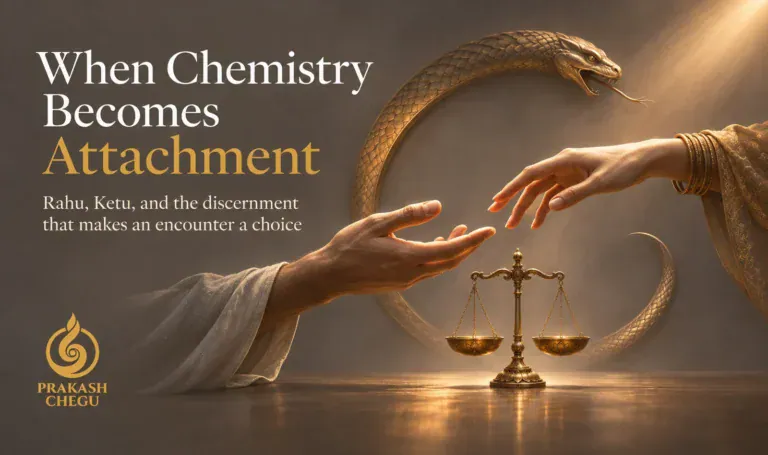
Rahu, Ketu, and the part of us that keeps waiting for one night to return
The night ended.
But somewhere inside you, the waiting continued.
You went back to work. Answered messages. Made plans. Perhaps you built an entire life with this person. Yet beneath the ordinary movement of your days, something remained turned toward the beginning: the way they looked at you, the ease of being touched, the extraordinary relief of feeling wanted.
Years later, you could still remember it more clearly than the conversation you had yesterday.
And every time the relationship disappointed you, that memory came forward to defend it.
“But you don’t understand what we had.”
Perhaps nobody does. Perhaps what you shared was beautiful. The question is what that beauty has been asking of your life ever since.
How much have you postponed while waiting for it to return? How many conversations have you softened? How many times have you made yourself smaller so you could remain close to the possibility of feeling that way again?
There are relationships in which the longing becomes more enduring than the intimacy.
This is where I want to bring Rahu and Ketu into the conversation. Their symbolism gives us a language for the hunger that reaches toward another person, and for the difficult grace of opening our hands when holding on has become our whole identity.
Because sometimes the deepest entanglement begins with an experience we loved.
The night was beautiful. Let that be true.
We often make healing unnecessarily cruel by demanding that we condemn what once delighted us.
We decide the connection must have been fake. The attraction must have been a trick. We must have been foolish. Otherwise, how could something so tender have led us here?
But what if you were simply human? Open. Hopeful. Hungry for closeness. What if your body felt pleasure and your heart recognized a possibility it had wanted for a very long time?
There is no shame in that.
You can acknowledge that someone awakened desire in you without making them responsible for the rest of your awakening. You can cherish a moment while questioning the future you built around it.
The difficulty often begins in that almost invisible movement from experience to conclusion.
“I feel deeply connected to you” becomes “We are meant to build a life together.”
“I have never felt this before” becomes “I will never feel this with anyone else.”
And soon a person we are still getting to know has become the keeper of something we believe we cannot live without.
We have given an extraordinary moment a permanent assignment.
Rahu and the promise of finally
Within Jyotisha, Rahu is commonly associated with appetite, fascination, amplification, and experiences that draw us beyond familiar boundaries. In the inner life, its symbolism becomes especially interesting around one word:
Finally.
Finally, someone sees me. Finally, someone wants all of me. Finally, I can stop being the one who holds everything together.
Notice how much can gather around a single person. They are being asked to become a lover, a home, an answer to loneliness, and proof that we were always worthy of being chosen.
That is a great deal for one human being to carry, however magnetic they may be.
Read through Rahu’s symbolism, desire can magnify the possibility until we begin relating to the imagined future as though it has already been promised.
A late-night conversation becomes the beginning of a marriage. A moment of tenderness becomes evidence of emotional availability. Sexual openness becomes a promise of devotion.
Meanwhile, the questions that might complicate the dream remain waiting outside:
Do we want the same life? Can we speak honestly? How does this person behave when they are disappointed? What have they actually offered?
Desire has its own intelligence. It tells us that something matters. Discernment asks us to discover what that something is.
Ketu and the hand that will not close
If Rahu gives us an image of reaching, Ketu gives us an image of what cannot be held through will alone.
In the spiritual language of Jyotisha, Ketu is associated with detachment, separation, inwardness, and liberation. In a relationship, we might contemplate that symbolism when the experience we are trying to preserve keeps slipping through our fingers.
The same restaurant. The same music. The same person beside us.
Yet something feels different.
We can become so occupied with restoring the original feeling that we overlook what the present is revealing. Perhaps there is a conversation we have avoided. Perhaps both people are exhausted. Perhaps the relationship needs care. Perhaps we wanted different things from the beginning.
Ketu’s symbolism invites a difficult question:
What are you learning now that the experience is no longer giving you what it once gave you?
There can be grief in that question. There can also be relief. You may finally stop trying to make longing perform the work of mutual commitment.
Release sometimes begins very quietly: with the willingness to hear an answer without immediately negotiating it into something more hopeful.
Why one memory can become so powerful
Patanjali offers a remarkably intimate observation in Yoga Sutra 2.7. Raga, attachment, follows pleasure; Vyasa’s commentary explores how remembered enjoyment gives rise to the desire to repeat or possess its source. genui{“citation”:{“ref”:”turn2view1″}}
Think about that in the context of a relationship.
You remember the person, of course. But you also remember who you were in their presence. The guarded part of you became soft. The lonely part felt included. The body you had criticized became a body someone delighted in.
Perhaps that is what makes the memory so difficult to loosen. You fear losing access to yourself as you were then.
“If I let this person go, will that part of me disappear too?”
Sit with that gently.
Someone may have helped you discover tenderness, sensuality, courage, or joy. Those capacities are now part of your lived experience. Their future need not remain dependent on this one person’s participation.
What opened in you deserves care. You can begin caring for it directly.
When a memory becomes an altar
An altar is a place where we bring our attention, devotion, and offerings.
Sometimes we build one around the beginning of a relationship without realizing it.
We offer our sleep to remembering. Our attention to checking. Our future to waiting. We bring every disappointment back to the same sacred image: how it was when it began.
The present must kneel before the memory.
A partner says they are uncertain, and we remember how certain their touch once felt. They say they cannot offer commitment, and we recall the weekend when it seemed impossible that they would ever want anything else.
We may be hearing their words accurately while refusing to let those words change our choices.
This is a tender place to become honest with yourself. You may love the person. You may also be devoted to the feeling of being chosen by them, even when that choice is no longer being made.
Ask yourself:
If our beginning had been ordinary, would I accept the relationship we have today?
Give that question enough silence to receive an answer.
The alchemy that daily love requires
Chemistry can arrive before we know very much about each other. Shared life gradually reveals what the attraction has brought into the room.
There is desire. There are also habits, loyalties, fears, responsibilities, and ideas about what love should require.
A weekend together may be exquisite. Building a home asks who notices the work that needs doing. Planning a family asks whether both people want children. Spiritual partnership asks how we treat each other when one person’s needs are inconvenient.
The engineer in me wants to see what can carry weight. An impressive first demonstration tells us something; repeated use tells us more.
Love acquires that kind of depth through living. Through telling the truth before resentment settles in. Through allowing a boundary without punishing the person who set it. Through an apology that changes the next conversation. Through showing up when nobody feels particularly radiant or impressive.
This is where I would place the alchemy of relationship: in what we become capable of practicing together.
There can still be fire. There can be play, eroticism, discovery, and wonder. But there is also somewhere for those experiences to live.
A relationship that can hold ordinary human life gives passion room to deepen beyond its first performance.
The spiritual story we tell about staying
Spiritual language is powerful. It can bring meaning to suffering, and it can become part of how we keep suffering familiar.
“We have unfinished karma.”
“This is my lesson.”
“I am learning unconditional love.”
Each of these deserves an honest follow-up:
What am I actually practicing here?
Am I becoming more truthful? More capable of receiving love? More willing to take responsibility for my actions? Or am I rehearsing the familiar habit of setting aside my needs so someone will remain close?
Sometimes staying is an act of devotion. Two people recognize what has happened between them and choose the patient work of repair. There is participation on both sides, including when the work is uncomfortable.
Sometimes leaving is the action that interrupts a pattern. A person finally believes what has been said, honors a difference that cannot be negotiated away, or stops accepting conduct that has repeatedly caused harm.
Neither choice becomes conscious simply because we give it a spiritual name.
The practice is in the honesty of the choice and the responsibility with which we live it.
I would be careful about calling another person a karmic collector. It may give pain a dramatic explanation, but it can leave us studying their supposed cosmic assignment while our own life waits unattended.
We can name deception, avoidance, cruelty, or incompatibility plainly. We can also acknowledge where affection was sincere and still insufficient for the life we hoped to build.
What about the seven years?
Ketu’s mahadasha is seven years in the Vimshottari system. That duration belongs to the system’s timing structure; the starting balance is calculated from the Moon’s birth nakshatra. A sexual encounter does not start a fresh seven-year period or establish a compulsory relationship debt. genui{“citation”:{“ref”:”turn2view0″}}
The more immediate question is what you are continuing to give your time to.
Perhaps you have spent seven years waiting. Perhaps seven months. Perhaps you have only just noticed the pattern. You do not need to turn those years into proof that your life has been stolen. They may contain love, children, friendship, learning, and sincere effort alongside disappointment.
There is room to grieve what did not happen without declaring everything that happened meaningless.
And there is room to choose differently before the calendar, or a prediction, gives you permission.
Let desire speak without giving it every decision
Sacred sexuality asks us to bring awareness into pleasure. It asks us to be present with what we feel and honest about what we are offering another person.
Am I sharing intimacy freely? Have I made promises I do not intend to keep? Am I hoping the other person’s body will answer a question they have already answered differently in words?
These questions belong to everyone involved.
A beautiful night does not create a debt of future access. Consent remains alive in the present. At the same time, wanting affection, sexual connection, and commitment is something we can speak about with dignity. We are allowed to ask whether the relationship can hold what matters to us.
Desire becomes easier to understand when we stop shaming it and listen closely.
What do I want from this person? What does being with them allow me to feel? Which part of that longing can we meet together, and which part asks for my own attention?
The inquiry can open into prayer, creativity, movement, honest conversation, or grief. Energy that has been organized around waiting may gradually find other places to serve your life.
A practice for calling your attention home
Set aside a quiet few minutes with a notebook. Sit comfortably and feel the support beneath you. Let your breathing remain natural.
Bring the relationship to mind without building a case for it or against it. Let there be room for the beautiful memory and the difficult one.
Then write:
What did I feel with this person that I had been longing to feel?
Stay close to your own experience. Desired. Welcomed. Adventurous. Safe. Beautiful. Important. Write the words that are true for you.
Next, ask:
What have I been asking this relationship to prove about me?
This question may reach beneath the romance. Perhaps you wanted proof that you were lovable, that you had not missed your chance, or that someone could finally see all you had to give.
Let the answer be met with tenderness. You are encountering a longing, and it deserves to be heard.
Finally, ask:
What would caring for my life look like this week?
Choose something you can actually do: speak clearly about a need, make space for a mutual attempt at repair, honor an answer, return to your sadhana, spend time with people who welcome you, or give attention to work you have left waiting.
If prayer belongs to your practice, you might close with:
May I cherish what was beautiful.
May I see what is here.
May I have the courage to act with love and truth.
Then let the practice enter your day through the action you chose.
The part of you that is still waiting
Be gentle with that part.
It may have waited a long time to feel what it felt. It may be frightened that letting go of this possibility means giving up on love itself.
You can sit beside that fear without allowing it to plan the rest of your life.
A relationship may have opened a door within you. Through it, you discovered a greater capacity for tenderness, desire, generosity, or devotion. Whatever happens between you and the other person, those discoveries deserve to become part of how you live.
Let them change the quality of your presence. Let them deepen the care you offer your body. Let them inform what you ask for in love and what you are willing to offer in return.
You may still feel longing. You may still remember the night.
But one morning you may notice that the memory has become quiet enough for you to hear something else: a friend laughing, a mantra taking shape in your breath, an idea asking to be created, the simple pleasure of being where you are.
Stay for that.
Your life is offering you another moment to enter fully.
Frequently Asked Questions
What does it mean when chemistry becomes karma?
It is when a powerful early experience stays lodged in you, the way they looked at you, the ease of being touched, the relief of feeling wanted, so vividly that years later you remember it more clearly than yesterday’s conversation. Every time the relationship disappoints, that memory steps forward to defend it: you do not understand what we had. The spark hardens into a story of destiny we keep waiting to return to.
Is a connection that feels fated actually karmic?
It might carry a karmic dimension; the tradition of Rahu and Ketu gives language to bonds that feel larger than their circumstances. But I would hold it with care. Feeling fated and being good for you are not the same thing. Sometimes what we call karma is really a memory we have enshrined, and the night we keep waiting to return to never actually comes back.
How do I stop waiting for a connection to return to what it was?
By grieving the beginning honestly instead of using it as evidence. The early experience was real, you do not have to deny it, but a relationship lives in its present, ordinary reality, not in its first chapter. Discernment means asking whether you are loving a person or guarding a memory, and being willing to let a chapter be complete rather than endlessly deferred.